The Genealogy of Jesus Christ: Conclusions

I’ll confess to you right here and now that when I sit down to read the Bible, I skip the genealogies, but when I sit down to study the Bible, I look for genealogies. For many who casually read the Bible, genealogies are cumbersome, boring and wearysome, but for more than casual readers, we come to realize that they are not included in the inspired text just to fill space or aid in curing insomnia; they tell a story.

Matthew begins his telling of the story of Jesus Christ by giving us some vital insight into just exactly who this Jesus guy is, and He is no ordinary man. It is no coincidence then, that this is no ordinary genealogy. When most people look at a Biblical genealogy, we assume that this is an exact record of biological ancestry; a pedigree one might say, but this isn’t always the case, in fact it seldom is just that. Sometimes, genealogies in the Bible don’t match up exactly, and skeptics and scoffers have no end of fun criticizing the Scriptures for what they assume to be historical inaccuracies, because they overlook the fact that the Scriptures are not like other books, for they are God’s revelation of Himself to Man, not the mere musings of the human mind.

In order for us to get the value of Biblical genealogies, we must realize that they are not so much concerned with a person’s biological ancestry as they are with demonstrating a person’s corporate and tribal status within the larger community. We can see this by noticing that in most cases, the great names are first, and the last name is the person who is being magnified by the presence of the greater names. By doing this, a storyteller can set up the basis for telling the descendant’s story by putting the descendant (last name) into the context of his great ancestors.

Matthew does not follow that pattern here, for he does not build Jesus up by associating His name with His great ancestors, rather he builds up the ancestors by associating their names with that of Jesus, which is the first and last name that is mentioned. I think a quick look at the structure will show you what I mean:

First off, we are looking here at Matthew 1:1-17 which is broken into three main sections. Verses 2-6 cover the time in the history of the Jewish people from Abraham to David, a period that culminates in the high point of Israelite history in the beginning of the Davidic monarchy.  In verses 7-11, Matthew reminds his readers both of the glory of the Davidic reign and the steady slide that resulted in Israel’s darkest period of captivity. The third period, in verses 12-16, extends from the captivity to Jesus, a period in which there is no king, a period in which the Jews are at the mercy of foreign powers and in which their hopes of redemption grow and are finally met when Jesus comes onto the scene as the culmination of Jewish history. Notice verse 16 where Jesus is born and is named by Matthew as “Jesus who is called Christ”. In doing this, Matthew is making all who have gone before subservient to Jesus, the Redeemer of Israel.

Note verse 17:

Thus there were fourteen generations in all from Abraham to David, fourteen from David to the exile to Babylon, and fourteen from the exile to the Christ.

In this summation, Matthew has done two interesting things: First, he has tied Jesus to the history of Israel so as to place Him at its very center, and second, he set up His arrival as a the beginning of a whole new era, an era that is not like any that has come before. In doing this, Matthew has also forced us to notice the number 14, as we’ve noted previously, pointing us to Jesus as King, son of David.

As we move deeper into the Christmas season, I think we would do well to keep in mind who Jesus is, that the incarnation of Jesus is a really big deal because of His identity rather than on the celebration itself. We often talk about “the reason for the season”; it’s almost cliché, but maybe this is too simplistic a view. I’m not entirely convinced that Jesus is the reason for season, but that’s a discussion for another time, what is really important in my view, is Jesus… no more, no less. Everything else is fluff.

And that is the point 12 months a year, not just in December.
Posted in Bible | Tagged , , , , , , , | 3 Comments

The Genealogy of Jesus Christ: Matthew 1:6-17

Matthew continues his genealogy as he moves from the first group of 14 names to the next. The first group culminates in King David, that glorious figure who is “a man after God’s own heart”, with whom God made a covenant that one of his descendants would always be on his throne, and quickly the second group of 14 comes along, ending with no one on David’s throne. This scenario underscores the failure of the people of the Abrahamic covenant, and the lack of fulfillment of their covenant.

We can see Matthew’s historic vision in this sequence, a vision of election and high privilege followed by human failure and lost opportunity. It would seem that this is a preview of what would follow in Matthew’s story as the pattern of Israel’s rebellion and subsequent judgment unfolds in Israel’s rejection of Jesus, and Israel’s loss of kingdom (21:33-22:10) the destruction of the nation (21:41; 22:18; 23:29-24:3)and eschatological destruction (8:10-11; 22:11-14).

The final group of 14 is an interesting one for several reasons. For the most part, the names found in the first two thirds of the genealogy can be found in the Septuagint, but the nine names in vv. 13-15 don’t follow any Old Testament genealogy. In addition, Matthew uses only nine names to cover about 500 years, while Luke uses 18, and of these, only four are in both lists; two of the four are Joseph and Jesus. To be fair, this is not uncommon in comparing genealogies, as we have mentioned, and neither Matthew nor Luke are recording genealogies as  strict historical pedigrees.  Finally, Matthew’s progression from father to son is suddenly broken when there is no direct link between Joseph and Jesus, leaving the father of Jesus not strictly identified (see verse 16). Notice that Matthew instead shifts our attention from Joseph to Mary as “mother of Jesus”.

Matthew will answer the obvious questions about this ambiguity in the next scene, and the implications of that answer will be the subject of the entire story… and to say that those implications are huge, would be an understatement, to say the least.

Posted in Bible | Tagged , , , , , , , | Leave a comment

The Genealogy of Jesus Christ: Matthew 1:1-6

I thought that since we are heading into the Christmas season, it might be fun to review texts that reinforce who it is that we are celebrating in this season. We’ll cover some more messianic prophecy, and we’ll continue with the “I AM: statements from john’s gospel, and I think we’ll also add a little study of Father Abraham along the way. This morning, I thought we’d start with a look at the genealogy of Jesus from Matthew’s gospel, and then from Luke’s… This is not boring list of names!

This is the genealogy of Jesus the Messiah the son of David, the son of Abraham: (1:1)

Matthew begins with this verse full of content and contextual implications. It would seem that Matthew is intent on linking the story of Jesus to the larger context of Israel’s history. Notice his reference to “the genealogy of” in language which in the original Greek parallels that of the Septuagint in Gen. 2:4 and 5:1, alongside the names of David and Abraham, two of Israel’s most illustrious heroes. That Matthew uses the terms “Jesus the Messiah” (or Jesus Christ) makes it quite clear that this son of David is special (cf. 2:4; 16:16, 20; 22:42; 24:5, 23; 26:63, 68). In putting the personal name together with the messianic concept, Matthew is referring back to the hopes of an entire Nation.

With the reference “son of David” our author is hearkening back to the glory days of his people and God’s covenant promises concerning the Davidic royal house, David may well be considered the pivotal name in the genealogy for it is mentioned 5 times, and is the only name associated with the title of “king” (v. 6), singling him out of all other royal references as the greatest. Many scholars also point out the presence of the numerical value associated with the Hebrew numeric consonants. For the name David the numerics look like this: d (4) w (6) d (4) or 4 + 6 + 4 = 14. The number 14 is the number of David to be sure, but here it appears that, as some suggest, it has more meaning than that, for it is also arrived at by multiplying 2 X 7. Seven, as we saw in our study of Revelation, is the number of completeness or perfection. Jesus is the second Person of the godhead. Thus, some suggest that 14 is the number of Messiah, and when you compare that to David, and recall that the Messiah would be the son of David, these scholars conclude their case.

As for me personally, I don’t know who is right or wrong about the numbers, but in noticing how often the number 14 appears here, and remembering how the ancient Jews felt about numbers, it appears to me that at the least, Matthew is trying in every way possible to make sure that his readers get “son of David” and “Messiah” out of this discussion.

Matthew goes on to mention that David was a “son of Abraham” which is another interesting component. Recall God’s covenant with Abraham: Isaac was the son of promise through whom all of the nations of the world would be blessed. Here, David is named “son of Abraham”. Jesus is mentioned as “son of David” and “Messiah” with the obvious attempt to reinforce Matthew’s contention that Jesus is the ultimate fulfillment of God’s covenant promise to Abraham.

This isn’t such a boring genealogy is it?

While Matthew doesn’t mention every man who could be mentioned here, the inclusion of the names of four women is worthy of our note. As scholars like to do, they often differ about why these four names are included. My thought is that these women are all Gentiles; yet here they are in the genealogy of Jesus, who is the fulfillment of the very non-Gentile Abrahamic covenant. It strikes me that this may be important for two reasons: First, because Matthew makes certain to point out when Jesus breaks the ethnic barrier between Jew and Gentile (cf. 8:5-13; 15:21-28; 28:18-20), and second because of the way that social outcasts received His message. Whether or not this was Matthew’s thinking, one thing is perfectly clear: This is no ordinary genealogy, and with the arrival of Jesus the Messiah, nothing would ever be the same again.

We’ll pick up in verse 6 when we get together next time!

Posted in Bible | Tagged , , , , , , , , | 10 Comments

I AM

mljfrmmaaa

“Very truly I tell you,” Jesus answered, “before Abraham was born, I am!”

John 8:58

This verse comes at the end of a rather long discussion between Jesus and the Jewish leaders that began with the validity of His testimony, and moved to a discussion of both His and their paternity, and now has simply come down to who exactly Jesus is (John 8:12-59). Jesus was quick to tell them in vv. 54-55 that He is God’s Son.  In the next verse He tells them that He knows Abraham’s thoughts as well when He says that Abraham looked forward to this day and rejoices in it. It is important to note that Jesus did not say this so as to speculate on what Abraham would have thought, but instead He is stating it as a fact; He is acting as a witness to it.

This completely blows their minds.

Their response in verse 57 is not one of amazement but is instead ridicule; they are marginalizing Him again so as to reduce or eliminate His credibility with the rest of the people.  Verse 58 is the tipping point in the discourse:  Jesus claims to be God.  To make the statement that Jesus made here is one that is direct, to the point and undeniable in its meaning.  “Before Abraham was born, I am!”  Jesus is telling them two things, first that He has been around since before Abraham; He isn’t thirty-something, He’s at least 2,000 years old.  Second, notice that Jesus didn’t say “before Abraham was born, I was alive” no, He said “I am”.  I Am is the name God used to identify Himself to Abraham, thus Jesus is telling them that He is none other than God in the flesh.  They understood this, and since they knew blasphemy when they heard it, they proceeded to grab for stones with which to execute Him.  Jesus slips away, for His time had not yet come to die.  It is worth pointing out that for all of the reasons Jesus cited, these people did not stop to consider the possibility that He might be telling the truth.

These great men of God, these teachers, lawyers and scholars were actually following the devil, and their haste to shut Jesus up when He states the greatest truth of all is a poignant reminder to all of us that we must “continue in His word” to ensure that we are recognizing the truth when it is spoken in this difficult and dark age in which we live.

As we move into the Christmas season and look forward to our celebrations, perhaps we too should stop and ask ourselves just who it was who was born in that Bethlehem manger so long ago; clearly He was not just the son of an obscure carpenter.

Posted in I Am | Tagged , , , , , , , , , | 9 Comments

Random Ramblings: December 3, 2016

mht5yqw-lp

This is one of those days when I don’t have anything all that pressing to write about, maybe I’m still suffering the after effects of a vacation in the tropics. Of course I came home just in time for the start, later than usual, of winter weather in my area. In fact, we’re expecting our first snow of the season for tomorrow morning; oh joy.

At a time such as this I’m reminded of Paul Harvey who, on certain Saturday programs used to say something like, “since we are in between acute world crises, let’s catch up on things that usually get lost in all the clutter…”

Of course there is the news from yesterday about a certain (idiotic) Congressman who is introducing a Constitutional Amendment to abolish the Electoral College, but do I really want to acknowledge such stupidity today?

No, I’m really not in the mood… I’ll just say that if you think the California, New York and Chicago should be making all of the decisions in America, this is the idea for you.

Maybe what really has my little mind boggled today is that it seems, as unlikely as it is, that Christmastime has arrived; I’m being pressured to go down to the basement and drag up the decorations, and my wife is tuning into the all Christmas music all the time stations…

Didn’t we just finish Christmas? Shouldn’t there be a baseball game on TV today? Where did the time go?

You know what? I have the voice of my father somewhere in the back of my mind… very faint and far off… telling a very young me that when I get older time will fly by. Does this mean I’m “older” now? Wasn’t he about 500 years old when he told me that?

Well, to a little kid, Dad’s are pretty ancient.

It seems like everything moves so much faster now; days fly by, except in airports of course.

To be perfectly honest, I’m really not sure who it is that thinks all this time flying by stuff is such a good idea, nor am I so sure that snow tomorrow is a very good idea… I think I’m going to be in favor of “global warming” from now on; yeah, that’s it. Let’s promote global warming and then at least we won’t have snow… then I can get out of dragging all of that Christmas stuff up from the basement; it’ll be summer all the time. Let’s see, what would I have to do to make the weather warmer tomorrow…? If only I could figure that out, I could tell everyone in town what to do, and then men everywhere could get out of dragging the Christmas stuff up from their basements; I’d be a hero!

Oh crap. You know what I just did? I came up with an idea that is even stupider than getting rid of the Electoral College. Yeah, like I can change the weather…

I guess I’d better get down to the basement, or I’ll be doing serious time in the doghouse.

Posted in Random Ramblings | Tagged , , , , , | 8 Comments

Visions of Christmas Past- Redux

The Christmas season is upon us, and even I can’t put it off any longer! I thought that it might be fun to take a look at it from two different points of view, looking back and looking forward.  Today, let’s look back…

For me, the notion of Christmas in the Victorian era is a great one; it somehow seems so innocent and wholesome.  I don’t know why this is, maybe I’m just a sucker for that period, but somehow things just seem more simple.  My honest guess is that this would amuse the people who lived then, but what the heck, let’s deck the halls!

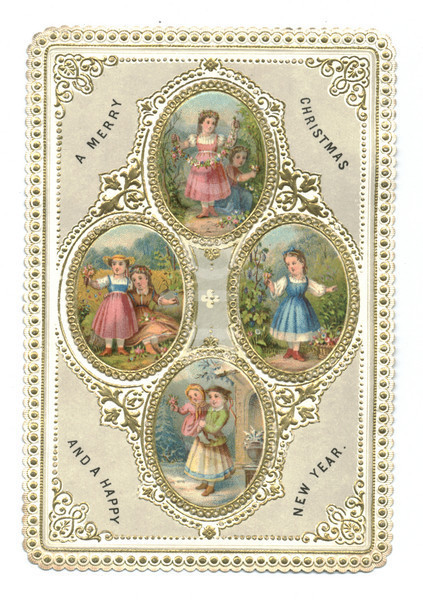
Of course you would have to start out with your Christmas cards, this was the era that invented them, and since internet connections weren’t that great in those days, everyone would actually write them and send them in the mail!

OK, try to picture this: People would go about town singing Christmas Carols in public!  Apparently the ACLU was asleep on the job in those days: Horror!


People did crazy things like look out for their neighbors, give gifts to them and carol in their yards to bring festive cheer and love into their lives… I must say that we are much better off today because instead of having to go out and do things like that, we can download a movie about other people doing it and feel just as good in the warmth and security of our own homes…

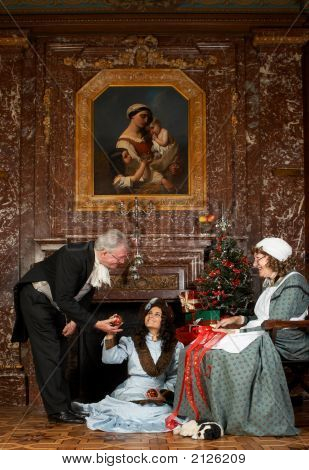
Then it would be time to get the house ready for the big day.  If you were well-to-do, you might go out and buy fancy ornaments for your tree, but if you weren’t, homemade ones were perfectly fine too.  In fact, a great deal of their decorating involved people coming together to make things and spend time together.

When the time came, everyone in the family would come together to celebrate.  Gifts were exchanged; often the gifts were hand-made as well as the decorations.  For most people, gifts that their loved ones made themselves were as good as the store-bought ones, because they were made out of love for one another.

And of course, if there weren’t any gifts, that’s OK too… they would spend time in each other’s company.  I guess that’s why the Christmas season in the Victorian context seems more innocent to me… or maybe there wasn’t anything good on TV; who can say?

Of course, I’ve been having a little fun with this comparison, but please don’t get the idea that I don’t appreciate the season in our own times; it’s a wonderful time… and let’s be honest, it’s what you make of it.

If we’re all caught up in the material and commercial aspect of it, it won’t be as much fun as it could have been.  I’m all for Christmas Simplification!  Why not just be happy with the Day, what it means and with one another’s’ company?

Of course my kids just call me “Scrooge”!

One last thing, I came across this video from 1898 called “Santa Claus” and I had to include it here, even though it’s a bit off-topic.  It’s pretty short; you’ve got to check it out.  It is charming in its simplicity…

Posted in Christian Life | Tagged , , , , , , , | 31 Comments

A Serpent is Lifted Up

Numbers 21:4-9

In this section, the Israelites are going the long way around Edom, which they will not cross because the Edomites, who are the descendants of Esau, are hostile to them. This is a very harsh desert region that even now, is inhabited by several varieties of venomous snakes. As they people mover through the region, they began to gripe and complain about the conditions; they spoke harshly against both Moses (“type” of Christ) and God Himself. God, hearing their mutinous talk, sent them a plague of snakes that left many with very painful and often fatal wounds. (vv. 4-6)

Before long, the people began to repent of their rebellion and sought out intercession from Moses, who prayed to God for deliverance. God gave Moses an odd instruction: make an image of a snake, attach it to a pole and hold it up for people to see. If they looked upon the image, they would be saved from their bites and the venom of the snakes. Notice that God did not simply remove the snakes or make the people immune to their bites. (vv. 7-9)

John 3:11-18

Here, Jesus is speaking to Nicodemus, shortly after He has told Nicodemus that he must be born again to enter the kingdom of Heaven. (vv. 1-10) Of course, Nicodemus is having a hard time following Jesus’ meaning, so Jesus is trying to explain the matter further in 11-18. Jesus points out that He knows what He is talking about, because He is speaking of things He has seen (v. 11). The Gospel, from that day to this, is spread by the testimony of believers, from Jesus’ own testimony to that of the Apostles, later recorded in Scripture, and also that of believers today: You can either believe it or not. Then, Jesus says that if Nicodemus cannot understand earthly things, how can he understand Heavenly things? Up to this point, Jesus was speaking of redemption, which occurs here on earth, not in Heaven. No one, He says, has ever gone into Heaven. Note that under the covenants with both Abraham and Moses, there is no promise of either Heaven or eternal life for anybody. The only one who had ever seen Heaven was Jesus Himself, who came from Heaven. (vv. 12-13)

It is at this point in His conversation that Jesus recounts the events of Numbers 21 with regard to the snake that was lifted up. He tells Nicodemus that as the people were cured of the snake venom when they looked upon the snake, so also will they be “cured” when they look in faith at Jesus Himself, when He is lifted up. In fact, He used the words “must be lifted up” in verse 14; there is simply no other way to restore the relationship between Man and God then Jesus going to the cross. When the snake was lifted up, the onlooker was cured of the venom, but God did not remove the snakes. When Jesus was lifted up, and people look to Him on the cross in faith, God takes away the more serious venom of rebellion, but He has left the cause of it in our world; interesting! Finally, Jesus tells Nicodemus that those who believe in Him will receive “eternal life”. (vv. 14-15) This is the first time Jesus used the term “eternal life” and it is the very first time it is promised in either the Old or New Testament, chronologically speaking.

From there, Jesus builds upon His theme of His dying to give those who believe in Him eternal life. In these very familiar verses, He ties together the concept of rebirth with His death on the cross.

Posted in Bible | Tagged , , , , , , , , , , | 4 Comments

Glory Hallelujah!

Joel has just described the final judgment of God against those who, despite His offers of grace, have opposed and oppressed His people, and who have opposed God Himself. We pick up the action in verse 17:

“Then you will know that I, the Lord your God,
dwell in Zion, my holy hill.
Jerusalem will be holy;
never again will foreigners invade her.

There are three apocalyptic elements here: “Zion”, “Jerusalem” and “foreigners”. Zion refers to the temple mount in the city of Jerusalem where the presence of God was said to dwell in the midst of His people. Jerusalem was the city where God dwelt in the midst of His people. In the Old Testament, these were pictures of the reality which was to come in the Person of Christ. In chapter 2 we saw that the Holy Spirit had come upon those who would follow Christ and be redeemed and thus, God dwells in the midst of His people in our age in the Body of Christ, the church. Foreigners refers to those who refused to receive the grace He offers and thus in this post Judgment verse, those who have refused God’s grace are no longer in the picture.

“In that day the mountains will drip new wine,
and the hills will flow with milk;
all the ravines of Judah will run with water.
A fountain will flow out of the Lord’s house
and will water the valley of acacias. (3:18)

New wine symbolizes Jesus Christ (Matt. 9:17), milk shows the Land has been redeemed and flows with abundance. Water symbolizes life; remember Jesus and “living eater”. The fountain shows that living water flows from God’s presence in the midst of His people (cf. Eze 47:1-12).

But Egypt will be desolate,
Edom a desert waste,
because of violence done to the people of Judah,
in whose land they shed innocent blood. (3:19)

Egypt in prophecy usually represents this world, Edom the enemies of God’s people. Notice that both are empty, for that is the meaning of “desolate” and what you find in a “desert waste”: Nothing. This world has been judged and is no more.

Judah will be inhabited forever
and Jerusalem through all generations. (3:20)

In contrast to this desolation (emptiness) God’s kingdom will be home to God’s people forever more.

Shall I leave their innocent blood unavenged?
No, I will not.”

The Lord dwells in Zion! (3:21)

There will be a final judgment; of this we can be certain. I do not know when it will come, but come it will. It could be at any time, or it could be in thousands of years; no one knows, especially not the ones who say they do know. In my view, Joel makes the sweep of redemptive history very clear, and we can easily see that we are in the midst of it right now, today, December 2, 2016.

We know that God does not desire that any should perish in the final judgment, for He desires that all humanity should have eternal life, but as we look around us at this world we live in, it is clear enough to anyone that many, most actually, are headed for destruction. We might feel a sense of despair: “God, why don’t you do something to save these poor people?” “God, why don’t you send someone to do something?” Let’s keep in mind that He did send someone to be here right now, today, to bring His grace to the world we live in…

He sent YOU; He sent me. What will we, you and I, do TODAY to bring God’s grace to those around us?

Posted in Bible, Christian Life | Tagged , , , , , , , , , , , | 4 Comments

The Magnificence of God’s Creation

The magnificence of God’s creative handiwork is all around us, it’s in the garden, in the trees, the flowers of the fields and the mountains, the sky; it’s even evident within our own bodies. Yet for me, for whatever reason, it is never more evident that in the seas, for the seas move and churn, they can be tranquil and they can be raging; it’s almost as though they are alive.

And the sea is so vast, stretching out as far as the eye can see and for thousands of miles beyond.

These pictures were taken on a small island a couple hundred yards from the mainland of Jamaica. The island sits high up on the rocks giving a fantastic view of the surf below. Om this day, we were in a very strong gale under overcast skies with temperatures running about 80 degree F and wind gusts blowing to 70 mph with heavy seas. The best part was riding in the small boat to and from the island, and timing your jumps on and off the boat that was being tossed in the surf; the next day, there were no more boats running…

I wanted to capture the surf as it crashed against the rocks and then was caught in the wind, without having my camera ruined by being blasted by the water, since it isn’t recommended that you let it get wet. I decided to wrap it up as best I could in my shirt, and stay as far back as I could to keep it reasonably dry, but in that wind nothing was dry for long as the raging surf would travel 40 or 50 feet in the air with every wave. To make this happen, I had to use quite a bit of optical zoom which sounds easy, but makes freezing the fast moving water much more difficult on a gloomy day.


Another complication as always was my poor eyesight; I couldn’t really see the waves coming and had to listen carefully and guess at the timing, not easy to do in those conditions where you had to shout for the person next to you to hear you in those conditions.

As you might imagine, I missed more shots than I captured; thank goodness for digital cameras!

Light was interesting too because the overcast was moving very quickly and it would lighten up and then get very dark with only a couple of minutes in between, making interesting effects in the images.

The most interesting part of this day was the feeling of being one with God’s Creation. Certainly this environment was one in which the sights, sounds and feel of the spray and the wind were impossible to miss. It was as though I could hear the voice of God on that island that day, and for me that was the second time I had that experience on that particular island, the first having taken place two years earlier to the day. (I posted about it back in November 2014.)

OK, that one drenched me, I had pushed my luck with camera, and I took no more pictures that day…

Posted in Christian Life | Tagged , , , , , , , , , , | 20 Comments

The Final Act

Joel 3:4-16

In these verses, God deals with those who have opposed Him and who have refused His offer of grace: This is His Final Judgment.

As you will recall from last time, 3:4 is the beginning of His indictment and conviction of the damned, for in their continual opposition and oppression of His people, they have opposed and oppressed God; their chance to repent and receive His grace and mercy has ended. This Judgment continues through v. 6 as God continues with His complaint against the Nations, and then in 3:7-8 sentence is pronounced:

“See, I am going to rouse them out of the places to which you sold them, and I will return on your own heads what you have done. I will sell your sons and daughters to the people of Judah, and they will sell them to the Sabeans, a nation far away.” The Lord has spoken.

A little bit of advice: Whenever you see the words “The Lord has spoken” in Scripture, it’s a good idea to take careful notice. In this case, time is up.

What follows is interesting indeed, for in 3:9-11 the host of heaven is called to assemble, and in 3:12-13 the Nations are gathered before God to be judged, and in v. 14 ff. His final judgment is executed using all of the imagery we saw in Revelation; they are destroyed and eliminated from the earth.

It’s all over for those who opposed God and His people.

For many who read this, you might be wondering something like “But wait what about God’s love? A loving God would never do this!

May I suggest an alternate question?

How could a loving God not do this?

A very long time ago, when I was 19 or 20, I met a young lady who was just about the most amazing young lady I had ever met; I was smitten, slain of heart. I got to know her at my job, and on a few occasions we went out with groups of people and had the chance to become better acquainted. The more time I spent around her, the more I was taken with her; I was in love for the first time. On one of those outings, I got my courage together and asked her out on a date, and much to my surprise, she said “yes”.

Sadly for me, her roommate overheard this and took her aside very quickly and said, “hey, you can’t go out with him, he’s a jock, everyone will laugh at you, you’ll lose all your friends.”

She hesitated for a moment, and turning back to me she said, “I’m sorry but I can’t go out with you.” I was very troubled by this, grieved would the word to describe my reaction. I pondered what I should do, but in the end I decided that if I really loved someone, and that person didn’t want my love, then I had to let them go, for to try to twist her arm or put pressure on her wasn’t love at all, it was brutality and/or oppression, and how could I do that to someone I love?

In the end, although at the time I felt I had a great deal of love to offer her, she declined to have it, and as a result, as sad as I might have been, she never got it.

Mankind chose to rebel against God; He didn’t force anyone to do this, yet we did it, for each and every single one of us has sinned against Him a multitude of times. Because God is a loving God, He sacrificed His Son that we might receive His grace… can you think of a greater sacrifice He could have or should have made to express His love for His children?

Grace has been offered freely to all who would receive it; those on the wrong side of the Final Judgment had an entire lifetime to receive it, but they declined do so. Yet anyone who did receive it had their sins not only forgiven, but taken away completely, as though they had never sinned at all; that is where the love is in the prophecy, and we’ll read all about it in the next and final section of Joel. See you next time!

Posted in Bible | Tagged , , , , , , , , , | 7 Comments