Looking far into the future

We have already seen the connection between a present temporal event and the future it represents in the first two chapters of Joel. Recall the plague of locusts in chapter 1, real and present; a crisis that required immediate action. Contrast that with the future presented in chapter 2, a future in which all of the people would have to face God’s final judgment. In both cases, repentance was called for: In the first case, repentance was need because God had sent a warning and a judgment upon the land for wickedness in the here and now. In the second case, repentance is required to secure our eternal future. Thus, the literal and physical circumstances of chapter 1 are illustrative of the much greater truth of eternity. If you followed along in our recent study of Hebrews, this will sound familiar to you, for everything involved in the Old Covenant was an illustration of the greater reality that came in the Person of Christ.

Joel is making that same point.

Chapter 1 is a physical illustration of the ultimate reality of chapter 2 for God’s people; chapter 3 continues farther into the future to reveal the ultimate reality of the final judgment, both for God’s opponents, and for His redeemed.

“In those days and at that time,
when I restore the fortunes of Judah and Jerusalem,
I will gather all nations
and bring them down to the Valley of Jehoshaphat.
There I will put them on trial
for what they did to my inheritance, my people Israel,
because they scattered my people among the nations
and divided up my land.
They cast lots for my people
and traded boys for prostitutes;
they sold girls for wine to drink.

Joel 3:1-3

As we begin to look at these verses, it is very important that we keep them in context, for if we do not, we will soon be lost. Notice how the chapter begins: “In those days and at that time…”

In what days and at what time?

Don’t be confused by the chapter break that was added centuries later, this continues directly from chapter 2; we are talking about the messianic age here, for nothing in the text has indicated any kind of a scene change. Note also that he says “in those days” which is plural; this is an age, the age in which you and I are living in now.

Those “nations” that live in opposition to God and His people have a serious problem, for in their opposition to the people of God (the redeemed) they have chosen opposition to God Himself. As we saw in our study of Revelation, this is the physical manifestation of the spiritual battle described in that prophecy as “this present evil age”. Joel’s point is made clearly in verse 4:

“Now what have you against me, Tyre and Sidon and all you regions of Philistia? Are you repaying me for something I have done? If you are paying me back, I will swiftly and speedily return on your own heads what you have done.

Once again, the kingdoms of Tyre, Sidon and Philistia are representative of all who oppose the people of God, represented in the text by “Judah and Jerusalem”. This is an important principle in Scripture:

To oppose the people of God is to oppose God Himself.

The next section, Joel 3:5-16 gives an account of God’s response to this opposition; see you next time!


Posted in Bible | Tagged , , , , , , , , , | 1 Comment

Photo of the Week: November 30, 2016

Posted in Photo of the Week | Tagged , , , , , , , | 4 Comments

God’s Response to Repentance

Joel 2:18-27

In the first part of this chapter, Joel has set up a picture, a picture in which the people have been in open and gross rebellion against God, and God has sent a serious plague upon them. Then the prophet calls upon the people to repent of their wickedness and to change their hearts, not to simply provide outward display; he has called them to get real and right with God. Now in these verses it is God’s turn to respond, and what a response!

In verse 18 we see that God became “jealous” for His land and took pity on His people in their repentance. What we see in v. 18 is the depth of God’s love for His people. Did you notice the change in tense? Joel is speaking in the past tense which clues us in to the fact that this is archetype; it is for all times and peoples.

God takes away the “locusts”, takes away their suffering and once again provides for the needs of His people. Now that they have turned away from their rebellion (sin) He provides them with abundant blessings. Take careful notice: By the time we come to the end of the passage, the people have been restored so completely it is as if they had never sinned. Of course that should come as no surprise, for I told you in the beginning that Joel’s is a messianic prophecy. God is once again dwelling with His people in a very special way, now that the people have been delivered from judgment.

Joel 2:28-32

These verses enable us to nail down Joel’s discussion as being without question messianic in nature, for they are quoted by Peter in his address to the crowds on the day of Pentecost (Acts 2:17-21). Peter as you know, told the crowd that day after the Holy Spirit had come to the Apostles, the pouring out of the Spirit at that time, was exactly what Joel had foretold. Jesus Messiah had come to earth bringing the good news of reconciliation between God and Man, and had then willingly gone to the cross so that His blood could be shed to take away the sins of Mankind; this is what Joel was alluding to in the previous verses. After that, came Pentecost and the pouring out of the Spirit thereby giving a sign to all humanity that God had carried out His purpose.

Now we can easily see why the crowd was so quickly impacted by Peter’s address to them, for they had come to recognize that on that very day, God was doing His greatest work; redeeming humanity.

Posted in Bible | Tagged , , , , , , , , , , | 12 Comments

Time to Repent

Joel 2: 12-17

This text falls into three parts as we will see, but more than that, it is the challenge that faces every human being alive today, for as you recall this chapter is in a context of Final Judgment. Each person at one point or another faces a decision; repent and turn to God, or refuse and deal with the consequences.

The first part of this section is comprised of 2:12-13a:

“Even now,” declares the Lord,
“return to me with all your heart,
with fasting and weeping and mourning.”

Rend your heart
and not your garments.

Verse 12 is God’s invitation to repentance, and then 13a takes us beyond the Old Testament acts of contrition into something much more vital and real: “Rend your heart.” Of course grief and lamentation were demonstrated by the tearing of a person’s garments as an outward sign of their regret and sorrow; God doesn’t care about outward signs, He is calling for an inward change of heart something real.

2:13b-14 is a sort of inducement to repent, reminding the people of God’s love for them, His mercy and graciousness. It even goes so far as to suggest that God may reward them with blessings in place of perils…

2:15-17 give the methodology of repentance for the people. Everyone should return to God; Joel lists several classes of people to illustrate this (2:16). They should earnestly pray to God asking for His forgiveness as they repent and turn back to Him.

Up to this point, it almost seems as though Joel were once again speaking of the assembly he called for in chapter 1, but let’s not be hasty; God’s reply is in the next section. As you will see next time, Joel suddenly begins to speak in the past tense, a sure sign that he is speaking in a transcendent sense. This transcendent tone is indicative that what is happening in the text is for all time.

Posted in Bible, Christian Life | Tagged , , , , , , , , , | 7 Comments

The Day of the Lord is Great

Joel 2:1-11

In the first chapter Joel described the plague of locusts that had devastated the land that was supposed to flow with milk and honey; it was the present national crisis before the people of Joel’s day. In this section, Joel is telling the people that they will face a much greater peril than the one that faces them now: The Final Judgment of God.

The first verse calls for the great trumpets to sound the warning, but we mustn’t confuse this with his call for Lamentation in the previous chapter for keep in mind again, he is now talking about the Final Judgment. Since they were facing an actual and literal plague of locusts, the prophet uses locusts here as a metaphor for the judgment; I’m sure you will see this in the verses, for these are obviously not literal insects being described. One clue in the text that tells us this is not a literal passage is the use of the word “like” 9 times to tell us that these “locusts” look or act “like” something other than locusts. Notice also the use of apocalyptic elements that refer to judgment: “darkness, gloom, clouds, blackness, fire, flame” and “desert”.

To ensure that we comprehend that he is referring to the Final Judgment, Joel adds these two verses at the end of our passage:

Before them the earth shakes,
the heavens tremble,
the sun and moon are darkened,
and the stars no longer shine.
The Lord thunders
at the head of his army;
his forces are beyond number,
and mighty is the army that obeys his command.
The day of the Lord is great;
it is dreadful.
Who can endure it? (2:10-11)

These are all apocalyptic elements that, when used in a prophetic context, always refer to the judgment of God, and when this is accompanied by the “day of the Lord” being “great”, they refer to the Final judgment.

Consequently, this passage is a warning that the people must wake up now, for not only are they faced with temporal judgment for their wickedness in the here and now, they face their ultimate doom on Judgment Day. For the original recipients, this is a much more urgent call to repent that it normally would have been because of the simple fact that because of the current crisis, they are facing starvation in the short term and simply cannot put off for a single day responding to Joel’s message. Thus, their preset and literal plague served as both God’s temporal judgment, but His warning of what would come.

Posted in Bible, Christian Life | Tagged , , , , , , , , , | 4 Comments

Rafting Down the River

I was informed last Tuesday by She Who Must Be Obeyed that we were going on a little trip to the Martha Brae River about an hour away from where we were staying in Jamaica. I wasn’t all that anxious to do this, but since there is no “He Who Must Be Obeyed” in our family, I grabbed my trusty camera and off we went. Upon arrival, I realized right away that having gotten away from the coast, we were out of the gale that had been going since before we had arrived in Jamaica, so at least we would have a respite.

The shades of green that we found were nothing short of amazing. The trees were of various shades, as was the river itself, depending upon the way the light struck it. It was an overcast day on the edges of Tropical Storm Otto (soon to be Hurricane Otto), but every so often the sun would peek out between the clouds, and the entire appearance of the surroundings would change. Add that to the overhanging trees, and there are some interesting opportunities for photography. Yet along with interesting opportunities came some equally interesting challenges, like the fact that I am not all that good at photography, oh yes, there’s also my very poor eyesight. Above all however is the fact that when in a raft going down a river, you get no second chances.

If you have never been in a place like this, and this was my first time, you would be amazed at the silence and the slowly moving river twists and turns its way through the jungle.

Then suddenly the sun pops out and a shot looms right above you…

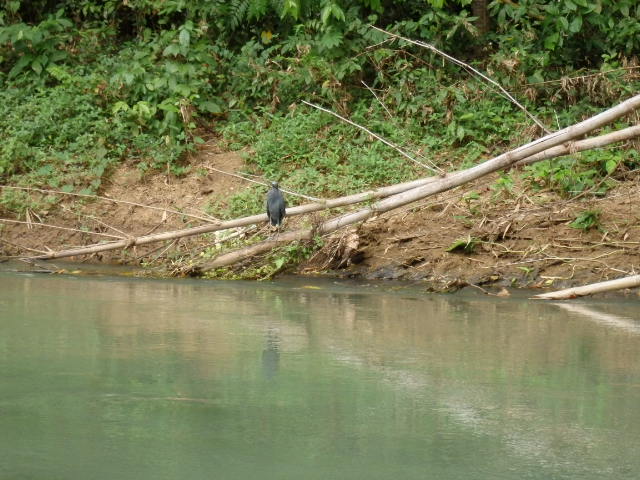
A moment later, the sun is gone and there is a heron watching for an unsuspecting fish.

Up ahead the sun pops in again and creates the most amazing shades of green…

…and around the next bend a completely different scene

All the while you gently float down the river as though there were nobody else in the world in a sort of serene amazement at what God has created.

Posted in Christian Life | Tagged , , , , , , , , | 30 Comments

Just a Note…

I’ve returned home from my tropical adventure and have some things to share with you about it, which I will do as this week continues. First and foremost, I want to take this opportunity to thank all of you who visited this blog over the past week, for your “likes” and comments. I must admit that I was surprised at how many comments there were; it’s going to take me quite a while to read them all, but please know that I appreciate them very much.

As for our trip, we met three other couples in Jamaica, dear friends all, and had a great time together, in spite of being impacted somewhat by Hurricane Otto… and the best Thanksgiving dinner I’ve ever had… I have some research to do so I can figure how that chef did some of the marvelous things he did to make a “traditional” Thanksgiving dinner, Jamaican.

Look for two photo essays this week, one from a river raft deep in a tropical forest, and the other from a small coastal island overlooking the surf as it pounds the rocks below, powered by a distant hurricane.

Thanks again for your visits here in my absence; I hope everyone had a wonderful week!

Posted in Christian Life | Tagged , , , , , , , | 2 Comments

The Day of the Lord

Joel 1

As Joel’s account opens, there is disaster in the land in the form of an invasion of locusts. They have destroyed everything in their path that grows; crops in the fields, grain in the barns; everything. The situation is dire indeed.

God has given him a message to the people, a message in five parts. Each of these contains a summons to a different group of people to come at once to the temple for lamentations. He begins in 1:2-4 with a summons to the elders of the land. In those days during the minority of King Joash, these are the men who would have served as regents over the land until the King was old enough to serve on his own. No doubt you have noticed that Joel has not mentioned who the King was when he wrote the book as the prophets normally did, and that would be explained by the minority of Joash.

In the next section, 1:5-7, Joel summons the drunkards of the land, those who would drown their sorrows about the disaster with wine. Notice that Joel points out that the locusts have destroyed the vines; their precious alcohol is about to run out.

Next he delivers his wake up call to those who live in cities (1:8-10). Here, he likens the city dweller to a betrothed young maiden who has lost her beloved; her joy and anticipation has been replaced with sackcloth and ashes. His reference to the lack of offerings made at the temple refer to the fact that the entire rhythm of the city had been set by the morning and afternoon offerings, announced citywide with the blasting of trumpets; they had ceased, for there was nothing left to offer.

Next, his warning goes out to the farmers who have lost everything (1:11-12). Next he calls to the priests (1:13) who can no longer mediate between God and the people. Everyone is to mourn and lament for God’s judgment is upon the land; they must come and cry out to God:

Alas for that day!
For the day of the Lord is near;
it will come like destruction from the Almighty. (1:15)

In verse 15 the Prophet alludes to something even more dire, for not only has God’s judgment come upon the land in the form of an invasion of locusts with devastating results, there is the final judgment yet to come. The time has arrived for the people to repent and return to God’s ways.

Posted in Bible | Tagged , , , , , , , , | 4 Comments

A Brief Introduction to Joel

The Prophet Joel has been called “the prophet of Pentecost”, “the prophet of hopefulness” and the “the prophet of the Spirit”, yet in spite of these nicknames, little is actually known about him as a man. In fact, there is a very great disagreement among scholars as to when his ministry took place, with estimates that range from around 900 BC to as late as 350 BC… and just about everywhere in between. I can only say that I think he belongs somewhere around 835 BC, and leave you to make your own call.

What is clear about Joel is his message, which as is true with most prophets was one of warning and hope. As you might suppose from his nicknames, his writings contain a very strong message of hope; more so than just about any other prophet, major or minor. I suppose that this would be a good place to mention the difference between “major” and “minor” prophets as a reminder… The only difference between the two is the length of their book; minor prophets wrote shorter books than the major prophets. This terminology has nothing whatsoever to do with the importance or relevance of what they wrote.

Joel’s book is divided into three parts: The Day of the Lord (Joel 1), The day of healing (Joel 2:1-27) and the day of the Spirit (Joel 2:28-3:21). If I were to try and sum up the book of Joel, I would say that he tells of the dire circumstances of the present, warning the people of the coming judgment of God, and that he went further to tell them of a new day when their sins would be forgiven and that they would have the opportunity to receive the greatest gift of God; eternal life.

Yes, the people of Joel’s day had some serious problems; they had gone far afield of God’s way of righteousness, and they needed to be concerned for their eternal future. Yes, they needed to stop fighting amongst themselves and deal with their dire situation. Yet in spite of this, there was a great hope if they would only follow God.

Come to think about it, I’d have to say that Joel’s message is just about as fresh today as it was then.

Posted in Bible | Tagged , , , , , , , , | 8 Comments

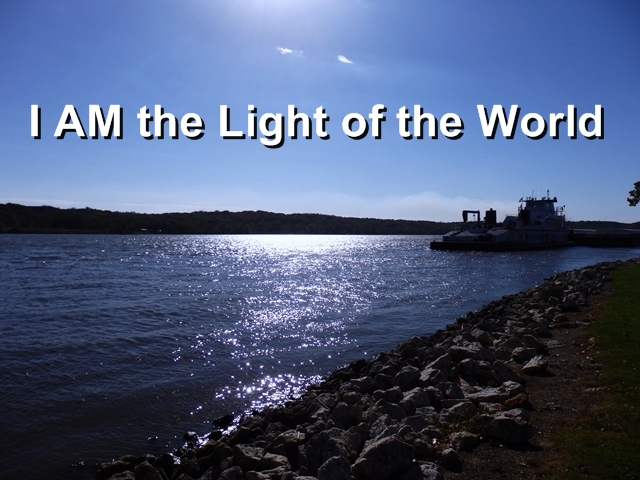
Light of the World

When Jesus spoke again to the people, he said, “I am the light of the world. Whoever follows me will never walk in darkness, but will have the light of life.”

John 8:12

John used light and darkness in his Gospel to refer to God’s presence or absence in the world, all through Jesus’ ministry He said that his disciples were in the light, and warned that darkness would soon arrive. Here once again Jesus equates His presence with light only now He is speaking in much broader terms for both the people who heard His voice literally, and those who would follow Him later on.

As His followers, we are always in His light, for we are in his presence.

Yes, that statement can be slightly intimidating, for He is with us always; we have no secrets. Yet if you think about it, that statement is not only reassuring, it is awesome to behold, for even when we misbehave, He is with us to guide us back to the pathway of life..

Oh what a glorious God we have!

Posted in Christian Life | Tagged , , , , , , , , , , | 9 Comments