Now that most of the overnight guests are headed home and I have a few minutes, I guess I need to file my final report on our Thanksgiving adventure; so here it is…
The dinner was a success, but then we knew it would be. Actually, it was a cakewalk, as expected. Come on cooks of America; be honest… as the big family dinners go, Thanksgiving is the easiest and cheapest by far. It’s not easy to mess it up, and come on, let’s be honest; the only way you can make a turkey dry is by overcooking it.
Everything was on the table and ready to eat at 4 pm, which was exactly when I planned it, and it was gone about 15 minutes later. Is it worth it to fuss for several days and then have it all gone in 15 minutes?
Well, you can be the judge.
Did anyone care about tradition when the dinner they had been smelling for several hours was ready to eat?
No, of course not, they were hungry.
Will anybody remember the dinner? No. (As long as there is turkey around somewhere and they got enough to eat.)
Thus, in the final analysis, is Thanksgiving about traditions and form and perfection of execution?
No, not in the slightest; it is about people, love, community and being thankful.
So, why do we knock ourselves out in getting it ready?
People, love, community and being thankful.
Is it a big job? Yes, it is, but it isn’t a burden if you remember why you are doing it. Rather, it is a joy. Yet, with that said, you can make it into a burden if you want to; all you need to do to make it a burden, is to be all about form, ceremony, tradition and “doing it right”. You see, when you come to my house, I’m going to “do it different” and you are going to have fun instead of form.
Incidentally, I believe in “doing” church the same way.
This is something that I wrote some years ago, but it still applies today…
Father, I thank you for all of the ways in which you have blessed me and my family. Our blessings are so great that it is hard to list them all, but I’d like to highlight some of them.
Thank you for my wonderful spouse, she loves me in spite of my many faults, and she is a joy in my life. Thank you for my children, guide them in all that they do so that they may always be pleasing in your sight. I thank you for my home and material blessings; Lord you have out done yourself!
I thank you for my Nation and my community, and for the freedom that we usually take for granted. I also thank you for my church family, may you continue to bless them and guide them through life according to your will.
Finally Father, I thank you for the person who is reading this right now. I pray that he or she will be blessed in this coming year, and that they will grow in faith; that they will always walk according to your ways. I pray that he or she will be blessed with good health, loving family and a grateful outlook on your blessings. Guide them, I pray, in your ways and according to your purpose.
Father, I ask and pray these things in the name of Jesus Christ our Lord, for whom I am most thankful of all… Amen
…and with all that has gone on the last few days, the big dinner will be like a Sunday stroll in the park; easy money!
Of course, the arrival of Chef Brian assures that; he has half and I have half, and I will say this is a luxury I haven’t had before.
I’ve also thought a bit more about what I posted yesterday; yep, I think there is a metaphor in all of this… and a lesson to be learned… but alas, I must be getting off to the real business of cooking a 20 pound beast right about now. I’ll be starting the fun by running outside and getting a bunch of fresh sage from the back yard, now that enough snow has melted to get at it. I was amazed several years ago to discover that fresh sage is at its tastiest after it has been buried in snow… as long as the temperature hasn’t dropped below 20 degrees, so this should be perfect. If you’re wondering why 20 degrees… that is about the point where the leaves die, at least in my yard. It hasn’t gotten quite that cold yet, and yesterday the bush looked very healthy, so that snow is working out to be a good thing after all. Yet, another storm is at hand, so I’m getting out there before it starts… see you later today, and good luck to all of you cooks out there!
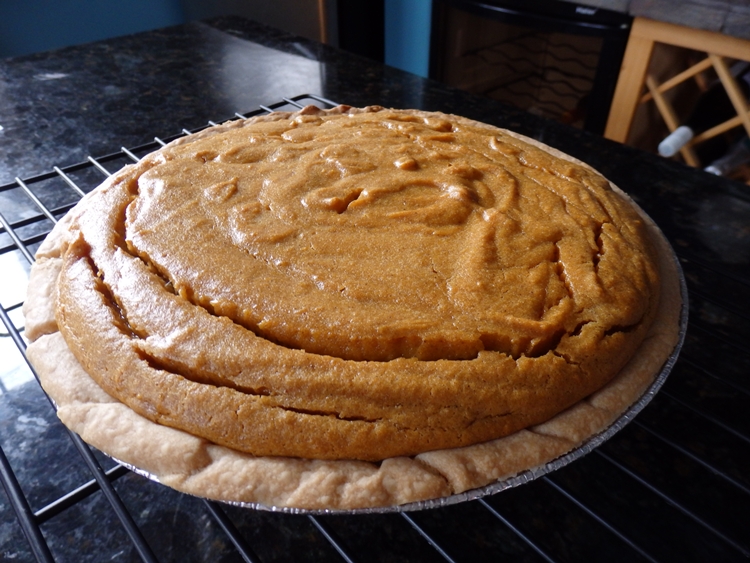
Everybody loves pumpkin pie for Thanksgiving, and the best pumpkin pie is a good sweet potato pie! Here is one I made this morning, moments out of the oven, and we’ll just let everyone assume it’s pumpkin.
Today, we continue my series on Thanksgiving. Please remember that it first ran in 2015 and has become something of a tradition on this blog, which is ironic considering my remarks in this post…
Tuesday in Thanksgiving week is all about house cleaning; I’m sorry, but I don’t have any tales to tell about that, nothing to chuckle about, nothing to report other than mission accomplished. I can assure you that there is nothing humorous about yours truly stuck with the job of cleaning a 4,000 square foot house… at least not from the perspective of this particular author. Now, from my wife’s point of view, it might be a different story, but she has her own blog for that!
It did give me time to think, because I guarantee you that if I think too much about how much I hate house cleaning, the job would never get done. Two things keep coming to my mind about Thanksgiving in the year 2015: First, is the way the markets look now versus the way they looked years ago, and the second is the role that tradition plays in all of this Thanksgiving business.
You see, when I was a boy and my Mom dragged me to the grocery store before Thanksgiving, the store was decorated lavishly for the holiday. No, not for Christmas; for Thanksgiving. There were pilgrims, Indians, turkeys, pumpkins, Indian corn, “Happy Thanksgiving” signs, and big displays of stuffing mixes, canned pumpkin for pies, bags of flour for pie crust… Thanksgiving was big deal in those days. Now? To look at the stores, you’d think this was the end of December as you listen to Paul McCartney singing about “simply having a wonderful Christmas time…”
The other thing of course is the role tradition plays in Thanksgiving for so many. Everything must be done a certain way, with certain dishes and certain arrangements, as though we were re-enacting that first Thanksgiving from 1621. Yep, I’ll bet it was the Native Americans who contributed the canned cranberry jelly stuff, or maybe the green bean casserole.
I’m not suggesting there is anything wrong with holiday traditions, nor am I suggesting there is anything wrong with family traditions; no, they are all good. What I’m beginning to think about, is whether or not the traditions themselves might have become the “end” instead of the “means to the end.” Back when I did my “traditional” Thanksgiving dinner that I posted about the other day, I didn’t mention how many recipes I had to write out that day for people who said the food was amazing… “but NOT for Thanksgiving”. And what had I really done? I made the same dishes they had always eaten for Thanksgiving, only I made them from scratch, instead of from a box or a can. (Like any self-respecting food snob would do 🙂 )
As I scrubbed the last commode, the thought hit me; more of a question really… could it be that the decline of Thanksgiving in our culture tells us something about the decline of the church in our culture? Hmm… is there a metaphor in all of this?
I’ve got to get back to work now, but I’ll be pondering, and I’ll check back later this morning and see if you’ve had any thoughts. If you aren’t American (or Canadian) please don’t be put off by all of this. I know you may not have “Thanksgiving” as such, but our churches face many of the same challenges, and I’d bet there is something comparable where you are; please feel free to share your thoughts as well.
If my people, who are called by my name, will humble themselves and pray and seek my face and turn from their wicked ways, then I will hear from heaven, and I will forgive their sin and will heal their land.
2 Chronicles 7:14
All of us have been broken in some way; all of us need healing. We are certainly broken from sin, but we may also have other hurts, wounds, or scars as well; our nations suffer accordingly.
But there is hope.
God can heal us from our brokenness; this we know, and yet sometimes we might wonder when He’s going to get started. This reminds me of a time when I was in a church leadership meeting and one of my fellow leaders asked a question that was on all of our minds: “We have done everything that we know to do as leaders, when is God going to send us the increase?” It was true; we had done everything that we could do as leaders in the church so that our church could grow spiritually, and yet the progress was slow.
One of our group spoke up and said the thing that nobody wanted to think about: “We have done what we need to do, but God won’t send the increase until we are ready to handle it. We think we are waiting on God, but God is waiting on us.”
We began to pray. We began to meet every Sunday morning, and every other time we met, to pray together before church began; to pray that God would send people who need to hear the gospel, that God would bless our people, that God would use our efforts to His glory and to accomplish His purpose… And the increase in spiritual maturity, not to mention numbers and healing came.
So often Christians sit and wait upon God. We talk of God’s timing and not ours, and some of us even learn to be very patient indeed. But has it ever occurred to us that God is patiently waiting on us to pray? Let us humble ourselves before God, seek Him out and ask for His forgiveness and healing, not only for ourselves but for others. We know that He is faithful, and we know that He is merciful and loving, so why would we doubt that He will respond and heal us and heal our land as well? Maybe it just isn’t enough to complain about the problems around us, maybe we need to get to the place where God has been waiting for us so that His healing can begin.
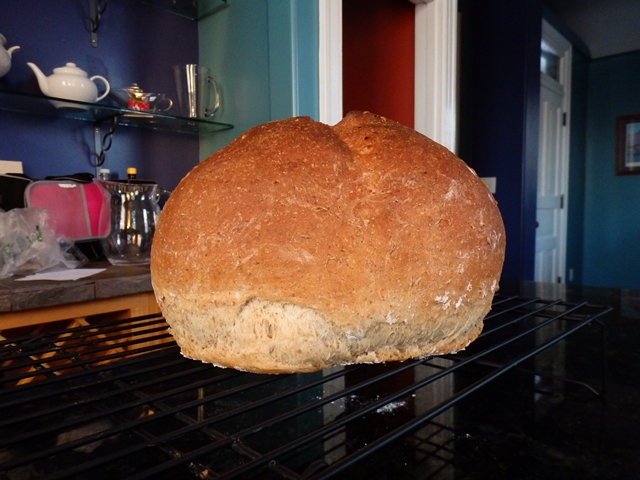
As I was working on making rye bread for this week’s turkey stuffing, the thought occurred to me that people might wonder what the point is to making homemade bread for stuffing when you can buy it in the store and save a great amount of time. Of course, one possible answer to such a question could be that the person doing this is simply a food snob, and I might consider a guilty plea to that one. A better reason is simply that the final product tastes better, and that is true without a doubt.
Don’t get me wrong, I used those store brands for years, and they aren’t bad at all, but after that year I did the “Traditional” Thanksgiving dinner entirely from scratch, I found out the well-kept little secret that homemade bread makes all the difference. There are two reasons for this, once is that homemade bread just tastes better anyway. The other reason is that you have a great deal more control over the flavor of the bread itself that is being used for the stuffing, meaning that you can alter it to suit the seasonings you plan to use in the stuffing. In the case of the rye bread stuffing, I looked at what was available in our local Hy-Vee market this evening, and I didn’t see it anywhere; no surprise there. I doubt that it’s likely to be found anywhere in this area, which (and this will surely sound like the words of a food snob) is a culinary desert.
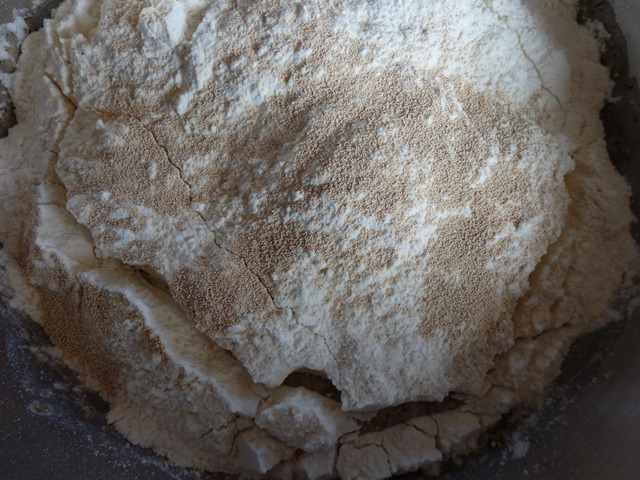
With all that said, I used my normal practice of making a dough starter, for this one, a sponge starter, which although it takes longer, builds far more complex flavor from the ingredients in the bread. If you aren’t familiar with this process, you simply take a certain percentage (usually you use a table to calculate how much of each ingredient) and then you combine those ingredients with all of the liquid to make a sort of a batter, and then you cover that with all of the rest of the ingredients, which are still entirely dry. This is covered with a damp cloth on your counter for at least an hour, but never more than four hours. As an alternative, you can develop even more flavor by letting it rest in the refrigerator overnight.
The starter will begin to bubble, as the yeast does its thing, causing the flour on top to begin to crack (see photo) and then it will push up through the cracks. That is when you mix everything together and begin to knead the dough. The result is flavor unlike anything you can normally buy at the store. I made two loaves, one for stuffing, and one to serve with dinner.
Other notes from Monday: We finally got to the grocery store; boy that was fun… The weekend storm seems to have caught everyone by surprise; this town is an ice rink! It was sort of a lucky break that we didn’t do the shopping earlier as planned, as we’ve had 5 cancellations since I published the menu, not that I’m suggesting a connection of course; now we have to decide what we’ll do with all the money we saved. My initial guess is that it will go to the power company for the extra heat the storm is causing everyone to need.
One last note, I regret to inform you that I have been forced to make a menu change. I posted yesterday that we would be having scalloped potatoes with fennel, but She Who Must Be Obeyed has seen to it that I can never make that one again. No, it isn’t that; she loves this recipe. It’s because last time I made it, I chopped off the ends of two of my fingers using a mandolin to slice the potatoes. I think I might not have been paying all that much attention to what I was doing…
I have to tell you that I really hate it when that kind of thing happens; it’s really an inconvenience. One must make a run for the sink and wash the “affected area” and then grab a bunch of paper towels and squeeze to stop the bleeding, and when it slows down some, then you have to grab the duct tape out of the drawer and wrap the situation up tightly, often one handed, and then attend to the mess you just made all over the place. In that case, I had to account for the pieces that were no longer attached to my fingers and throw away all of the potatoes that got messed up with blood… and to top it off, I had to drag out more potatoes and slice them to make up for the loss, wasting time and money in the process.
Oh yes, and it hurt like the dickens… We won’t get into the colorful and creative language that I might have used.
Yes, of course she has a point, blind people shouldn’t play with mandolins, but I was going to give that job to Chef Brian when he’s here. Yet even that is out, because as I discovered earlier today, Mrs. Don threw the mandolin away so I wouldn’t use it when nobody’s looking. You know, it’s amazing how well she knows me! At any rate, the substitute dish will be roast garlic mashed potatoes.
I am starting to feel like I really need to hurry from here on out; I’m way behind schedule.
That’s it for Monday, Tuesday is all about cleaning the house, and I am a Committee of One assigned to the job.
“Shout for joy to the LORD, all the earth. Worship the LORD with gladness; come before him with joyful songs. Know that the LORD is God. It is he who made us, and we are his; we are his people, the sheep of his pasture.”
Psalm 100:1-3
Is there a better Thanksgiving message than that? I doubt it.
He has made us, we are His, we are His people, we are His joy…
As we continue with our preparations for Thursday, as we deal with the last-minute, the anticipation… oh and the weather in many areas, I hope that we might also keep our joy in Him close to our hearts. I would be willing to guess that for most people, were they to literally make a list of what they are thankful for this year, they might overlook this point. I can hardly blame them, for I too might overlook it; that’s usually what we do with the obvious. Let’s keep in mind that just because our joy in Him is obvious, that does not make it trivial, for on the contrary, it is profound!
May we grab on to this and hold it tight this Thanksgiving: He made us and we are His. I firmly believe that the more we hold this in our hearts, the more complete our joy will be…
It would be a fair question to ask why I would choose a “Pennsylvania Dutch” theme for this year’s Thanksgiving feast; even I must admit that it is “different”. Of course, “different” is a good enough reason for me, but it sounded even more fun because Cathy and I spent a fair amount of time in Southeastern Pennsylvania while we were living in the Washington area; it is simply beautiful there in Pennsylvania Dutch country. You might have seen my post from last July (2015) about chasing trains… well that’s where we were chasing them. Southeastern Pennsylvania has quite a few “heritage” lines as they call them in the UK.
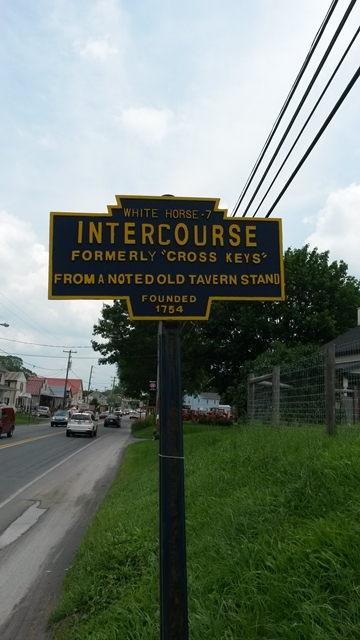
I don’t think I mentioned this in the July post, but I nearly met my end there in a little town called Intercourse, Pennsylvania. We wanted to get a photo of the town sign there, thinking no one would believe there would be a town with that name, so we pulled into a bank parking lot, and I took the camera and ran across the highway (US 30 as I recall) to get the shot. On the way back to the car, I had to wait seemingly forever to make a run for it, and when there was finally a break in the traffic, I bolted. I heard a noise, and looking up I saw that I wasn’t the only one with the same idea; there was a horse drawn wagon shooting right at me.
In a moment, when you have a fraction of a second to make a decision, instinct and in this case, muscle memory kicks in, and I made a quick cut to my left as though avoiding an oncoming free safety in the secondary of a broken field. I could easily have touched the wagon as it flew past and its driver, just as surprised as I was yelled, “Sorry man!” as he made his perilous left turn….
So… why not Pennsylvania Dutch?
With all of that said, I must report that as of Monday morning, I am already behind the 8-ball. You see, we planned on doing the shopping for this week on Saturday, but we never made it. Friday night a major winter storm went through the area, and the winds howled and the snow fell from roughly 8 pm Friday until about noon on Saturday. When we emerged from the house on Saturday afternoon, it was to begin the fun task of clearing away enough snow and ice… and broken tree branches, to get out for church on Sunday, after which we had a prior commitment. Hopefully we will traverse the ice and get to the market tonight.
Losing a day of prep time is a bit of a setback, but I still have an “ace in the hole” because on Wednesday afternoon, my son is coming in from Chicago; did I mention that he is a chef? Yep, we might just put Chef Brian to work when he arrives just like old times…
A man’s pride brings him low, but a man of lowly spirit gains honor.
Proverbs 29:23
Living with God, as His follower, His servant, in relationship with Him, is a little bit counter-intuitive. We might normally associate a proud man with success, but the Bible teaches that this is not so. The Bible teaches that the proud will come to ruin while the humble will rise to a position of honor; how can this be?
It seems to me that the confusion comes with the use of the word “honor.” To receive “honor” is usually associated with accomplishment, and accomplishment is usually associated with some sort of a behavior that is prized on earth. We don’t usually turn on the TV to see an award ceremony where the awards are presented by God, thus maybe we have made the wrong associations. Since honor in this life involves the praise of men, so it is given to those who impress men. This is not the kind of honor spoken of in the Bible.
The humble servant of God does things that will probably never draw attention to that person; they are simply helping others, and in so doing accomplishing God’s work. They do not seek attention for their works, because they know that the attention and praise of other people are not the object of their labor. They will do what needs doing, they will see to the needs of others in a variety of ways, and they will seek to advance God’s purposes of reconciliation and redemption; they will not hire a publicist.
The honor that this person receives will never be televised; there will be no plaque. They will receive the only praise that counts for anything important, and this will come when they meet the Lord face to face and He says, “Well done good and faithful servant.”
Join us on a journey through life following Jesus Christ. Our journey of life is an adventure of discovery that is both exciting and challenging. It is a discovery of clear and simple faith that comes from the a clear and simple understanding of the Word of God.
No, we aren't perfect, we are works in progress. There's no judging, no guilt and no condemnation here, just perspectives on life and truth as we work on our Project to become a little more like Him every day.
My Other Blog
Click the image to visit my other blog, Photo Vistas, my journey in pictures