When I am Weak, He is Strong

We now continue in this section where Paul is making the point that grace gives victory over sin, and that victory is assured. As always, it seems to be one thing to say so, and another thing in daily life; how does this victory come about in the face of life’s challenges? We’ve already seen that this victory comes through the presence of the indwelling Holy Spirit, which we received at “birth” when we were born again. This new life makes us God’s children, His family, and it is our membership in His Family that assures our victory.

Paul continues proving this point as we turn to his next sub point, in verses 26-30 where we find that God will bring His children through their earthly trials.

In the same way, the Spirit helps us in our weakness. We do not know what we ought to pray for, but the Spirit himself intercedes for us through wordless groans. And he who searches our hearts knows the mind of the Spirit, because the Spirit intercedes for God’s people in accordance with the will of God. (8:26-27)

When times are tough, we might not know what to do, we might be at our wit’s end, but the Holy Spirit that indwells us intercedes, even though we may not understand it at the time. There is a really interesting little element in play here, something that we like to talk about, but sometimes overlook in times of trial; the indwelling Holy Spirit is really quite active in our lives when we are weak. On the other hand, when we are strong, or when we think we are strong, the Spirit seems to be less active; you may have experienced this yourself. Yet the interesting component of this is that the Spirit is always there, always busy and always working, but we are often distracted going our own way, doing our own thing. In these times, I often find that I have blundered yet again into a “learning moment” wishing I had learned that lesson last time so I wouldn’t need to learn it yet again this time…

And we know that in all things God works for the good of those who love him, who have been called according to his purpose. For those God foreknew he also predestined to be conformed to the image of his Son, that he might be the firstborn among many brothers and sisters. And those he predestined, he also called; those he called, he also justified; those he justified, he also glorified.

Romans 8:28-30

In these verses, Paul continues making the point that God has promised to see us through our trials in life. Verse 28 is one of comfort for millions, for it assures those who love Him that no matter what our circumstances, God will see us through and work things out to a good end; good for His purpose.

“Wait! Hold on, what was that again?”

Yeah, there’s a condition: “…those who love him…” Who are the ones who love Him? Jesus told His disciples that if they love Him they should keep His commands (John 14:15), Thus I would suggest that those who love Him are those who keep His commends, the very first of which was “follow me” or to put it another way, those who love God are those who have responded in obedience to the Gospel− Christians.

For those God foreknew he also predestined to be conformed to the image of his Son, that he might be the firstborn among many brothers and sisters. (8:29)

This is a tricky verse, and by that, I mean a controversial one. Let’s be careful that we don’t read things into it that aren’t there. “For those God foreknew…” follows from verse 28, which is directed at those who have responded to the Gospel in obedience, so they are the ones He “foreknew”. This is because God knew well in advance that when the day came that the Gospel was proclaimed to all nations, many would respond to it in obedience, and thus they were foreknown. God ordained or “predestined” that they would be “conformed” to the image of His Son, so that His Son, who was first to be raised in glory from the tomb would be followed by His brothers and sisters. If you have been following our tour through Romans, you will recall that Paul has been teaching this quite a bit already.

And those he predestined, he also called; those he called, he also justified; those he justified, he also glorified. (8:30)

Those who responded in obedience to the Gospel (predestined) were called. This isn’t difficult when you ask yourself what is really going on when the Gospel is proclaimed, for when it is proclaimed, we are being called to follow Jesus. Those who respond in obedience have been justified, which happens to be the theme of the book we are studying, and they in due course will be glorified just as Jesus was when He rose from the grave. What this passage is there to teach Paul’s readers is that our victory over sin by God’s grace is assured because God has ordained that it will be so, which happily is the context in which the passage falls.

I realize that some may prefer to add some extra significance to what these are saying, and that’s fine by me; I won’t make a big deal out of it since I don’t debate any more. Actually, if you are a Total Depravity fan, you will need that extra bit of significance to make Total Depravity work, but if I may offer a suggestion before you go ahead… You may well be able to fix the doctrinal problem that Total Depravity brings about, but aren’t you going to have an even bigger problem with Selection and Predestination? If it was me, and I was still a debater, I would just leave these verses in context because it is easier to defend Total Depravity than it is to defend Selection and Predestination… I’m just sayin’
Posted in Bible | Tagged , , , , , , , | 2 Comments

God’s Children

For those who are led by the Spirit of God are the children of God. The Spirit you received does not make you slaves, so that you live in fear again; rather, the Spirit you received brought about your adoption to sonship. And by him we cry, “Abba, Father.” The Spirit himself testifies with our spirit that we are God’s children. Now if we are children, then we are heirs—heirs of God and co-heirs with Christ, if indeed we share in his sufferings in order that we may also share in his glory.

Romans 8:14-17

With these verses, Paul begins the final argument to demonstrate his proposition that grace brings victory over sin. Paul’s final point is that the victory of grace over sin is completely assured. This argument is broken into four sub points, the first of which is comprised of verses 14-17. The first sentence is the transition from the previous passage into the new subject which is that grace has assured that we are God’s children.

Of course, “the Spirit you received” refers to the presence of the indwelling Holy Spirit through whom we have been adopted to sonship. Because we have become God’s children by having been born again of the Spirit, we can truly call God “Father”. Our assurance of this is that the Spirit who indwells us testifies with our spirits that we are His. Because we are now His children, we are also His heirs, co-heirs with Christ; that is borne out by our willingness to suffer with Christ in this life.

The second of the four sub points is found in 8:18-25, and is truly amazing: As co-heirs with Jesus Christ, we will inherit the universe. I realize that most preachers don’t preach sermons on this and most Sunday school lessons aren’t about it either, maybe that’s because they fear that we will let our imaginations get carried away. For just a moment, however, try to imagine what that would look like; the whole universe, restored to its pristine condition. Our present circumstances are nothing when you consider what we will have in Christ; why obsess about circumstances? The entire creation is yearning for the day when God’s children are revealed! (8:18-19). Sin has had a terrible consequence on the creation, this wonderful world that God created has been in decay ever since, but it will not always be this way, for it will be redeemed as we have been (8:20-21).

The creation groans in anticipation of that great day just as we do, we who have the firstfruits of sonship, who eagerly await the fullness of sonship when even our mortal bodies will be redeemed (8:22-23). The final two verses are a little different, an odd way of putting it, yet they make a great point. We are eagerly awaiting the final part of the promise we have received from God, and the very fact that we are still hoping demonstrates that it has not yet been accomplished. For in this life we still must deal with pain, suffering, sickness and physical death. So, we will continue to wait eagerly and patiently until Christ completes the last bit of His work upon His return.

Posted in Bible | Tagged , , , , , , , | 3 Comments

The Solution to the Problem

Therefore, there is now no condemnation for those who are in Christ Jesus, because through Christ Jesus the law of the Spirit who gives life has set you free from the law of sin and death. For what the law was powerless to do because it was weakened by the flesh, God did by sending his own Son in the likeness of sinful flesh to be a sin offering. And so he condemned sin in the flesh, in order that the righteous requirement of the law might be fully met in us, who do not live according to the flesh but according to the Spirit.

Romans 8:1-4

Remember that the proposition Paul is setting out to prove in this section is that grace gives us victory over sin. In 8:1-13 Paul’s supporting point is that grace gives us complete victory over sin by the Holy Spirit. This is broken into 2 sub points: 8:1-4 shows that grace has taken care of the penalty for sins, and 8:5-13 shows that we can overcome our sinful natures by the working of the Spirit within us.

In chapter 7 Paul went to great pains to demonstrate that we cannot overcome sin on our own and he brought that point to its climax in 7:24-25:

What a wretched man I am! Who will rescue me from this body that is subject to death? Thanks be to God, who delivers me through Jesus Christ our Lord!

These verses are the reason for the connective “therefore” in 8:1 and it is as if Paul were saying, “Oh no, I can’t do it on my own, but wait; Christ has done it for me!” Clearly, verses 3-4 establish that Jesus has fulfilled the righteous requirements of Law relating to our sins.

If we were to stop reading after verse 4, then we will shortly return to chapter 7 and despair. We already know that Jesus has paid the price for our sins, and so we want to live the right way from now on, but we are still weak in our mortal bodies, surrounded by sin and temptation; it is only a matter of time until we stumble again. I really believe that this is the reason that many Christians struggle with guilt, self loathing and sheer frustration, with the result that they question the very foundation of their faith.

But Paul kept on writing.

Those who live according to the flesh have their minds set on what the flesh desires; but those who live in accordance with the Spirit have their minds set on what the Spirit desires. The mind governed by the flesh is death, but the mind governed by the Spirit is life and peace. The mind governed by the flesh is hostile to God; it does not submit to God’s law, nor can it do so. Those who are in the realm of the flesh cannot please God.

Romans 8:5-8

In these verses, Paul once again gives us the challenge of a choice: Will we live according to the old way, or will live according to the new way? As he often does in his writings, Paul uses flesh and spirit as his means of describing the old and new ways of life. Yet here he adds another element to the challenge by describing the two ways of life in terms of our focus; “mind set on…” If our mind is set on the flesh (old ways of life that center on the sensations, needs and desires of the physical body) then we cannot please God.

You, however, are not in the realm of the flesh but are in the realm of the Spirit, if indeed the Spirit of God lives in you. And if anyone does not have the Spirit of Christ, they do not belong to Christ. (8:9) If we are a follower of Christ, then the Holy Spirit lives within us; He is our Comforter, our Helper, promised to us by Jesus Himself. This is where our minds are supposed to be focused, not on our circumstances. And if the Spirit of him who raised Jesus from the dead is living in you, he who raised Christ from the dead will also give life to your mortal bodies because of his Spirit who lives in you.  (8:11) If we are followers of Jesus Christ, the Holy Spirit within us will give life to our mortal bodies so that we are no longer living in death (separation from God). It would be helpful if we recognize that Paul isn’t talking about after we die in this sentence; he’s talking about right now.

Therefore, brothers and sisters, we have an obligation—but it is not to the flesh, to live according to it. For if you live according to the flesh, you will die; but if by the Spirit you put to death the misdeeds of the body, you will live.

Romans 8:12-13

We have an obligation to live according to the Spirit, to set our minds on the Spirit within us; Jesus has already done the work, now we need to make a choice. Oh, and by the way, we are expected to make the right choice to live according to the Spirit. When we do, when we set our mind on the Spirit, the Spirit will guide us, sustain us, strengthen us and enable us to not only walk away from the legal penalty for sin, but to put sin to death in our lives.

Therefore, grace gives us victory over sin in every sense.

Now if all things are possible with God, and if God is in us through the Holy Spirit, and if we set our minds on the things of the Spirit, then we really can overcome sin in our lives, not by our own human strength, but by His life in us.

Remind me please: What was it again that is too hard?

Posted in Bible | Tagged , , , , , , , | 12 Comments

TLP Living: 2/10/20

donmerrittonline.com

Posted in Christian living | Tagged , , , , , , , | Leave a comment

TLP Inspiration: 2/10/20

The Cry of My Heart

How lovely is your dwelling place,
Lord Almighty!
My soul yearns, even faints,
for the courts of the Lord;
my heart and my flesh cry out
for the living God.

Psalm 84:1-2

What does your soul yearn for− what does your heart cry out for?

I would imagine there are many possibilities.

As I sit here this morning thinking about it, this might be the question above all questions, the answer to which will tell us everything about ourselves. If my soul yearns for earthly things, say money or status or power, maybe for drugs or drink, possibly for love and romance… what would that say about my spiritual condition?

Yes indeed, there are so many possible answers…

Why is it that my soul cries out for God when I find myself in trouble, but when all seems well, things other than God have my attention? Oh yes, that says something about my spiritual condition!

I want to say that my heart and soul cry out for God, but if that were true, what would my daily life look like; would it look the same as it does now? Hmmm…

The things of this life are all around us, the pleasures of this life call out. The problems of this life are all around us as well; they aren’t easy to miss: The things of this life are ubiquitous in fact, and if my attention is to be on the things that are above, maybe I’m going to need to decide consciously to put it there, instead of on the things of this life. Yes, maybe I’m going to need to put my attention on God purposefully, deliberately, as a choice I make. After all, don’t our hearts and souls yearn for the things were pay attention to?


Posted in Christian living | Tagged , , , , , , , , | 4 Comments

Merciful

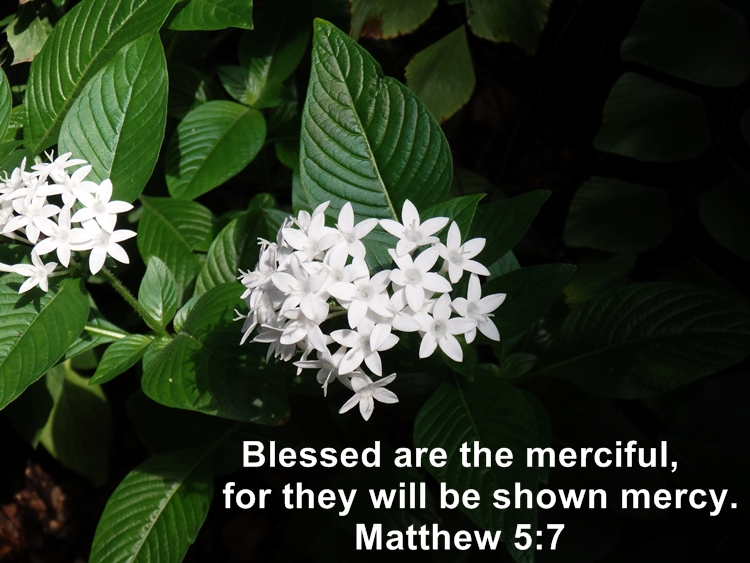
Mercy is the most fundamental aspect of our relationship with God. We only have a relationship with God because of His tremendous mercy, for without it, we are permanently estranged from Him. Thus, Jesus teaches mercy on our parts as a foundational requirement of being His disciple.

We have received His mercy; we are to show mercy to others when the occasion arises. We have received His love; we are to show love to others. How can we show mercy without love, and love without mercy? Yes, this is fundamental.

The person who has received God’s mercy and who shares God’s mercy with others, both through the Gospel and through our own attitudes and actions, will in the end, receive mercy when those who have refused it receive God’s judgment; this is also a fundamental truth.

Now we come to the reversal of this: What kind of person does not show mercy to others?

The ruthless, the cruel, the inhumane, the purely evil…

Will they receive mercy: of course not, they will be judged. Will they be blessed in this life by relationship with God? No, for they live in open rebellion against Him. Will they receive mercy in the end? No, they will receive justice instead.

Posted in Bible | Tagged , , , , , , , , | 7 Comments

Paul Begins His Next Point

Romans 7:14-25

We are still in the third main section of Romans where Paul is proving that grace gives victory over sin. In his first supporting point, he has shown that any notion that grace makes sin unimportant is simply false. Now in the next supporting point, he returns to the proposition, that grace brings victory over sin. Here he will support his case with 2 sub points, first that we do indeed struggle with sin (7:14-25) and then that victory comes through the Holy Spirit (8:1-13).

In this post, we have the first sub point, that we do indeed struggle with sin. If you have read the verses (please do read them) they paint a very dire picture, and if they stood all alone, I might be inclined to take back my comments about “The Fall” and our being “fallen” from yesterday, but praise be to God, for this is the set up for Paul’s point, not the point itself!

Humanity is weak and all have sinned and fallen short of the glory of God; who can argue against that statement? Jesus Himself noted it on that fateful night in Gethsemane when He observed that the spirit was willing but the flesh was weak. We live in a world that is full of the consequences of sin. Our human world often glorifies and romanticizes sin; it models sinfulness for us every day and so it is no wonder that we struggle with sin; for us to avoid sin altogether is asking a great deal indeed. It could be likened to being on a diet and sticking to it in a bakery when nobody is looking: Oh, the temptation!

But nobody held a gun to our heads and forced us to buy those sticky buns; we were just weak.

This is what Paul means when he speaks of our sinful nature. Here, why don’t I just come out and say it? Paul is not teaching the Doctrine of Total Depravity in these (or any other) verses; that doctrine doesn’t work. Total Depravity teaches that because of “The Fall” we are born sinners and totally depraved all of the time; we are not capable of making decisions to follow God or to do anything other than to be depraved sinners. If that were so, then why is Paul writing this persuasive piece that keeps throwing a choice at us; if we are totally depraved then we cannot be persuaded, and we cannot make the right choice, for we would of necessity, be utterly incompetent to do so. Sometimes dear reader, it is helpful for us to actually consider the meaning of the words people throw at us, before we just accept a non sequitur as being true.

We human beings are not totally depraved, but we are fallible, we do make mistakes and errors of judgment; each of us has struggles as we try to live in a harsh world… but do not let anyone convince you that God made you depraved. God did not make you depraved, dear reader− He made you His precious child.

We must not stop reading at the end of chapter 7. If we stop now, we will walk away with entirely the wrong idea, for in 8:1-13 Paul will show us that not only does grace pay the price for our sins, but that it will make it possible for us to overcome this whole sin struggle business once and for all, and we will see how he does it next time…

Posted in Bible | Tagged , , , , , , , | 8 Comments

The Fall, Falling and Figuring Things Out

Romans 7:7-13

My normal practice here is to simplify the complex. If I am criticized for being too simplistic or basic in my explanation, I figure I’ve done my job. For this post, I’m going to do the opposite (just for fun) and complicate that which is simple. Don’t worry, I’ll cover the simple part first, and then delve into the work of complicating it. First, the simple part:

Paul uses a “straw man” argument in this passage. A “straw man” argument is an argument that poses an absurdity and then blows it away to make a larger point. Here is the straw man: “Is the law sinful?”

What a ridiculous question; of course it isn’t sinful, if it is, then God is a sinner!

Paul makes this clear in the verses that follow; I hope you’ve read them. In those verses Paul points out that the Law was a good thing, for it showed us what God expects of us, and gives us regulations so that we can avoid grieving Him. The only problem is that in doing this it strikes a chord in humans that leads us astray. The good news however, is that by revealing how much we need a savior, it also leads us to accept grace when it became available. We can see this at work when we talk to people about Christ, and they tell us they don’t really need saving because they are “a good person.” The Law shows that while we may be good, on our own we aren’t quite good enough… but there’s another way.

OK, that’s the simple part: End of lesson. Here’s me making it complicated:

I would imagine that many read these verses and begin thinking about The Fall and the results of “The Fall” and its consequence that we are “fallen” and can’t help ourselves from sinning against God. I do not like the expressions “The Fall” and “fallen”. I almost never use them, and when I do I normally say that I don’t like the term, but I need a label to shorten things up, for if I say “The Fall” people know what I’m talking about without having to re-tell the whole story. You might be wondering what I have against these frequently used terms, so I’ll tell you:

They don’t work!

Oh, in a way I wish that they did, it would be so much easier for me to take refuge in the notion that I have nothing to do with my own sin, but that simply is not true, for I have everything to do with my own sin. Yes, Adam was the first man to have sinned, but I don’t need his failings, I have plenty of my own. Here, let me ask you a question: If we sin because Adam sinned, then why did Adam sin because he was “fallen”? Did Adam sin after “The Fall”?  Of course not; that’s crazy! If his sin was “The Fall”, then it happened before “The Fall”, even if only seconds before. “The Fall”, and “fallen” as the reason for (cause) of sin are circular arguments, and they do not reflect accurately Paul’s teaching in Romans. You might recall from last week that when we read these kinds of passages in context, they reveal quite a different story.  Martin Luther was a great man of faith, but he was mistaken when he wrote that “even now millions of babies are burning in hell to the glory of God”.

Therefore, when I sin, I cannot blame the Law, I cannot blame Adam, I can’t blame the Devil and I cannot blame God.

Believe it or not, I think this is really great news!

It is really good news because grace gives victory over sin!

Oh, by the way, that is Paul’s proposition, the very point he has set out to prove in this section go figure.

Posted in Bible | Tagged , , , , , , , | 4 Comments

Released from the Law

Romans 7:1-6

Do you not know, brothers and sisters—for I am speaking to those who know the law—that the law has authority over someone only as long as that person lives? For example, by law a married woman is bound to her husband as long as he is alive, but if her husband dies, she is released from the law that binds her to him. So then, if she has sexual relations with another man while her husband is still alive, she is called an adulteress. But if her husband dies, she is released from that law and is not an adulteress if she marries another man.

Romans 7:1-3

Paul concludes this point with an interesting illustration; marriage. When a marriage partner dies, their covenant is dissolved and the remaining partner is free to marry again; I don’t know about you, but I find this an interesting point. If I remember correctly, Jesus blew the minds of the Pharisees one day when they brought this up. It seems they couldn’t deal with the thought that in heaven a woman might have more than one husband, if her husband died and she remarried, so they asked Jesus about it. To be fair, on this particular occasion, they weren’t trying to trap Jesus; their real targets were the Sadducees. Anyway, Jesus told them that in heaven, we will be like the angels who do not take partners in marriage. When I read those verses, I always smile at the rivalry between the Pharisees (who did believe in resurrection) and the Sadducees (who did not)… and at the same time, I have a chuckle at the expense of some of our romantic notions about heaven.

Back to Paul’s point, it would seem that Paul didn’t share any romantic notions about husbands and wives in heaven either. When the husband dies, the widow is free to marry another because she… and her husband for that matter… are released from the bonds of matrimony. In the same way, just as Jesus’ body died on the cross, so did we, and we are thus set free from the Law.

So, my brothers and sisters, you also died to the law through the body of Christ, that you might belong to another, to him who was raised from the dead, in order that we might bear fruit for God. For when we were in the realm of the flesh, the sinful passions aroused by the law were at work in us, so that we bore fruit for death. But now, by dying to what once bound us, we have been released from the law so that we serve in the new way of the Spirit, and not in the old way of the written code.

Romans 7:4-6

Having been released from the Law, we reap significant advantages such as freedom from sin, freedom from fear and freedom from death; yes indeed, this is a really big deal. Before this, we were caught up in a system that didn’t lead us to a good place, for under the Law, we could only be condemned. It would seem that there is something deep in human nature that the Law could not repair: “…when we were in the realm of the flesh, the sinful passions aroused by the law were at work in us, so that we bore fruit for death.”

What is it in us that drives us to sin in the face of divine law?

Have you ever told a 2-year-old not to do something? If so, what do they do?

Yep, the very thing you told them not to do!

I think that answer to the question comes down to what the nature of sin really is. It isn’t merely the violation of a rule; it’s a spirit of rebellion. When Adam ate the forbidden fruit, his problem wasn’t just that he did a “no-no” it was that he wanted to be like God; he rebelled. Law defines what it is to rebel, it makes rebellion clear to us and what do we do?

We rebel.

Things are different now, for through Christ we died to the Law and are released from its written code; obedience to God is not longer a matter of mastering our own will, for now we have a whole new life within us, so that we serve in the new way of the Spirit. The presence of the indwelling Holy Spirit changed everything; there is only one thing we have left to do, and that is to make a choice: Follow the old way or follow the new way.

The sad truth is that most of us never actually make a choice, and suffer repercussions as a result. What is the repercussion? Without making a choice, our “settings” remain “default settings” and therefore we follow the old ways. When a person is still following the old ways, they tell everybody around them of their status; can you guess what they say? Yes, that’s it! They say…

“But it’s too hard…”

Posted in Bible | Tagged , , , , , , , | 6 Comments

Photo of the Week: February 6, 2020

Posted in Photo of the Week | Tagged , , , , | 2 Comments