Welcome to The Life Project!
Join us on a journey through life following Jesus Christ. Our journey of life is an adventure of discovery that is both exciting and challenging. It is a discovery of clear and simple faith that comes from the a clear and simple understanding of the Word of God. No, we aren't perfect, we are works in progress. There's no judging, no guilt and no condemnation here, just perspectives on life and truth as we work on our Project to become a little more like Him every day.-

-
My Other Blog
-
Recent Posts
-
Join 7,548 other subscribers
Blog Stats
- 444,930 hits
CONTACT ME
Please feel free to contact me via email... lifeprojectblog.com@gmail.com-
Recent Posts
Archives
- November 2026
- October 2026
- September 2026
- August 2026
- July 2026
- June 2026
- May 2026
- April 2026
- March 2026
- February 2026
- January 2026
- December 2025
- November 2025
- October 2025
- September 2025
- August 2025
- July 2025
- June 2025
- May 2025
- April 2025
- March 2025
- February 2025
- January 2025
- December 2024
- November 2024
- October 2024
- September 2024
- August 2024
- July 2024
- June 2024
- May 2024
- April 2024
- March 2024
- February 2024
- December 2023
- September 2023
- August 2023
- July 2023
- June 2023
- May 2023
- April 2023
- March 2023
- February 2023
- January 2023
- September 2022
- August 2022
- July 2022
- June 2022
- May 2022
- April 2022
- March 2022
- February 2022
- January 2022
- December 2021
- November 2021
- October 2021
- September 2021
- August 2021
- July 2021
- June 2021
- May 2021
- April 2021
- March 2021
- February 2021
- July 2020
- June 2020
- March 2020
- February 2020
- January 2020
- December 2019
- November 2019
- October 2019
- July 2019
- June 2019
- May 2019
- April 2019
- March 2019
- February 2019
- January 2019
- December 2018
- November 2018
- October 2018
- September 2018
- August 2018
- July 2018
- June 2018
- May 2018
- April 2018
- March 2018
- February 2018
- January 2018
- December 2017
- November 2017
- October 2017
- September 2017
- August 2017
- July 2017
- June 2017
- May 2017
- April 2017
- March 2017
- February 2017
- January 2017
- December 2016
- November 2016
- October 2016
- September 2016
- August 2016
- July 2016
- June 2016
- May 2016
- April 2016
- March 2016
- February 2016
- January 2016
- December 2015
- November 2015
- October 2015
- September 2015
- August 2015
- July 2015
- June 2015
- May 2015
- April 2015
- March 2015
- February 2015
- January 2015
- December 2014
- November 2014
- October 2014
- September 2014
- August 2014
- July 2014
- June 2014
- May 2014
- April 2014
- March 2014
- February 2014
- January 2014
- December 2013
- November 2013
- October 2013
- September 2013
- August 2013
- July 2013
- June 2013
- May 2013
- April 2013
- March 2013
- February 2013
- January 2013
- December 2012
- November 2012
- October 2012
- September 2012
- August 2012
- July 2012
- June 2012
- May 2012
- April 2012
- March 2012
- February 2012
- January 2012
- December 2011
- November 2011
- October 2011
Photo of the Week: August 31, 2016
Posted in Photo of the Week
Tagged Christian, locomotive, photography, photos, steam engine, trains
1 Comment
A Programming Note
By the time this is published, I will be flying out to the West Coast to visit family in the LA area. As a consequence I will not be at my duty station for a few days, and won’t be posting any more Hebrews items until I return. I have scheduled a Photo of the Week for later today and an item to run on Sunday.
In the meantime I wish everyone a wonderful and blessed week and I will be back at work on September 7 with the next installment from Hebrews, and hopefully some new photos to share and stories to tell.
Superior Sacrifice – Superior Covenant
But when Christ came as high priest of the good things that are now already here, he went through the greater and more perfect tabernacle that is not made with human hands, that is to say, is not a part of this creation. He did not enter by means of the blood of goats and calves; but he entered the Most Holy Place once for all by his own blood, thus obtaining eternal redemption. The blood of goats and bulls and the ashes of a heifer sprinkled on those who are ceremonially unclean sanctify them so that they are outwardly clean. How much more, then, will the blood of Christ, who through the eternal Spirit offered himself unblemished to God, cleanse our consciences from acts that lead to death,[c] so that we may serve the living God!
Hebrews 9:11-14
In yet another amazing passage, one that continues to build his case, our author charges head long into the notion that the Old Covenant is still somehow in effect. Having just concluded a discussion of the earthly tabernacle and earthly sacrifices, he contrasts the work of Jesus against the old system in telling us that the Most Holy Place into which High Priest Jesus entered with His blood sacrifice was not the one in Jerusalem that is a mere illustration of the real thing, He instead entered the Real Thing in heaven. Our author highlights the difference and relevance of his assault by noting that the reality and result of this work by Jesus is “already here.” Clearly, he is not referring to any future event.
Next is a contrast between the nature of the old and new sacrifices, the first being performed with the blood of animals, is contrasted with the second, being the blood of the Son of God, and it is this difference that made possible eternal redemption. Can you see why the author earlier said that the Old Covenant Law was obsolete? If the final blood sacrifice was made with the blood of the Son of God, what standing can there be for animal sacrifices going forward? It’s really a ridiculous notion when you think about it.
Verse 13 makes reference to sacrifices and ashes that were made to cleanse those who were “ceremonially unclean” under the Law, and the author makes the point very clearly that this only made those people “outwardly clean.” Keep in mind, that everything that the Law dealt with was “outward” for it was a set of earthly regulations; even its promises are of an earthly nature. Contrast this with verse 14: The sacrifice of Christ doesn’t aim to cleanse us outwardly, for it cleanses our conscience which is an inward cleansing; the New Covenant is all about inward spiritual things, not outward earthly ones. With this inner cleansing, we can serve the living God in fellowship with Him.
For this reason Christ is the mediator of a new covenant, that those who are called may receive the promised eternal inheritance—now that he has died as a ransom to set them free from the sins committed under the first covenant.
Hebrews 9:15
Jesus Christ is the mediator of a superior covenant. It is superior because it deals with the inner parts of Man rather than the outward parts. This has set us free from our bondage to sin, death and the grave, and made it possible for us to actually be called God’s children, not as a metaphor, but by that eternal life which is now ours in Christ.
Posted in Bible
Tagged Bible study, Christian, discipleship, encouragement, hope, inspiration, Jesus, life, love
3 Comments
“Reflections on Jude” Released
As I mentioned last week, I have completed and posted “Reflections on Jude” today, and it is now available for download HERE.
The link will take you to the “Publications” page of my website where you can choose from several other titles; all are offered for free.
You are welcome to use this file for whatever purpose you like; you may even make it your own… as long as you don’t do so for sale or commercial purposes.
Tabernacle Worship
Now the first covenant had regulations for worship and also an earthly sanctuary. A tabernacle was set up. In its first room were the lampstand and the table with its consecrated bread; this was called the Holy Place. Behind the second curtain was a room called the Most Holy Place, which had the golden altar of incense and the gold-covered ark of the covenant. This ark contained the gold jar of manna, Aaron’s staff that had budded, and the stone tablets of the covenant. Above the ark were the cherubim of the Glory, overshadowing the atonement cover. But we cannot discuss these things in detail now.
Hebrews 9:1-5
Chapter 9 opens with a brief description of the Old Testament Tabernacle and its contents which would have been quite familiar to the Jewish readers of this letter. As you can see, it is not the author’s purpose here to go into any great detail on this subject, for he is heading in a more important direction, however, I’ve included a chart that will compare the tabernacle contents with their New Testament counterparts:
| OT Tabernacle | New Covenant counterpart |
| Altar of burnt offering | The cross and death of Jesus |
| Basin | Baptism |
| Holy Place | The church |
| Lamp | The Word and the Holy Spirit |
| Table | Fellowship between God and Man |
| Bread | Lord’s Supper |
| Altar of incense | Prayer |
| Veil | Body of Christ |
| Ark | Presence of God |
| Manna | God’s provision |
| Staff | Leaders of God’s choice |
| Tablets | God’s law |
| Cherubim | Ministering angels of God |
| Atonement cover | Reconciliation to God |
When everything had been arranged like this, the priests entered regularly into the outer room to carry on their ministry. But only the high priest entered the inner room, and that only once a year, and never without blood, which he offered for himself and for the sins the people had committed in ignorance. The Holy Spirit was showing by this that the way into the Most Holy Place had not yet been disclosed as long as the first tabernacle was still functioning. This is an illustration for the present time, indicating that the gifts and sacrifices being offered were not able to clear the conscience of the worshiper. They are only a matter of food and drink and various ceremonial washings—external regulations applying until the time of the new order.
Hebrews 9:6-10
Verses 6-7 continue with the author’s brief description of the scene in the tabernacle, culminating in the annual entrance of the high priest into the Most Holy Place; notice that he had an offering for his own sins, as well as for all of the people. I point this out because it is a tell-tale sign that the ministry of Jesus is completely different than that of the Old Covenant priests, and should convey to us that Jesus is not and will never be an Old Covenant priest.
Verse 8 marks the point where the author shifts from his description of the tabernacle into his application of this information. See the words “the Holy Spirit was showing by this…”? The author is telling us that as long as the Old Covenant was in effect, the reality of Jesus was not yet in force. Please take note that the opposite is also true: Now that Jesus has finished His work, the Old Covenant is no longer in effect, and never will be again. Why do I keep pointing this out? Because millions of our dear brothers and sisters in Christ are looking forward to the day when the Old Covenant Temple is rebuilt, and the Old Covenant sacrificial system is once again practiced, with the understanding that Jesus Himself will one day be that high priest who enters the Most Holy Place… and that simply cannot be!
Look at the next verse: “This is an illustration for the present time…” All of the things that went on in the Temple were illustrations, even the Temple itself was an illustration. An illustration represents the reality pictured, but an illustration is never the reality itself. The gifts and offerings in the old Temple worship could never clear the conscience of the worshippers, because they could never take sin away, for in the final analysis, they only involve earthly things. Now pay careful attention to what he says next: external regulations applying until the time of the new order. These are very interesting “external regulations” for they have an expiration date attached; how can that be? Yes, I’ve even had a comment or two along these lines… how can something “everlasting” be over?
Let’s think… these Temple ceremonies and sacrifices are meant to illustrate something. They illustrate an eternal truth that Man needs salvation from sin. When that salvation was accomplished once for all time by Jesus on the cross, the illustration is not longer necessary, but the truth they once illustrated remains: Man needs salvation from sin, only now, we have found it in the work of Jesus on the cross.
You see, that wasn’t really so hard to understand, was it? The illustration that was the Old Covenant is over because the eternal reality of what it illustrated has come to pass… simple.
Posted in Bible
Tagged Bible study, Christian, discipleship, encouragement, hope, inspiration, Jesus, life, love
12 Comments
The old is no more
For if there had been nothing wrong with that first covenant, no place would have been sought for another. But God found fault with the people and said:
“The days are coming, declares the Lord,
when I will make a new covenant
with the people of Israel
and with the people of Judah.
It will not be like the covenant
I made with their ancestors
when I took them by the hand
to lead them out of Egypt,
because they did not remain faithful to my covenant,
and I turned away from them,
declares the Lord.
Hebrews 8:7-9
Something was wrong with the Old Covenant, the Law of Moses. The prophet Jeremiah foretold of its end, and the author of Hebrews is telling us clearly and unambiguously that the end has come. I’m always amazed that more of us can’t seem to comprehend this. So many Christian doctrinal traditions treat the New Covenant as little more than addendum to the Old. Others add elements of the Old into the New almost on a whim; how clear does it need to be?
This is the covenant I will establish with the people of Israel
after that time, declares the Lord.
I will put my laws in their minds
and write them on their hearts.
I will be their God,
and they will be my people.
No longer will they teach their neighbor,
or say to one another, ‘Know the Lord,’
because they will all know me,
from the least of them to the greatest.
For I will forgive their wickedness
and will remember their sins no more.”
Hebrews 8:10-12
This is the rest of the quotation from Jeremiah 31:31-34, note that he described features of the New Covenant that were never present in the Old. Notice also that this entire quotation is cited by our author here in Hebrews as an accomplished fact, and not something still off in the future, as some would claim it to be today. If you still aren’t convinced, there is one more verse in this chapter:
By calling this covenant “new,” he has made the first one obsolete; and what is obsolete and outdated will soon disappear.
Hebrews 8:13
The Old Covenant is called “obsolete and outdated.” Some might suggest that it will “soon disappear” but it still hasn’t; if you are thinking along these lines, think again.
Within just a few years of the time Hebrews was written, the Romans sacked Jerusalem, destroyed the Temple and scattered the people who were fortunate enough to survive the siege, and the Old Covenant has not been practiced from that day until this. Gone are the sacrifices, the offerings, the priests, the tabernacle, the holy place and all the rest of the system that was completely, totally and utterly replaced by the work of Jesus Christ, our great high priest who reigns even now at the right hand of the Majesty in heaven… and all of that was foretold centuries before by the prophets.
Posted in Bible
Tagged Bible study, Christian, discipleship, encouragement, hope, inspiration, Jesus, life, love
4 Comments
A New Covenant
Now the main point of what we are saying is this: We do have such a high priest, who sat down at the right hand of the throne of the Majesty in heaven, and who serves in the sanctuary, the true tabernacle set up by the Lord, not by a mere human being.
Hebrews 8:1-2
This section is one that is often a surprise to people not familiar with the relationship between Old and New Testaments. As we go through this chapter, we will be challenged to see things the way God views them, and to be quite candid, things aren’t always what they at first appear to be. These first two verses give us a bit of that; notice that there is a difference between the tabernacle that Jesus is serving in as high priest, and the earthly one. For starters, Jesus isn’t in Jerusalem, nor is He serving in a place made by human hands, but by God Himself. Finally, notice that the tabernacle He is in is “true.” If Jesus is in the true sanctuary, what does that say about the one in the Old Testament?
Fasten your seat belts, we are about to find out!
Every high priest is appointed to offer both gifts and sacrifices, and so it was necessary for this one also to have something to offer. If he were on earth, he would not be a priest, for there are already priests who offer the gifts prescribed by the law.
Hebrews 8:3-4
The offerings and gifts that the earthly priests sacrificed were prescribed by the same Law that established their office and Jesus, because He is from the tribe of Judah could never have been a priest, and since He is an entirely different kind of priest, He has a different kind of offering. Jesus did not offer sacrifices consisting of animals for atonement to put off the penalty for sins, He offered Himself, and took sin away entirely.
They serve at a sanctuary that is a copy and shadow of what is in heaven. This is why Moses was warned when he was about to build the tabernacle: “See to it that you make everything according to the pattern shown you on the mountain.” But in fact the ministry Jesus has received is as superior to theirs as the covenant of which he is mediator is superior to the old one, since the new covenant is established on better promises.
Hebrews 8:5-6
How surprising it would have been for those first recipients of this message to learn that their beloved Temple in their beloved Jerusalem was only a shadow of the real thing. I am often amazed today when I listen to people discuss the rebuilding of this Temple in the future, as though the Temple were the real thing… but it was never the real thing; it’s but a mere copy or shadow of the reality that is in heaven… and do you know what? So were the sacrifices, the priests and even the Law itself. Of course Jesus is superior to the Levites; He is the real thing, while they were shadows of what would come one day. Of course Jesus was the superior sacrifice; for His was the one that takes away sin. Of course the New Covenant is superior to the Old, for the New Covenant is the real deal and the Old Covenant was but a shadow of the reality that was to come, and it was set to pass away.
None of this should really be a shock to anyone, for the Old Covenant Law was entirely earthly; physical. It never promised to take away our sins, it never promised eternal life. These things weren’t even ideas that were in play anywhere at that time. The rules and regulations are but a shadow of the reality of having God’s laws written on our hearts. Most importantly, the Old Covenant and its system of laws and sacrifices and the Temple all speak of Jesus Christ who was to come one day.
And that day came!
Our author will continue to explain all of this from this point through 10:18…
Posted in Bible
Tagged Bible study, Christian, discipleship, encouragement, hope, inspiration, Jesus, life, love
10 Comments
Like Melchizedek
f perfection could have been attained through the Levitical priesthood—and indeed the law given to the people established that priesthood—why was there still need for another priest to come, one in the order of Melchizedek, not in the order of Aaron? For when the priesthood is changed, the law must be changed also. He of whom these things are said belonged to a different tribe, and no one from that tribe has ever served at the altar. For it is clear that our Lord descended from Judah, and in regard to that tribe Moses said nothing about priests.
Hebrews 7:11-14
In the last section, we got into the whole Melchizedek issue, and here, the author is applying it to our present situation in Christ. A careful reading of this text will begin to reveal an amazing aspect of the relationship between the Old and New Covenants, and we quickly discover why the Old Covenant is no more. To begin, verse 11 brings us a rhetorical question: If perfection could have been attained through the old priesthood, why do we need another? Simple enough… Let’s understand “perfection” for a minute here, since I think it might refer to something that many might not be thinking about right off. By “perfection” the author isn’t asking whether or not the Law could make a man perfect through His obedience to it; I’m sure you can recall Paul asking those kinds of questions. In this case, perfection is linked to the priesthood itself, and the priesthood represents the entire Old Covenant system of atonement for sins. Since that system cannot take sin away, it cannot bring about perfection. Jesus not only provided for forgiveness of sins, He took them away entirely.
Verse 12 brings up an interesting point in claiming that if the priesthood is changed, the Law must also be changed. This is because the Levitical priesthood (Order of Aaron) was created and established by the Law, and a new priesthood can only be established by doing something with the Law first. In the next verse, the author points out that the new high priest is from the tribe of Judah, and the old priests were from the tribe of Levi. According to the old Law, priests can only come from the tribe of Levi, while kings come from the tribe of Judah. Jesus came from Judah, the tribe of kings, and He was the heir to the throne of David. He is not eligible for priesthood under the Law of Moses… so something must give!
And what we have said is even more clear if another priest like Melchizedek appears, one who has become a priest not on the basis of a regulation as to his ancestry but on the basis of the power of an indestructible life.
Hebrews 7:15-16
Enter Melchizedek; he is a priest, but he is not a Levite, so how can he become a priest? Think carefully now… a Levite is a priest because of a life force, in their case one of genetics and ancestry, but that life force is temporary, because they will die and need to pass the priestly office on to an heir. Contrast this with the life force by which Melchizedek is made a priest: Indestructible life. Which is better?
For it is declared:
“You are a priest forever,
in the order of Melchizedek.”
The former regulation is set aside because it was weak and useless (for the law made nothing perfect), and a better hope is introduced, by which we draw near to God.
Hebrews 7:17-19
Again we have the quote from Psalm 110:4. Melchizedek is priest forever; indestructible life. In addition the old Law was set aside because it was “weak and useless”. An interesting note here is that the term “set aside” is a legal term. Even now, when a judge sets something aside, he rules that it is null and void, and has no effect.
When the author says that the “law made nothing perfect” you might well notice that the Law is being spoken of in the past tense because it is entirely over. Also, notice that “perfect” is being used in a different context than it was several verses back when it was applied only to the priesthood. Here we are talking about the entire context of the Law, not just atonement. Not only could the Law not take sin away, it made sin more evident than having no Law at all. For anyone who cares to notice, the Law makes imperfection obvious, so that we can easily see that Man is quite lost without a direct relationship with God. Melchizedek’s priesthood is a vast improvement over the Law of Moses, for it gives us this direct relationship.
And it was not without an oath! Others became priests without any oath, but he became a priest with an oath when God said to him:
“The Lord has sworn
and will not change his mind:
‘You are a priest forever.’”
Because of this oath, Jesus has become the guarantor of a better covenant.
Hebrews 7:20-22
Melchizedek became a high priest, not because he inherited it, but because God directly intervened in the process to appoint him… and He swore an oath that it should be so: Powerful stuff. Because of it Jesus is the guarantor of a better covenant, and that pretty much says it all.
Now there have been many of those priests, since death prevented them from continuing in office; but because Jesus lives forever, he has a permanent priesthood. Therefore he is able to save completely those who come to God through him, because he always lives to intercede for them.
Such a high priest truly meets our need—one who is holy, blameless, pure, set apart from sinners, exalted above the heavens. Unlike the other high priests, he does not need to offer sacrifices day after day, first for his own sins, and then for the sins of the people. He sacrificed for their sins once for all when he offered himself. For the law appoints as high priests men in all their weakness; but the oath, which came after the law, appointed the Son, who has been made perfect forever.
Hebrews 7:23-28
I think these final verses are pretty obvious and no further words are necessary from me. We have arrived at the point where the superiority of Jesus as our high priest is obvious to all, and the author is moving on to a discussion of the New Covenant.

Posted in Bible
Tagged Bible study, Christian, discipleship, encouragement, hope, inspiration, Jesus, life, love
4 Comments
Poor in Spirit
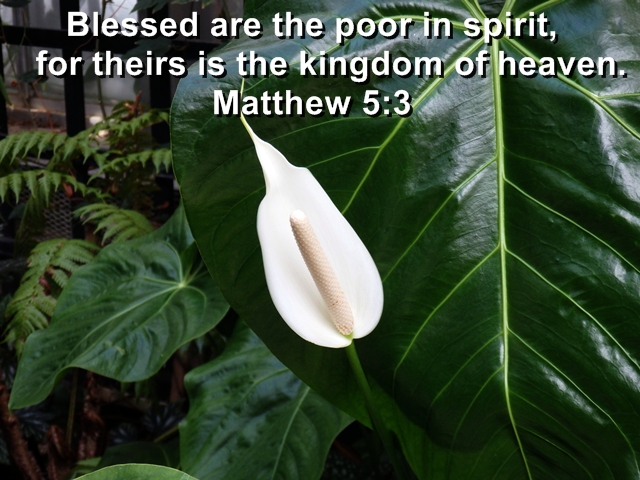
The first Beatitude speaks of those who are “poor in spirit”. Much has been made about the difference between Matthew’s language and that of Luke in Luke 6:20, for Luke merely says “the poor”. Does Matthew have more in mind than mere economic circumstances?
I’m happy to let others argue, but it seems to me that Matthew, a Jew, might be aware of the Old Testament idea of poverty not only in literal terms, but as a state of mind as well, for the Hebrew word for “poor” has this additional connotation to it. In those days, a poor person not only had to deal with bad economic circumstances, they also had to contend with the fact that they had fewer rights in society, for then as now, they lacked the resources to enforce their rights; consequently they were at the mercy of others.
Living in such a state made it clear to anyone who could fathom the notion, that the poor must depend entirely upon God. Most of us today, even those of us who don’t enjoy material abundance, live in circumstances far better than those of a poor person in ancient times, and maybe we too have a hard time seeing what Matthew means; let’s look at it this way: In our world, a person of very limited means is never far from being destitute, while a rich person has a much larger buffer to get through tough times. The poor person knows they live close to the edge; the rich person can convince himself that everything is wonderful, that he is the master of his own life, and in doing so, he only deceives himself, for God is the master of everything. We see time and again in Scripture that a rich person has a great obstacle to overcome in following God, for he thinks he is the one in control, while a poor man has no such delusion to overcome, and no great wealth to hold him back. The poor person is free to follow the Lord, while the rich person carries his wealth as a millstone around his neck; woe is he.
The kingdom of heaven is both a present reality and a future hope, for it is with us today in Christ, and will be fully realized in its ultimate fulfillment when He returns. For the person who recognizes his or her current dependence upon God for everything in life, it is a present reality indeed, and a source of great joy, “for theirs is the kingdom of heaven.”
Posted in Christian Life
Tagged Bible, Christian, Devotional, encouragement, hope, inspiration, Jesus, life, love, photos
8 Comments
Talk to Him
Posted in Christian Life
Tagged attitude, Christian, Devotional, encouragement, hope, inspiration, Jesus, life, love, photos
5 Comments