
Love

Posted in Christian Life | Tagged , , , , , , , , , | 6 Comments

Strangers in a Strange Land

All these people were still living by faith when they died. They did not receive the things promised; they only saw them and welcomed them from a distance, admitting that they were foreigners and strangers on earth. People who say such things show that they are looking for a country of their own. If they had been thinking of the country they had left, they would have had opportunity to return. Instead, they were longing for a better country—a heavenly one. Therefore God is not ashamed to be called their God, for he has prepared a city for them.

Hebrews 11:13-16

“These people,” Abraham, Isaac and Jacob and their families, lived in a time and place where the fullness of God’s promises to them had not entirely come to pass, and they looked forward to complete fulfillment to their dying day, but they did so with joy, for the fulfillment of God’s promises was never in doubt; they lived by faith. They saw from a distance, but they held on. You’ll recall that our author said that the Old Covenant worship was but an illustration, a shadow of the reality to come. Here the author uses the words “at a distance” to describe the same thing, for the reality of all of God’s promises came in the person of Christ.

There’s something really interesting developing in these verses, something that is very relevant for the original recipients of the letter, and very relevant for us as well.  Did you notice that the author keeps pointing out that they were foreigners? They were strangers in a strange land when Abraham and his household entered the promised land, for there were already people there with a different culture, different language and different values.  Abraham had followed God to a place he didn’t know, and where the inhabitants didn’t know him. But that isn’t the point the author is making. Notice verse 13, “…they were foreigners and strangers on earth.” It wasn’t just that they had left Ur and travelled to Canaan, they had left the kingdom of this earth, and entered a covenant with God. They were no longer like the other people in a way that is much more significant than mere language and culture, for they have become people of God, in an environment that was in rebellion against God. Returning to Ur wouldn’t bring them home, for they were no longer citizens there either, their orientation was now a heavenly one, and they could only look forward to the day when it became a reality.

Now, consider the implications of this upon the Jewish Christians in Rome during Nero’s persecution.  Even if they had lived in Rome all of their lives, even if the State recognized them as Roman citizens, they had been transformed into citizens of a different realm, for in Christ they had become citizens of the Kingdom of Heaven.  They were now strangers in a strange land, a land that was in open rebellion against God… and Rome was acting the part.  Rome persecuted them because they were of God now; that’s what the world does and it should surprise no one. Yet through this trial, they had thus far remained faithful to their new Kingdom, and in the course of that, they had declared a testimony for Christ, and as we now know as we study the past, the Gospel spread rapidly by their testimony of faith in Jesus even in the face of terrible persecution.  Thus, God was not ashamed to be their God.

The historical context of this is very interesting, but it also cries out to us in an important way.  What is it telling us…?  It tells us that we, too are strangers in a strange land, for no longer are we citizens of an earthly nation; we too are citizens of the Kingdom of Heaven, and we too have a role to play in its development. As Paul tells us, we are its Ambassadors here on earth; what will our testimony be?

Posted in Bible | Tagged , , , , , , , , | 9 Comments

Active Faith

Chapter 11 of Hebrews is a discourse on active faith; interesting when you consider that it comes right after the warnings of chapter 10 against losing our faith.

Who said faith and works were mutually exclusive?

That faith and works were somehow in opposition to one another is a presupposition of men, not a Biblical concept, for in the Bible, the two go hand in hand.  This is not to say that we can ever earn our salvation by works; of course not!  Salvation is by grace through faith. Yet, there is a definite linkage in the Scriptures between faith and action that many seem to miss.  I think they might miss this connection because they consider salvation the end of the story, but as we have seen time and time again, it is the beginning.

In this chapter, the author begins with a very brief discussion of what faith is:

Now faith is confidence in what we hope for and assurance about what we do not see. This is what the ancients were commended for.

By faith we understand that the universe was formed at God’s command, so that what is seen was not made out of what was visible.

Hebrews 11:1-3

Of course, we all know verse one as the classic definition of faith, and it is this faith that the Old Testament heroes were commended by God for having. It is also the faith that we have in Jesus Christ, for we are certain of His Truth even though we have neither seen nor touched Him. Verse 3 gives us an example of faith in the creation of the universe at God’s command. The universe is made of what was not seen, for no one saw Him give the command, and the universe came into being where before there was nothing at all.

Verses 4-7, which you can refer to at your leisure, refer to several Old Testament characters, and reminds us of their active faith, and then the author comes to Abraham:

By faith Abraham, when called to go to a place he would later receive as his inheritance, obeyed and went, even though he did not know where he was going. By faith he made his home in the promised land like a stranger in a foreign country; he lived in tents, as did Isaac and Jacob, who were heirs with him of the same promise. For he was looking forward to the city with foundations, whose architect and builder is God. And by faith even Sarah, who was past childbearing age, was enabled to bear children because she considered him faithful who had made the promise. And so from this one man, and he as good as dead, came descendants as numerous as the stars in the sky and as countless as the sand on the seashore.

Hebrews 11:8-12

When God called Abraham to pack up the household and leave his homeland, he had no idea where he was going, but he went because he had faith. (Action) When he finally arrived in the promised land, he made his home there even though he was a stranger in that place and knew no one, because he had faith in God and His promises. (Action)  Abraham and his descendants were confident in God’s promises of a great nation, and they acted accordingly. Abraham believed God actively, and as a result Sarah bore him the son of promise and because of Abraham’s active faith, God fulfilled His promises, in spite of Abraham’s mistakes and miscues.  This is what faith can do when coupled with God’s covenant promises.

Why do you suppose the author took this detour from the rest of the letter, and why here?

Let’s consider the structure of the letter first.  In chapters 8-10:18 we saw an amazing recitation of all that God has done for us in Christ, with the superior high priest, superior sacrifice, bringing about a superior covenant with superior promises. We also saw how all of this replaced the old shadows of the old ways.  This was followed by a section of warnings, and now faith.  This all makes perfect sense, because all that the author has been sharing was there to help the recipients of the letter hold on to their faith in terrible times of trial. At such a time, more than in normal times, it would have been critical for them to understand that their faith is active rather than passive, for none of the characters discussed in this chapter were mentioned because of the way they clung to their faith while sitting at home on the couch.  They are all heroes of faith because they put their faith into action.

As we continue in the next post, we’ll see the application of this faith in something wonderful; see you then!

Posted in Bible | Tagged , , , , , , , | 8 Comments

More Warnings

Remember those earlier days after you had received the light, when you endured in a great conflict full of suffering. Sometimes you were publicly exposed to insult and persecution; at other times you stood side by side with those who were so treated. You suffered along with those in prison and joyfully accepted the confiscation of your property, because you knew that you yourselves had better and lasting possessions. So do not throw away your confidence; it will be richly rewarded.

Hebrews 10:32-35

We continue now with the warnings in chapter 10. Remember the context;  Hebrews 10:19-39 is the section context in this letter written to Jewish Christians in Rome during the persecution of Nero to encourage them to hold on to their faith in severe trial, and following right after a section on the superiority of the New Covenant.

The author refers to an earlier persecution, a time of trial almost as difficult as the present one, when these Christians had come through with their faith intact, and then he urges them to continue to hold on through the present crisis promising them a rich reward.  We might ask ourselves what this reward is to be, is he referring to a temporal reward or an eternal one?  In context, it must be an eternal one why? Because that is the reward that has been under discussion leading up to this section; there has been nothing in the text to tell us differently, thus that context remains in place. If we attempt to impose a different meaning here, then we might satisfy our doctrinal need to reinterpret this section, but we will have the wrong application for the text.

You need to persevere so that when you have done the will of God, you will receive what he has promised. For,

“In just a little while,
he who is coming will come
and will not delay.”
And,

“But my righteous one will live by faith.
And I take no pleasure
in the one who shrinks back.”
But we do not belong to those who shrink back and are destroyed, but to those who have faith and are saved.

Hebrews 10:36-39

Verse 36 keeps the last three verses of the chapter in context as an exhortation; this is critical to our understanding of 37-39.  Verse 37 tells us that Jesus is surely coming soon (so hang in there, hold on to your faith). Verse 38 tells us that the righteous will hold on to their faith, and yet some will shrink back and lose out, and verse 39 encourages us all to continue in our faith and not shrink back, for to shrink back will result in our destruction.  Notice that “destruction” is contrasted with “saved.” We are only left with one last question: What is destruction?

But we do not belong to those who shrink back and are destroyed, but to those who have faith and are saved.

Hebrews 10:39

It would seem entirely consistent with the context of this passage within the letter to the Hebrews, and within the New Testament, that our author is telling us that we could lose everything we have in Christ.

This chapter falls at the high point of the letter.  We’ve seen that our superior high priest has brought a superior sacrifice to establish a superior covenant based on superior promises.  We’ve seen that the old Law is gone, and that the New has come, and that the New is the reality that was only illustrated by the Old. We have learned that we can enter the Most Holy Place, the very presence of God with confidence,  and we have been warned to hold on to what we have in Christ, even in very difficult times, because what we have is so great and so wonderful that nothing can compare with it.

This is a message of love and encouragement, not a threat or a warning about a God who wants to zap you!  Some have suggested that this passage is too harsh, others have suggested that it must be adapted to fit a doctrine:  Why? Too harsh Really? Would we have God hide things from us and then fall away out of ignorance?  That would be the actions of a God looking for a “gotcha” moment, not a God of love.  Doctrinal traditions… would we really rather use this for an argument to be “right” about something that may or may not be right, when it is a message of encouragement?  Really?

All we have in the passage is a message that our hope is awesome, so hang on to your faith come what may, and you will be in an amazing place for all eternity… this strikes me as wonderful! You know why? Because I can do it, and so can you. This is not a burden, at least not until we make it one.  This isn’t negative; it’s positive… until we make it negative… and it certainly isn’t complicated until we impose our doctrines upon it and make it complicated… so why do that?

Here’s a challenge for you, just for fun: Forget everything you’ve heard and everything you’ve read, including what you’ve read here.  Then go back and read chapter 10 over again, verses 1-39. Don’t think about anything it doesn’t say… and then see if you haven’t just read the most amazing and encouraging thing ever!

Posted in Bible | Tagged , , , , , , , , | 3 Comments

Warnings

If we deliberately keep on sinning after we have received the knowledge of the truth, no sacrifice for sins is left, but only a fearful expectation of judgment and of raging fire that will consume the enemies of God. Anyone who rejected the law of Moses died without mercy on the testimony of two or three witnesses. How much more severely do you think someone deserves to be punished who has trampled the Son of God underfoot, who has treated as an unholy thing the blood of the covenant that sanctified them, and who has insulted the Spirit of grace? For we know him who said, “It is mine to avenge; I will repay,” and again, “The Lord will judge his people.” It is a dreadful thing to fall into the hands of the living God.

Hebrews 10:26-31

Our author gets off to a very candid start in this paragraph, coming right to the point of his warning.  You will recall no doubt, that this letter was written to Jewish Christians in Rome during the persecution of Nero for the purpose of encouraging them to hold firmly their faith through a time of severe trial, and this is not the first such warning in this letter. (see Hebrews 8:1 ff.)

I would call your attention to the word “we” in verse 26; “If we deliberately keep on sinning…”  Surely the word “we” does not mean the same thing as the word “they.”  Thus, in a context of a letter written to encourage Christians, “we” is not referring to those who are not in Christ, and to suggest otherwise requires the suspension of the rules of context, grammar and vocabulary.  If we would go further and suggest that “after we have received the knowledge of the truth” would refer to an unbeliever, saying that to receive the knowledge of the truth is not to have accepted it and been born again, because they knew but didn’t believe, would also seem to be a contention in utter disregard of the rules of context, grammar and vocabulary; a parsing of words worthy of a politician. Must I really comment on the words “enemies of God”?

How much more severely do you think someone deserves to be punished who has trampled the Son of God underfoot, who has treated as an unholy thing the blood of the covenant that sanctified them, and who has insulted the Spirit of grace? Can you think of any context in the New Testament that asserts that an unbeliever is sanctified by the blood of the Covenant?  Take a look at the next verse, v. 30, and consider what it means to know God; hey didn’t Jesus have something to say about that in John 8:55? Notice here that “we” are they who “know” him who said…  Who is this “we” again unbelievers? Hardly.

Look, I know I’m laying it on more thickly than I normally do here, and I’m doing so for a reason. If we want to merrily go on down the road with the idea that these warnings are for “them” and not “us” then how can we learn from them? What is the point of giving these warnings to Christians, if they apply only to non-Christians? What would be the purpose of these warnings, if we have nothing that we can lose the whole letter would be almost meaningless to the people it was written to.

Are these warnings uncomfortable? Yes they are, and yes they should be. Would I rather not think about them? Yes, but how could I learn and grow if I only did what I want and only thought about the fun stuff?  Can you see why I keep saying that Hebrews is often quoted and seldom taught?  It gets messy!

Posted in Bible | Tagged , , , , , , , , | 19 Comments

Unswerving Faith

Therefore, brothers and sisters, since we have confidence to enter the Most Holy Place by the blood of Jesus, by a new and living way opened for us through the curtain, that is, his body, and since we have a great priest over the house of God, let us draw near to God with a sincere heart and with the full assurance that faith brings, having our hearts sprinkled to cleanse us from a guilty conscience and having our bodies washed with pure water. Let us hold unswervingly to the hope we profess, for he who promised is faithful. And let us consider how we may spur one another on toward love and good deeds, not giving up meeting together, as some are in the habit of doing, but encouraging one another—and all the more as you see the Day approaching.

Hebrews 10:19-25

After the wonderful news of the last couple of chapters, the author is moving us toward another series of warnings, and his transition in these verses is as inspiring as any appeal in the entire New Testament.  We have a confidence gained from the previous discussion of the superior high priest who has brought us a superior sacrifice to bring about a superior covenant based on superior promises, and as a result we can ourselves enter the Most Holy Place.

Imagine how this would have sounded to the original recipients… Remember, they were Jewish Christians living in Rome at the time of Nero’s terrible persecution, tempted to give it all up to avoid the Emperor’s wrath, but after reading these chapters and now coming to this incredible assertion… how can they turn their backs on Jesus?  Oh yes, very persuasive!

Yes, we have an entirely new way, a way right into the holy presence of God, a way that their ancestors couldn’t have imagined, and it is here now… and yes, here it comes: “Let us hold unswervingly to the hope we profess, for he who promised is faithful.” How could they let all of this go? They have in their hands the keys to the Kingdom, what could Nero do to them to make this worth giving up? Then the author takes the next step, a very dangerous one…  Not only should they hold on, they should seek out ways to encourage others, and as if this weren’t enough, they should not give up meeting together.

Let’s stop and consider this point.  It was dangerous enough to simply be a Christian in those days, but meeting together was infinitely more dangerous than that.  A group of believers in worship can bring attention, can be noticed. It can result in somebody reporting that they saw you with the others; guilt by association could result.  Some had apparently quit meeting for these reasons, but our author urges them to continue, to persist no matter the cost, for what they had in Christ was so worth it.  Even more as the Day approaches…

The Day, as we saw earlier, refers to Jesus’ coming again, and as we know, He didn’t come in their lifetimes.  We can also reasonably infer that we are about 2,000 years closer to His return in our day, yet we still don’t know when His return will happen.  Most of you who read this are not in places where there is persecution. For us this should be so easy, it shouldn’t even be an issue, and yet more and more have forsaken the assembling of the believers together.  Even among those who have not forsaken it, how much do we really encourage others?

Since I can only answer for myself, I guess we’ll leave that as a rhetorical question…

Posted in Bible | Tagged , , , , , , , , | 2 Comments

Photo of the Week: September 8, 2016

Posted in Photo of the Week | Tagged , , , , , , | Leave a comment

Once for All

The law is only a shadow of the good things that are coming—not the realities themselves. For this reason it can never, by the same sacrifices repeated endlessly year after year, make perfect those who draw near to worship. Otherwise, would they not have stopped being offered? For the worshipers would have been cleansed once for all, and would no longer have felt guilty for their sins. But those sacrifices are an annual reminder of sins. It is impossible for the blood of bulls and goats to take away sins.

Hebrews 10:1-4

The author of Hebrews is now wrapping up this central core section of the letter, and he is doing so by once again focusing on the superior sacrifice that Jesus brought to establish a superior covenant with superior promises. Again, he states that the Law is merely a shadow of a reality to come, stating again that its sacrifices cannot take away sin. In fact, he seems to have found three ways to restate this in just a few short sentences here.  I’ve never actually gone through these chapters and counted the number of times he’s made this same point… why?  It might just be that this point takes a lot of repetition before we comprehend it.  The Law was not sufficient to complete God’s purposes, so it has been replaced by a better system, a perfect one, that takes our sins away entirely, after all, the Law was but an illustration of what was to come, and what was to come was the reality of Jesus Christ.

Therefore, when Christ came into the world, he said:

“Sacrifice and offering you did not desire,
but a body you prepared for me;
with burnt offerings and sin offerings
you were not pleased.
Then I said, ‘Here I am—it is written about me in the scroll—
I have come to do your will, my God.’

Hebrews 10:5-7

After the restatement of the Law’s inadequacy in the first 4 verses, this quotation from Psalm 40 shows the attitude of Christ, the real sacrifice, who gave up His life as the sacrifice that would end the problem of sin once for all.

First he said, “Sacrifices and offerings, burnt offerings and sin offerings you did not desire, nor were you pleased with them”—though they were offered in accordance with the law. Then he said, “Here I am, I have come to do your will.” He sets aside the first to establish the second. And by that will, we have been made holy through the sacrifice of the body of Jesus Christ once for all.

Hebrews 10:8-10

Acting as commentator, the author restates another of his themes: The first covenant was set aside to make room for the second, and by that second covenant, the New Covenant, we have been made holy by the removal of our sins in Christ.

Day after day every priest stands and performs his religious duties; again and again he offers the same sacrifices, which can never take away sins. But when this priest had offered for all time one sacrifice for sins, he sat down at the right hand of God, and since that time he waits for his enemies to be made his footstool. For by one sacrifice he has made perfect forever those who are being made holy.

Hebrews 10:11-14

You’ve probably noticed that the mere fact of the repetition of the old sacrifices has been used by the author to make the point that they could never take away sins, and here that is one more time, set beside the contrasting one time sacrifice that Jesus made. This fact alone, repetition of the same sacrifices, day after day, year after year, is proof enough that this system is finished… yet so many miss it even now! Jesus, after making His sacrifice has sat down on high and awaits his enemies being made His footstool which is some interesting imagery, for sure. His enemies are defeated, and upon His return, their activities will cease once and for all time, becoming as a footstool for His feet.

The Holy Spirit also testifies to us about this. First he says:

 “This is the covenant I will make with them
after that time, says the Lord.
I will put my laws in their hearts,
and I will write them on their minds.”
Then he adds:

“Their sins and lawless acts
I will remember no more.”
And where these have been forgiven, sacrifice for sin is no longer necessary.

Hebrews 10:15-18

Once again, we see the verses from Jeremiah 31 foretelling of the New Covenant that was to come, and now has come, and notice the final sentence, the author’s summation of these chapters. Sin has been forgiven, and further sacrifices are no longer necessary: The Old Covenant is over.

When the same things are repeated over and over again, it is incumbent upon us to take notice of them. This repetition isn’t simply poor writing style, if anything, the letter to the Hebrews of Rome is one of the best written of all the New Testament books; some of the phrasing is nothing less than brilliant.  No, the repetition is a literary device to underscore these points, to highlight them; the author really wants the people to remember them, and hopefully we will remember.

Posted in Bible | Tagged , , , , , , , | 5 Comments

Last Will and Testament

In the case of a will, it is necessary to prove the death of the one who made it, because a will is in force only when somebody has died; it never takes effect while the one who made it is living. This is why even the first covenant was not put into effect without blood. When Moses had proclaimed every command of the law to all the people, he took the blood of calves, together with water, scarlet wool and branches of hyssop, and sprinkled the scroll and all the people. He said, “This is the blood of the covenant, which God has commanded you to keep.” In the same way, he sprinkled with the blood both the tabernacle and everything used in its ceremonies. In fact, the law requires that nearly everything be cleansed with blood, and without the shedding of blood there is no forgiveness.

Hebrews 9:16-22

The Hebrews author is continuing his contrast between the Old Covenant and the New, but here he takes an interesting twist, one that I would never have thought of is this last will a metaphor, or is it literal?  I’ll let you decide as we go along…

Clearly a will has no impact on anything until the person who made it dies.  Then we go through a descriptive reminder of the oath swearing ceremony at the inception of the Old Covenant, with all of the people parading past and being sprinkled with the blood of the sacrificed animals, and the sprinkling of the various objects of the tabernacle.  This served a dual purpose by most accounts, first that of the actual oath swearing, which can be compared to signing a contract, for it is the point at which the people voluntarily entered into relationship with God.  It symbolized this oath: If I do not obey the terms of this covenant, then so shall it be with me, or to be blunt, if I don’t keep up my end of the deal, I give permission for my own blood to be spilled. The second purpose was the ritual of cleansing, as was discussed in the previous verses in the last section, in the case of the Old Covenant these are outward acts and cleansing, not inward ones. God also swore an oath when the carcasses of the sacrificed animals were consumed by fire.

My question for you is this: OK, so who died that the Old Covenant should take effect?

It was necessary, then, for the copies of the heavenly things to be purified with these sacrifices, but the heavenly things themselves with better sacrifices than these. For Christ did not enter a sanctuary made with human hands that was only a copy of the true one; he entered heaven itself, now to appear for us in God’s presence. Nor did he enter heaven to offer himself again and again, the way the high priest enters the Most Holy Place every year with blood that is not his own. Otherwise Christ would have had to suffer many times since the creation of the world. But he has appeared once for all at the culmination of the ages to do away with sin by the sacrifice of himself. Just as people are destined to die once, and after that to face judgment, so Christ was sacrificed once to take away the sins of many; and he will appear a second time, not to bear sin, but to bring salvation to those who are waiting for him.

Hebrews 9:23-28

Now the contrast of the New Covenant: Jesus needed better sacrifices for the New Covenant, since it is the reality that the Old Covenant merely illustrated. Once again, the author points out that High Priest Jesus did not enter the Most Holy Place in a Temple that was a copy, but that He entered the real Temple that is in the actual presence of the Father in heaven, and He brought with Him a different sacrifice altogether. Jesus Himself was the sacrifice. He was sacrificed once for all time, and this was possible because He was not a goat or a calf or a lamb, He was the Son Of God. As our author makes so very clear here, there is one sacrifice that counts, and that was the sacrifice of Jesus; the Real Deal.

So, who died, that all of God’s promises might come into effect in reality and truth? …………Got it? Yep, it was Jesus!

Wait! No! What about the Old Covenant, who died to put it into effect?

Really? Do I really need to answer that one?

OK, fine… it was no one. Remember, the Old Covenant was only a picture, a poor copy of what would come later, so at the time the author described in verses 16-22, calves stood in for the oath swearing; no one died. When Jesus died on the cross, He fulfilled all of God’s promises, bringing from illustration into present reality.

There’s only one question left to complete the picture, and that is: When do we have our oath swearing ceremony, coming into contact with the blood of the New Covenant sacrifice?

Posted in Bible | Tagged , , , , , , , | 10 Comments

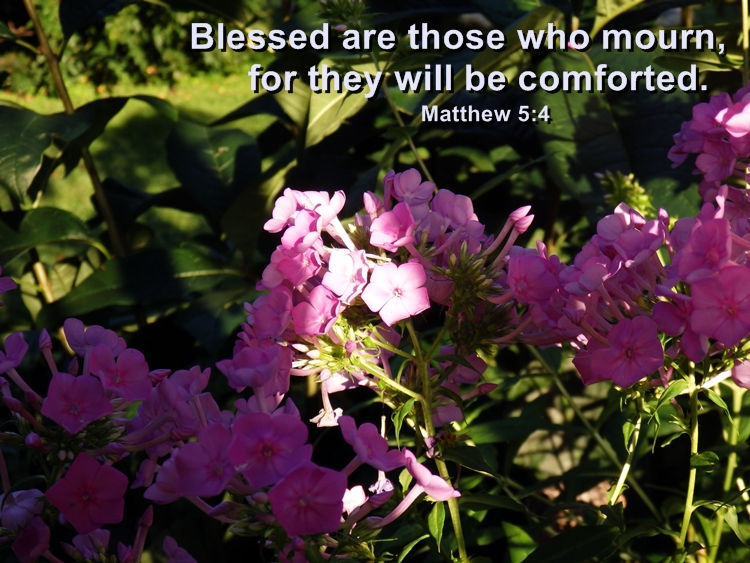
Those Who Mourn

Most of the time, we don’t associate blessing with mourning; maybe we should rethink this… Matthew didn’t actually say what those blessed ones are mourning; it could be the loss of a loved one, it could be the loss of their home or possessions, or it could be the sinful and rebellious state of this world. Maybe it doesn’t matter…

I think it is safe to say that for a person to truly mourn they first had to love; certainly this would be true in the loss of a loved one. It would also be true if a person is mourning the loss of possessions, for if they didn’t love the possession(s) lost, would they actually mourn?

It wouldn’t seem so.

If the person was mourning for the wickedness of this world, wouldn’t that show they loved God a whole lot?

Consider for a moment those who do not mourn; what a terrible and sad life they must lead! Never having enough of a relationship with anyone for love to develop; never being able to mourn? Never having a loving relationship with God so as to mourn for those who rebel against Him?

Never loving never mourning?

Those who mourn will receive comfort from God, both in the here and now and in the ultimate future when all pain and sorrow will cease. I don’t know about you, but for me, just knowing this is a comfort that brings joy into my life.

Posted in Christian Life | Tagged , , , , , , , , , , | 20 Comments