Ecclesiastes: The Prologue

Ecclesiastes 1:1-12

And so dear reader, we begin our most excellent adventure through the book of Ecclesiastes. After identifying Solomon as the “Teacher” of this lesson, the theme of the entire book is set forth in verses 2-3: The works of men are meaningless. The latest NIV uses the word “meaningless” here where other translations, certainly the older ones, have used the English word “vanity,” and I must admit that I’ve had some difficulty getting used to the change. The Hebrew word is hebel which literally means vapor or breath. Used as it is in this book, what it really refers to is something that is fleeting and empty; without meaning. “Vain” or “vanity” would be the traditional words for this, as in “they shall not have died in vain” meaning “for no reason.” So, I must admit that the new Niv’s “meaningless” is spot on in modern usage.

“Meaningless! Meaningless!”
says the Teacher.
“Utterly meaningless!
Everything is meaningless.”

What do people gain from all their labors
at which they toil under the sun?


We need to note the expression “under the sun” and understand that it tells us the point of view from which the author is speaking: life “under the sun,” here on earth, the natural state of things without God. As you will see, he writes differently when he changes his viewpoint to include God. Thus, the whole theme of the book is that all of human striving and energy in this world has no meaning whatsoever.

Verses 4-8 give four examples from nature to back up the author’s thesis:

First, in verse 4, he mentions succeeding generations as coming and going, verse 5 mentions the rising and setting of the sun over and over, then verse 6 speaks of the wind that blows and blows. Verse 7 mentions the rivers and streams that flow and flow; time marches forward and what is accomplished? Verse 8 seems to sum this up as simply wearisome, as though there is all of this natural activity… and so what?

Verses 9-11 amplify this unceasing action of nature and brings it into human terms: “There is nothing new under the sun.” The generations have always come and gone, the sun has always risen and set, the wind has always blown and the rivers and streams have always flowed; none of this is new. Nobody remembers the former generations of people, and nobody will remember us. In all of these generations, people have worked and striven to accomplish great things, and who even remembers their names or what they were about?

Who cares?

Nobody!

The Christian faith is essentially an optimistic faith, we speak of victory, and redemption, hope, assurance and an eternal future… see any of that here? Of course this is the Old Testament, but Judaism is also an optimistic faith for the most part; where is this dude coming from?

That’s why this is a tricky book.

As we continue our adventure, we will see that the Teacher has searched for human wisdom, that he has received it, and that he has discovered that human life “under the sun” isn’t all it’s cracked up to be. Without God, it is meaningless… but then I’m getting ahead of myself.

Solomon, through all of his striving for wisdom has discovered to his surprise that putting this world into its proper perspective is a process that calls all of our natural inclinations into question, and that without an alternative; the quest for wisdom would best be avoided. To put this another way, reading this might cause us to wonder if the day-to-day struggles of this life are really all that important.

Verse 12 is transitional, and leads to the main body of the book, which we will throw ourselves into next time!

Posted in Bible | Tagged , , , , , , , | 19 Comments

A Brief Introduction to Ecclesiastes

As we begin our adventure through Ecclesiastes, we should set out a little background information about it. First of all, I want to be very up front with you: This book is a little tricky, so we need to be very careful about things like context. If we don’t keep the context straight, then we will come away with a long list of contradictions with the rest of Solomon’s writings, not to mention the rest of Scripture. Thus, we must first and foremost bear in mind that this is a book of personal reflections, most of which are not intended as godly counsel or direction. If we aren’t clear on that, and we decide to interpret this in a strictly literal sense, than by the time we are half way through, we will simply give up on life and look for a bridge to jump off of, or a psychiatrist to medicate us. This is not the intent of the book, and it is why I have called it a “tricky” book.

To understand this more fully, let’s take a quick review of the career of Solomon, the book’s author. King Solomon reigned over Israel for 40 years, following in the footsteps of his father, King David. His reign was the high water mark for ancient Israel, being as it was a time of unparalleled power and prosperity. In the early days of his reign, Solomon had a very close relationship with God, received a special gift of wisdom and wrote the Song of Songs. As time passed and Solomon’s storehouse of wives and riches continued, he began to fall away from God, and his apostasy began to show up among his subjects. As a mature man, he penned the Proverbs, sharing much of the wisdom God had granted him. Although the historical books don’t provide a great deal of data on Solomon, they do indicate that he entered a period in which he was, well let’s just say he wasn’t quite right in his thinking, but began to restore his relationship with God, and although his relationship was never again what it had been, he seemed to come to terms with God in his last years. This is when he wrote Ecclesiastes, and it clearly reflects the results of his searching for wisdom and the trials that this search brought upon him. As you might suspect, this is reflected in the structure of the book.

Ecclesiastes has three sections: A prologue (1:1-11) which introduces the book’s main themes, the body (1:12-12:8) which consists of a long monologue outlining Solomon’s search for the meaning of life, and a brief epilogue (12:9-14). The prologue and epilogue are distinguished from the main body by the use of the third person reference to Koheleth (which means “preacher”), and in this respect mirrors the structure of Job.

The aspect of this book that we must always bear in mind is that throughout, Solomon writes from two entirely different points of view. One is the viewpoint of natural man, and the other is from the viewpoint of divine insight. The natural man’s view of life is skeptical and pessimistic (all is vanity) while the divine view is steadfast and hopeful. Obviously, mixing these two up is what results in chaos and confusion for a reader. An example of Solomon’s two points of view is found in 12:11 where he speaks of this negative and positive commentary under the metaphors “the gods” for the negative and “nails” for the positive. As we go through the book, I’ll point out more along these lines, and we won’t be confused.

I have written many times here of the futility of trying to find Truth through human wisdom, pointing out that Truth is to be found in the One who is “the way, the truth and the life.” As you will come to understand, old King Solomon spent a great many years and a whole lot of trouble and anguish to learn this vital lesson.

When we get back together, we will begin our journey by taking a look at the prologue, and our most excellent adventure will begin!

Posted in Bible | Tagged , , , , , , , | 4 Comments

A Couple Things…

You may have noticed that we’ve finished our posting on John’s Gospel earlier today.

So, what’s next?

Tomorrow morning, I thought we’d start a new adventure, this time in the Book of Ecclesiastes, and what an adventure that will be! Please make your plans to join us on a most excellent adventure into an often misunderstood little bit of wisdom.

I also wanted to take this opportunity to let you know that I have also added new versions of both Hebrews and John to my website. If you would like to download them, you can find Hebrews HERE and you can find John HERE… or if you want them both, simply click the “Reflection Series” picture on the right column on my blog page. As always, both are free of charge.

Posted in christian | Tagged , , , , , , | 4 Comments

A Final Thought from Our Study of John

When I was a boy, I read a book about the life of Jesus, and it really got my attention. As I thought about it, and as I thought about this Jesus guy, I really had no problem believing that He was the Son of God, and it occurred to me that I should try to be more like Him, but there was one thing about Jesus that kind of bothered me: He cheated!

To my nine-year-old mind, Jesus cheated when He went to the cross because after all, He was God… and He knew how the story was going to end; that’s cheating! It was almost as if it didn’t count if He knew all the things that He clearly knew before He allowed Himself to be taken prisoner. Gee whiz, I would do the same thing if I knew all that stuff.

Yes, to be young again…

When I was a teen, that attitude stuck with me, in fact, I didn’t really see the implication of this until I was n my 30’s; yes Jesus knew how the story ended, and He went to the cross knowing that the story wasn’t nearly over yet. He would suffer greatly for a time, and then…? Victory, honor, glory, reigning…

John says that he wrote the gospel so that many might come to believe in Him, and many have done so, but how deep is our belief? Ah yes, an uncomfortable question, surely, for some of us might believe like I used to, accepting the basic facts, and still holding something back.

My thinking changed one day when reality hit me like a freight train: Yes, Jesus knew how His story would end… and so do I know how my story ends; victory, honor, glory!

Jesus knew He would rise from the grave, and so will I.

Jesus knew He would ascend to Heaven, and so do will I.

Jesus knew He would suffer for a short time, and so will I.

Jesus knew He would reign as King of kings and Lord of lords, and I know that I am co-heir with Him.

Because Jesus knew these things, He did His Father’s will, will I do the same?

Dear reader, this is where we come to the always inconvenient question: Do we really believe that what we believe is really real?

It is one thing to accept the basic facts on an academic or theoretical level, but will we allow them to affect who we are on a fundamental level? Well, will we?

We will if we really believe that what we believe is really real.

Posted in Bible | Tagged , , , , , , , , , | 14 Comments

“Do You Love Me?”

SONY DSC

John 21

Chapter 20 is John’s record of events concerning the risen Christ in Jerusalem; chapter 21 is John’s story from Galilee.  Why the disciples had traveled there isn’t given, but it makes sense that they wouldn’t be staying on in Jerusalem after all of the recent events.  I would imagine that the disciples weren’t entirely sure what to do with themselves after following Jesus for over three years…  The scene opens with a cast of seven disciples near the Sea of Galilee when Peter announces that he’s going fishing.

Note that John refers to the “Sea of Tiberius” which is another name for the Sea of Galilee in those days.  Tiberius is the name of a large town, which in those days was a new Roman town located on the shore of the lake.  Today it is the largest city in the area.  The guys all joined Peter in the boat for a night of casting the fishing net, but their results were lacking entirely, and by early morning there was a man on the shore who noticed their bad luck.  John identifies this man as Jesus, although they could not yet recognize Him from the boat.

From the beach, Jesus calls out to them and recommends that they cast their net on the other side of the boat.  A fishing boat of the time would normally remain close to shore and cast on the shore side to get the best catch of fish, so most likely Jesus was telling them to try the lake side instead, and what a payoff!  They caught so many fish that they couldn’t haul it into the boat.  John realizes that it was Jesus who was on the shore, and Peter grabs his clothes and jumps into the water swimming to shore leaving the others to tow the nets to land. When they arrive, it seems that Jesus had a campfire going and was cooking breakfast. Jesus had a menu of bread and fish, something that we’ve seen Jesus do before, but this time, instead of the disciples rounding up fish and loaves that Jesus multiplied, Jesus has fish and loaves and the catch of the disciples will be the multiplier; Jesus has passed the torch, you might say.

John provides us with some eyewitness details in this portion of the text: there were 153 large fish in the net, Peter drags it ashore and Jesus is not only the cook, but the server.  Interesting isn’t it?  A guy who was executed, dead and buried is putting on a fish fry!  He is no ghost, for I can’t recall a single time when I’ve ever heard of a ghost eating fish:  Jesus had arisen from the grave bodily.

After their meal, Jesus walks off a distance with Peter and asks him three times if he loves Jesus.  Each time Peter assures Him that he does, but by the third time Peter’s feelings were hurt because Jesus kept asking.  Much has been made of the Greek used here, but it seems to me that Greek nuance isn’t the point that Jesus is making.  Peter had denied Jesus three times on the night of His arrest, and Jesus asks him three times if he loves Him.  Could it be that that had dawned on Peter?  Could it be that Peter felt terrible guilt over his cowardly denial?  Let’s not forget that this is the first time that they had been off together since Jesus’ death, and Jesus has some business to settle with him.  Peter must learn to care for the other followers of Jesus, His “sheep,” and this means taking the charge seriously and selflessly, a lesson that must not be lost on all leaders of the church today.

In v. 18 Jesus gives Peter some insight into the manner in which he would die as a martyr for the Gospel, as John points out in v. 19, and then says: “Follow me!”  This is the same imperative with which Jesus began His ministry in 1:43 and sets the tone for the conclusion.

At this point, Peter notices John following behind them and says “What about him?” Jesus is not having any of this; it would have been better if Peter had said something more like, “Yes sir!” Jesus lets Peter know that whatever He has in mind for John is none of Peter’s business, for Peter’s call is to follow Jesus.  None of us is in a position to know what adventures we will experience in following Jesus, but we must know that our call is to follow Him, and not to question whether or not someone else might have an easier time of it, and Jesus makes this abundantly clear. Peter’s imperative was to “follow” Jesus, and so is ours.

Posted in Bible | Tagged , , , , , , , , | 16 Comments

The Tomb is Empty!

2djrysn-lp

John 20

Last time, our lesson closed when Pilate finally sent Jesus away to be crucified.  Now we pick up the story after the crucifixion has been completed, on the first day of the new week with Mary Magdalene who went to the tomb very early, while it was still dark and found that the tomb was open and the body of Jesus was gone.  John has already used “darkness” in this Gospel as a metaphor for disbelief several times, and this is no different, for upon discovering the empty tomb neither Mary nor Peter and John believed that it indicated Jesus had risen from the dead, for they had not grasped this concept in advance. As the sun rose and light began to spread across the land, this would change…

The drama begins early in the morning, before sunrise when Mary Magdalene finds the tomb empty.  She rushes to tell the disciples that the body has been moved or stolen and Peter and John race to the scene where they confirm that the body is gone.  John completes this part of the story by pointing out in v. 9 that none of them understood from Scripture that Jesus would rise from the dead.  I might point out that they also didn’t understand this from the things that Jesus had told them.  It would be beneficial for all of us to understand that we have the same problem today very frequently because we are used to thinking in earthy terms.  Very few Christians today, at least in America, have what could be called a Biblical world view, instead most of us have a cultural or secular world view which inhibits our ability to see things as they really are, and we need to be aware of this to avoid misinterpreting not only Scripture but the world around us. As for Scripture in this regard, take a look at what Peter said in Acts 2:25-32: Obviously, he understood what Scripture taught on this point by the Day of Pentecost.

Mary had found the tomb empty, had run back to tell the disciples, Peter and John had come running and confirmed the tomb was empty… and had in turn gone back to their homes leaving Mary at the scene crying.  Still crying, she looks into the tomb again and this time sees two angels inside; there is nothing in the text to tell us that she understood that they were angels.  They ask her why she is crying, and her reply demonstrates that she has no concept of their double meaning; she is crying because someone has stolen the body.  She did not comprehend the second meaning that there should be no cause for crying any longer: He has risen! She turns and sees Jesus standing there but does not recognize Him.  Her lack of recognition is interesting, for it shows us that there is nothing remarkable in His appearance.  That she doesn’t realize who He is shouldn’t be that shocking, for I cannot recall a time in my own life in which I would ever expect to see someone walking around and talking when I had gone to visit their grave.  She assumes He is the gardener.

Jesus asked her why she was crying and then who she was looking for, a question He had already asked twice on the night He was arrested.  She answers Him by asking about the whereabouts of the body.  Jesus calls her by name; the shepherd “calls his own sheep by name and leads then out” (10:3). Immediately she is “called out” of her unbelief!

Jesus says a curious thing at this point, “do not hold on to me.”  A close look at this reveals that His meaning is something like: Do not try to hold me here on earth for I have to return to my Father (go to prepare a place for you 14:2) go and tell my brothers that I am going to prepare their co-inheritance.  She returns and tells them these things; note that John goes to lengths to make sure we know who was the very first to give testimony about having seen the risen Christ.

The scene shifts from the tomb to a place in town where the disciples, excluding Thomas, are gathered behind closed and locked doors: Suddenly Jesus is in their midst. He simply says “shalom” and lets them see His wounds; they are thrilled!

This is no social call; Jesus is all business, giving them three pieces of vital information.  First, He tells them that He is sending them out just as the Father has sent Him.  They are to carry on His mission of salvation into the world, now that they have seen all that they had seen.  Second, He breathed on them and told them to receive the Holy Spirit.  This appears to be a foreshadowing of the Day of Pentecost.  It appears to be a foreshadowing as there is no apparent reaction to this act yet, but when the Spirit is poured out in Acts 2 the reaction is dramatic. Third, He gives them an awesome charge saying that if they forgive anyone their sins they are forgiven, if not they are not forgiven.  Obviously much has been written and speculated upon with regard to this, but I can’t help thinking about what Jesus told the disciples in Matthew 16:18 ff. saying that “whatever you bind on earth will be bound in heaven, and whatever you loose on earth will be loosed in heaven.” I can’t help noting that it was Apostles who wrote what would be required to enter into a covenant relationship with Jesus in the New Testament…

20:24-31 is the story of “Doubting Thomas” who had stated that he wouldn’t believe that Jesus had arisen from the dead until he put his fingers into the wounds on his body.  Jesus suddenly appears in the room and offers Thomas the chance, Thomas replies with a hugely significant statement of faith: “My Lord and my God.” This is of course the highest statement of faith found in the New Testament, theologically speaking, equating Jesus not only as Lord but also as God.  Jesus quickly bursts his bubble by pointing out that anybody with a brain would understand that with what Thomas has seen, but many more will come to that understanding based only upon the testimony of others. John ends the chapter by telling the reader the purpose for the book:  Many wonderful things were done by Jesus that are not recorded here, but what is recorded is recorded so that the reader might come to the same conclusion based upon John’s eyewitness testimony that Thomas came to by seeing Jesus after the resurrection.

Posted in Bible | Tagged , , , , , , , , | 11 Comments

The Verdict

meln8ve-lp

John 19:1-16

These verses comprise one of the most amazing narratives in all of world literature.  They tell a terrible story of betrayal, hypocrisy, and weakness, evil and hate, yet through this quagmire of politics, dishonesty and intrigue God’s great eternal purpose is assured.  Irony?  That would be putting it mildly! These verses tell the story of Jesus’ condemnation to the cross, a story in which there are no heroes, villains aplenty and in which the system of this world is manipulated to condemn the very Son of God by the most religious of all God’s people:  It is shameful, penetrating and a source of great insight into the motivations of those who will oppose God.

After Pilate’s attempt to free Jesus was thwarted in favor of Barabbas (18:39-40) Pilate orders Jesus flogged, a very severe application of torture that would precede crucifixion or that could be a form of punishment on its own.  These verses describe briefly the treatment that Jesus suffers at the hands of his soldiers and the “fun” they have with Him, and then Pilate goes back out to the mob to once again attempt to release Jesus.

Pilate has told them he can find no basis for a charge against Jesus, and when Jesus appears he makes his fateful statement, “Behold the man” (KJV). What the crowd was “beholding” was a man broken by torture.  Bleeding, beaten, bruised and in a condition fit only for the Emergency Room, there stood Jesus not looking like much of a threat to anyone.  The bloodthirsty crowds led by their holy religious leaders go crazy demanding His crucifixion. It could be that Pilate thought they would be appeased by the sight; if so he was mistaken.  His frustration is clearly evident when he says, “You crucify him!”  The Jews will not relent; they want their Messiah dead and silenced once and for all.

In verse 7 the Jews finally tell Pilate the real reason they want Jesus dead: He has claimed to be the Son of God.  In a sense they were right; making such a claim was a capital offense in the Law… unless of course Jesus was telling the truth.  Pilate’s reaction was one of fear, and he goes back into the Palace taking Jesus with him.  It is not clear from the text exactly what the source of his fear was: Was he afraid of an insurrection, or was he afraid of Jesus?  In any event, Pilate asks Jesus a surprisingly intelligent question: “Where are you from?”  The turning point in Jesus’ relationship with His disciples was when they finally came to realize that He had come from God, but when Pilate asks, Jesus is not going to answer.  The hour for Him to die has come; it is the reason He has come to earth; everything hinges on this.  Pilate points out that he has the power to have Jesus crucified, and this time Jesus does answer him.  Jesus reminds Pilate that his authority is not his own, but that it came from above, in the immediate sense from his Roman superiors and in the larger sense from God.  Such a reply under the circumstances is truly impressive. It is as though Jesus were trying to make Pilate feel better about his position when He pointed out that the leaders of the mob outside (the chief priests) have the greater guilt in the situation; Pilate is a pawn in a much bigger drama between God and Satan.

Pilate wants this to end, and he wants no part in killing Jesus.  The mob responds with a threat to his career, having forgotten all about their religious claim; incredible the length of disingenuousness that they will go to!

There are many opinions about Pilate’s words in the final verses (13-16), but it seems to me that his frustration has turned to anger toward the Jewish leaders.  He brings Jesus back out and sits in the judge’s seat.  Whatever he announces from here is legally binding.  Pilate’s reference to Jesus as “your king” in vv. 14-15 is a deliberate taunt to the crowd.  Here is the pagan Roman governor sitting in judgment over the broken and bloody man they want killed and calling Him their king is incredibly insulting to a people who see God Himself as their ultimate king.  Pilate is rubbing their noses in the fact that pagans rule the proud Jews; he has had enough of them!

And then it happens…

The chief priests shout back that they “have no king but Caesar!”

Now who has committed blasphemy and treachery?  One can imagine the foundations of Heaven itself quaking at that moment.  Pilate does what he has to do, and Jesus is taken away to save the world by shedding His precious blood on the cross.

Surely the word “perfidy” came into being to describe this scene.

Before the next lesson, carefully read what happened next in John 19:17-42; our story will pick up after that.

Posted in Bible | Tagged , , , , , , , | 10 Comments

Blessed Are You

20141121_090503-lp

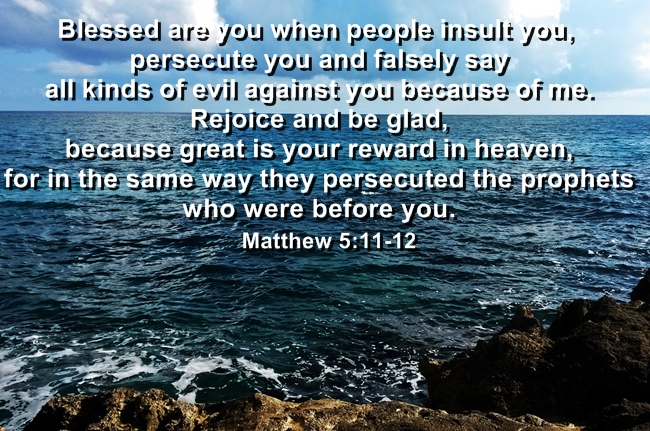
In verse 10, Jesus said that those who are persecuted for righteousness are blessed; here He gets personal, for now He isn’t referring to someone else, or some group of individuals, now it is about “you”. People may speak all sorts of evil against us as followers of Jesus; what should our reaction be  should we pop ‘em right in the mouth?

It wouldn’t seem so; Jesus says we should “rejoice and be glad”, of all things.

Really? We should rejoice and be glad when people are speaking against us because of our faith in Christ?

Yes we should, for great is our reward in heaven.

Jesus didn’t exactly say so here, but our reward here on earth won’t be so bad, since it is a relationship with Him. In the old days, people spoke against the prophets in the same way that they spoke of Jesus’ followers; both were persecuted, sometimes killed in the process, but they seemed to be OK with all that, for they knew that they had a great reward awaiting them, and because they, like Abraham, believed God’s promises.

So now we conclude the Beatitudes, with an implied question dangling: The prophets believed God’s promises and endured. The early Christians believed God’s promises and endured. Do we believe God’s promises?

Posted in Christian Life | Tagged , , , , , , , , | 1 Comment

Random Ramblings: October 15, 2016

dktrfl

The other day Russ P. asked a question in his comment on my post “Humility Exemplified”, and I thought I’d share it with you today, along with my thoughts on the matter. The post was about Jesus’ washing of the disciples’ feet and how He both humbled Himself in doing so, and said that we should do likewise. The question was: “How do we clean the filth of sin from one another?”

In the post I mentioned that Jesus was doing more than helping the disciples with their hygiene, for He was showing that they must be spiritually cleansed; Russ was using some of my words in his question…

I think it’s a fair question; how can we help one another be spiritually cleansed?

I think it begins when we do all we can to be spiritually clean ourselves by immersing ourselves in God’s Word. Yet in making this statement I do not simply refer to reading some Bible verses, not even reading a chapter a day, for that often becomes a race with the clock to see how quickly we can get through it. Little benefit comes from reading Scripture as a form or ritual, I’m afraid. I don’t even mean careful academically based study, although such study is indeed a good thing. What I am really talking about here is our development of the spiritual discipline of praying in God’s Word.

To do so means that we spend quality time with our Lord in His Word, literally praying His Word and asking Him to fill our beings with the riches it contains. We ask Him to reveal to us it’s meaning and significance in our lives, and allow enough time to hear His reply so that if we were asked what God was saying to us in the passage we’d gone through that day, we could not only answer the question, but we could tell the other person what we were doing about what He said.

That may sound a little odd to some, but it is nonetheless true. Yes, it also begs another question: “How do we get to such a place?”

We get there by having a deep and profound relationship with Him; a relationship of openness and intimacy in which we hold nothing back from God, where nothing is allowed to separate us from God. It is a relationship in which we are naked and unashamed before God. I wrote a great deal about this when I covered the topic of “Nakedness as a metaphor in Scripture”. Those posts can be found by clicking on the tab at the top of the page.

When we have reached that kind of relationship with God, we will change in the way we deal with others. They will see His love and caring in the way we live our lives and interact with them. As relationships with others grow from acquaintances into mutual respect and trust, the Holy Spirit within us will do the heavy lifting to help the other person move forward in their relationship with our Lord, for at that point in relationship our main job is to show up and get out the Spirit’s way. This is hard to describe in a “how to” format, but when you get there, you’ll know.

You see dear reader, this is not a matter of working a plan or a program, it’s a matter of being in a place where we can let the Holy Spirit work in our lives, and through us, in the lives of others. This is dear reader, Biblical Discipleship.

Russ, I want to thank you for your comment and question the other day; I hope this will give you and many others a little more to ponder and to take to God in prayer.

Posted in Random Ramblings | Tagged , , , , , , , , , | 8 Comments

On Trial

John 18:28-40

Our story has progressed from where we left off last time.  Jesus and the disciples left the upper room and went to the garden where Jesus was arrested while at prayer.  His response to their demand for Him of “I am he” proved to be enlightening to the soldiers and guards who had come to take Him in, but He went along quietly in order to accomplish God’s redemptive purpose.  He was taken before the Jewish leaders, roughed up and convicted of a phony charge in a joke of a trial.  Peter, as Jesus had predicted, denied knowing Jesus three times, and now, early the next morning He is taken before Pilate, the ranking Roman official, for trial because only the Romans could impose capital punishment.

In vv. 28-32, the Jews approach Pilate with the request that he condemn Jesus to death.  Note that Pilate doesn’t seem interested in granting them their wish.  Note also the way they have approached him:  First, they cannot enter the palace because they would be “unclean” and ineligible to participate in the Passover meal, so Pilate must come out to them.  One might wonder what their ceremonial condition was after the role they played in putting the Son of God to death!  The upshot of the exchange so far is that they need the Romans to agree to an execution, and oh by the way, Jesus had predicted the manner of his death in 3:14.

Pilate has Jesus brought to him for a few questions; one can’t help having a little sympathy for old Pilate here.  Jesus, like the Jews outside isn’t all that respectful of Pilate’s predicament in His answer to Pilate’s first question about whether or not He was a king.  “Is that your own idea…?”  Pilate’s answer to Jesus’ question reveals that he wants nothing to do with any of this; “Am I a Jew?”  The rest of his question in v. 35 is basically ‘what have you done to tick these people off?’  The answer he receives in the next verse is the crucial point of the text:

“My kingdom is not of this world.”  It is from “another place.”  The Jews were looking for the Messiah to bring a kingdom to the world; a worldly kingdom.  It would throw the Romans out, defeat their enemies and restore the former glory of Israel, and the Jewish leaders would have tremendous power in that earthly kingdom.  Jesus actually came with an entirely different kind of kingdom; a kingdom of faith and forgiveness.  Forgiveness was the last thing the Jewish leaders were concerned about.

Pilate jumps on the king aspect: “You are a king then?”  If Jesus were an aspiring king without the endorsement of the Roman government, then it could be asserted that He was plotting treason against Caesar.  Even now, however, Pilate is troubled by this whole thing; he isn’t buying the idea that Jesus is a threat to the government.  In His answer, Jesus admits to being a king, but again demonstrates that He is not an earthly king, for His reason for being born is to testify to the truth.  In all likelihood, Pilate would have a hard time putting truth and kings together as treason.  In fact, as we also know, kings, governments and truth are strange bedfellows.  Pilate’s response to Jesus’ truth assertion shows us all we need to know about him: “What is truth?” It reveals a high level of frustration as it is one of the great unanswered questions of worldly life.  Little did Pilate know, Jesus had answered this question earlier: “I am the way, the truth and the life” The answer to the great question about truth is that Jesus is the very embodiment of Truth.

Pilate goes back outside and tries again to end the standoff with the Jewish leaders, announcing that he finds no basis for any charge against Jesus.  In doing this, he of course is speaking in terms of Roman law.  He reminds the people that the Romans offer an annual pardon to a Jewish prisoner at the Passover, sort of a goodwill gesture.  The Jews want Jesus dead and silent; they demand a man who deserves to die for the safety of the public.  Their hatred of Jesus and the truth that He has brought to them from God Himself; the truth that they should be rejoicing for, is so great that they will do anything to be rid of Him and by extension God.  It is really a shocking and reprehensible thing they are doing, one that they will pay dearly for in the future.  It is also an indication of how many will react to the truth of simple Christianity for centuries to come… as Jesus warned his disciples in the upper room.

Next time, we will pick up the story at this point as the drama continues…

Posted in Bible | Tagged , , , , , , , , | 4 Comments