Justice on Earth and Beyond

20141121_092035-lp

Ecclesiastes 3: 16-22

Our most excellent adventure now examines the state of judgment both here on earth, and in heaven. Before we look at the text, I would be remiss if I didn’t remind you that we are still within the context set in 2:26, within the thesis I stated a couple of posts back: Satisfaction in this life and thus true happiness can only be found when we are within the will of Almighty God.

As in the last two sections, the Teacher is making an argument, so we must keep this in mind as we read this section on justice. Verse 16 tells of something Solomon has seen “under the sun” so we know that he is again speaking in human terms. The courts of men are corrupt; it was true then and it is true now.

Verse 17 takes us back to a more heavenly view: God will ultimately judge both the wicked and the righteous, and of course this has been set up this way to beg an obvious, but unstated question: Why does God allow this wickedness to go on?

Many have given answers to this question, including me, but for the sake of the lesson, let’s see what the Teacher has to say:

I also said to myself, “As for humans, God tests them so that they may see that they are like the animals. Surely the fate of human beings is like that of the animals; the same fate awaits them both: As one dies, so dies the other. All have the same breath; humans have no advantage over animals. Everything is meaningless. All go to the same place; all come from dust, and to dust all return. Who knows if the human spirit rises upward and if the spirit of the animal goes down into the earth?” (18-21)

Everything on this earth has an expiration date; our works, our dreams, our trials, our joys apart from God, even our very lives, for just like the animals, we will surely die. Yes, dear reader, there is a time for every season under heaven, including my season. The time for men to choose whether or not they will follow God’s ways is one of those seasons too, and the day is coming when that season of men choosing not to follow God’s ways will also pass away, and when it does, all of us will be called to give an account. That is the answer to the unwritten question.

I would like to mention one other thing before we continue, and that is about verse 21:

Who knows if the human spirit rises upward and if the spirit of the animal goes down into the earth?

I hate to draw your attention away from Solomon’s point here, but I think that the NIV and most other modern translations have missed this one. I might be crazy, but there is no “if” in the Hebrew, nor is there the “that” that the NASB puts in this sentence. I can’t claim to be a great scholar of Hebrew, but the way I read the original is this: “Who knows the spirit of the man that goes upward and the spirit of the beast that goes down to the earth?”

To this question, there is a definite answer: God knows, and He will judge them accordingly when He sees fit to do so.

The chapter ends on this note, a summation of the entire section:

So I saw that there is nothing better for a person than to enjoy their work, because that is their lot. For who can bring them to see what will happen after them?

In thinking about this summation, recall that Solomon has linked happiness with work in one instance only: when we are working to accomplish God’s purpose. So, with this in mind, what is the Teacher telling us? The best way for all of us to proceed through this life is for us to dedicate ourselves to His service, for God has created us to do this; anything less is meaningless and futile.

Finally, here is the complete structure of the case the Teacher has made:

Thesis: Satisfaction in this life and thus true happiness can only be found when we are within the will of Almighty God.

First supporting point: God, in His infinite wisdom has ordained a season for every purpose of Man.

Second supporting point: The only things that last are the things ordained by God and our part in them, which brings happiness and satisfaction as His gift.

Third supporting point: God will rightly judge the works of all men to determine whether or not they have followed His ways, for the season of men will come to an end.

Conclusion: Satisfaction in this life and thus true happiness can only be found when we are within the will of Almighty God.

Now, our most excellent adventure will move back under the sun as we continue into chapter four…

Posted in Bible | Tagged , , , , , , , , , | 10 Comments

God is in Control (2)

Ecclesiastes 3:9-15

Mankind lives in the sorry state of rebellion against God. Yes, I’m afraid that is the reality of life under the sun, but that doesn’t mean that God has lost His grip, for He has ordered things in a certain way under the sun; there are seasons that men cannot change, seasons for everything. Within all of this chaos, confusion, rebellion and order, God still has a purpose. Of course, His purpose is significantly clearer in the New Testament than in the Old, but there was Purpose in play even then. In the OT, every person who sprang forth from the seed of Abraham had a choice to make; they could either confine themselves to God’s will (purpose) for them, or they could live in rebellion under the sun. In our day, this choice extends to every single human being.

The Teacher makes this case here in Ecclesiastes 3. In this text, he deals briefly with three aspects of God’s purpose beginning in verses 10-11 where he speaks of our completion of God’s purpose, then in 12-13 he speaks of our enjoyment of God’s blessing and then finally in 14-15, he speaks of our contentment with God’s will. All of this is his answer to the question posed in verse 9:

What do workers gain from their toil?

We are those workers, so what do we get?

I have seen the burden God has laid on the human race. He has made everything beautiful in its time. He has also set eternity in the human heart; yet no one can fathom what God has done from beginning to end. (10-11)

When we come to understand that we are put here for God’s purposes rather than our own, we begin to see that everything is beautiful in its time. To put this into Christian terms, we might ask ourselves what could be more beautiful than to see our labors result in someone coming into relationship with Jesus Christ. We might see that a man or woman who is able to be set free from bondage to addiction or poverty or hopelessness and enter into the fullness of His grace is a beautiful thing indeed, and more rewarding than all of the treasure of this world. Yes, He has put eternity into our hearts, for unlike the animals, we have the ability to plan and to think ahead, but what will our plans and thinking be: to serve God or to serve ourselves? With the former we will find beauty that others may miss, while with the latter, the only beauty we will find is that which will perish with us.

The Teacher continues:

I know that there is nothing better for people than to be happy and to do good while they live.  That each of them may eat and drink, and find satisfaction in all their toil—this is the gift of God. (12-13)

Those of us who do our toil for God’s purpose have a gift that others do not; real happiness and satisfaction. The Teacher has made great pains, and will continue in this book to take great pains, to document the utter futility of the pursuit of mere human endeavors, but the gift of God for those who labor in His service is a most excellent gift, for it is a gift that will endure and that will satisfy the craving within every man and woman to seek after the eternal things of God.

I know that everything God does will endure forever; nothing can be added to it and nothing taken from it. God does it so that people will fear him.

Whatever is has already been,
and what will be has been before;
and God will call the past to account. (14-15)

The Teacher winds up this thought in these verses in an interesting way as he gives us a contrast of sorts. God’s purposes and accomplishments last forever, we can neither add nor detract from God’s purpose, but where is the contrast? The contrast is the works of men that are “meaningless” under the sun. Verse 15 makes this clear as the Teacher quotes himself (Ecc. 1:9) where he wailed about the futility of our accomplishments. God is n charge, not us; we can do whatever we want, but if we want our accomplishments to count for something, then we must accomplish things that are within God’s will and purpose for us, not our own flights of fancy. God has ordained this so that we might take notice, for everyone will be called to account.

The rest of this chapter, as you might guess, speaks of the justice of God; His most excellent justice. Before we dive headlong into God’s judgment, let’s pause and get our bearings. I’ve never actually come out and said this before, so lucky you; you get to read it first: God’s judgment is really something of a paradox: God is entirely and completely in control of it, but you decide the outcome.

Oh, I can hear the theologians screaming! Hey, not so fast; think about it. You decide whether your life will be used to advance His purpose or yours, and that decision will result in what becomes of you in judgment. Will you pursue all of those meaningless things as you chase the wind in this life under the sun, or will you labor for His purposes and enjoy His gifts of happiness and satisfaction?

OK, now I can’t wait to see what the Teacher has to say next time!

Posted in Bible | Tagged , , , , , , , , , , | 13 Comments

Salt and Light

pnrkk4k-lp

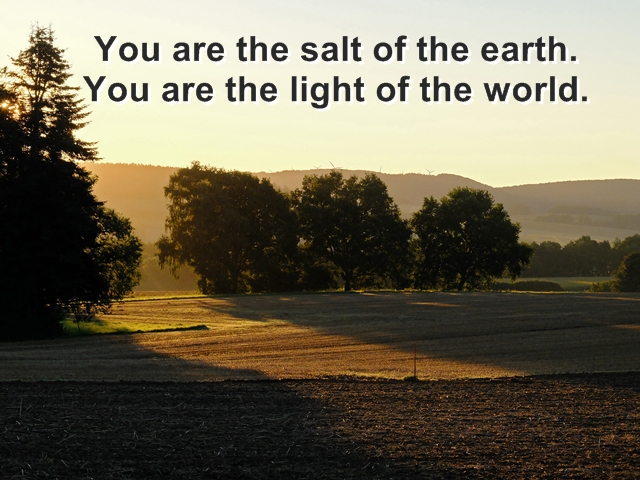
“You are the salt of the earth. But if the salt loses its saltiness, how can it be made salty again? It is no longer good for anything, except to be thrown out and trampled underfoot.

“You are the light of the world. A town built on a hill cannot be hidden. Neither do people light a lamp and put it under a bowl. Instead they put it on its stand, and it gives light to everyone in the house. In the same way, let your light shine before others, that they may see your good deeds and glorify your Father in heaven.

Matthew 5:13-16

Over the past several Sundays we have seen a series of character traits or attributes that we call the beatitudes, but so far, we have attributes without a purpose; in these verses, Jesus gets to His larger point.

To illustrate, He uses two metaphors, salt and light. Salt had many uses in the ancient world, thus it is very difficult to nail down the exact use Jesus might have been referring to; He just didn’t say. Over the years, people have chosen a possible use and claimed it as the thing Jesus had in mind, but to be perfectly honest, such a position is only a matter of speculation, so let’s try to avoid falling into that trap; we’ll just look at salt as a basic and useful substance. As an example, I’ll mention what were probably the two most common uses of salt, as a food preservative, and as the basic ingredient for seasoning food. For either of these uses, if the salt loses its saltiness, i.e. its usefulness, then it is worthless. If we, as “the salt of the earth” lose our usefulness, then we might fit into that same category.

This image becomes crystal clear in His next metaphor; light. We, as we exhibit the traits of character that Jesus spoke of in the beatitudes, we become the “light of the world.” Imagine if you can, a world filled with the meek, the poor in spirit, peacemakers, and all of the rest of those attributes, next to what we are used to… this is what Jesus meant here by “the light of the world.” Light does no good if it is hidden from view; it’s just like salt that has lost its saltiness, so He tells us to let our light shine forth in this dark world as a contrast to the norm, to the glory of God.

That is what “Kingdom” is all about.


Posted in Bible | Tagged , , , , , , , , , , | 6 Comments

Random Ramblings: October 22, 2016

laypark-102213-038-pv

“Oh no, another picture of the White House; this can’t be good.”

I agree.

I don’t want to write about elections or politics, in fact, I’ve gone out of my way not to hear about the election. Of course I haven’t gone so far as to have not read the 100+ page document dump the FBI released earlier this week, or the latest WikiLeaks release… and the ones before that. Still, I haven’t been listening to the election coverage, other than to survey what was written and reported in the aftermath of Wednesday’s candidate ‘get together’.

For me, that’s staying out of it. I think these are matters of degrees…

There was something “fishy” about the post debate coverage, something that looks remarkably like campaign talking points. I watched as many commentators do their post debate spiel as the networks made available on their websites, and I couldn’t help but notice that nearly all of them admitted (some rather glumly) that the Donald “won” the debate.

I’ll take their word for that.

But then all of the sudden there was a shift, and many of these same people began to say that the Donald blew any chance he had of winning the election by giving a “wrong” answer to one of Chris Wallace’s questions. There is no way that Mr. Trump can possibly recover from such a terrible gaffe; he’ll lose in a landslide now. Of course, having a very long (even for someone in politics) political memory, I recognize that they have all been saying Trump would lose in a landslide since before the conventions; why are they announcing this as if it were something new now and what was the gaffe?

The question was whether or not the candidates would abide by the election results: Mrs. Clinton said that she would and the Donald said he’d like to wait and see.

That doesn’t strike me as a gaffe, it strikes me as someone who wasn’t willing to sign a suicide pact, in light of the number of voting fraud allegations there have been in recent years. Yet the real point of my ramblings today is neither Clinton nor Trump, nor politics in general; it’s the reporting of the election. For as long as I can remember, the news coverage of politics has favored the Democrats, everyone knows that. Yet it has never been so obvious; they don’t even try to be objective any more.

Where is the outcry from the public?

Oh, we’ve gone to sleep.

Back when I was an undergrad, I had a Journalism professor who told us about a new trend in journalism, something called “advocacy journalism”. He said that this form of journalism had no particular claim to objectivity, and that its purpose was to “advocate” a cause; he said that would be the “death of journalism” and that we would all live to see it.

He was right.

I mentioned the 100+ pages of documents released by the FBI this week, and I would bet that most of you didn’t hear about it. If you’ve read them then like I have, you know that the lack of coverage says it all. Twenty years ago, these documents would be the only thing you’d hear about, and they would not only bring the Clinton campaign to an end, they could even bring the Obama Administration to an ends as well.

Yep, my Journalism professor was right.


Posted in Random Ramblings | Tagged , , | 15 Comments

God is in Control (1)


falling-leaves

There is a time for everything,
and a season for every activity under the heavens:

a time to be born and a time to die,
a time to plant and a time to uproot,
    a time to kill and a time to heal,
a time to tear down and a time to build,
    a time to weep and a time to laugh,
a time to mourn and a time to dance,
a time to scatter stones and a time to gather them,
a time to embrace and a time to refrain from embracing,
a time to search and a time to give up,
a time to keep and a time to throw away,
a time to tear and a time to mend,
a time to be silent and a time to speak,
    a time to love and a time to hate,
a time for war and a time for peace.

Ecclesiastes 3:1-8


In the previous verses, 2:24-26, the Teacher has set forth a basic proposition that God is in control and that outside of His will, everything is useless, meaningless, empty, futile; vanity. Yet within His will there is satisfaction and true happiness; in this chapter, he sets forth to prove his point. In this first part, the Teacher reminds us that there is an undeniable pattern to life, a rhythm we might say, which has been established by God.

These vases are so familiar, they were even made into a hit song back in the 1960’s, but do we really grasp their significance?

To ensure that we really “get” this passage, commentators often go into great detail to analyze each of these couplets, to squeeze out every bit of juice from the poem, often engaging in great philosophical dissertations that are quite fascinating to ponder, and you are quite welcome to search these out if you like. If you choose to take this approach, you can join so many other great minds who suddenly find themselves trying to justify killing, tearing things down and hatred into a Biblical context of love and compassion. It sounds like taking a side trip that involves a whole lot of chasing the wind to me…

I say this because these verses are not eight separate points, this passage does not stand on its own in the context of this book; it is one complete thought set up to demonstrate one part of the demonstration of one point in a series of points that make up the complete message of Ecclesiastes, and as richly rewarding as it may be to analyze this line by line, to do so misses the point entirely. I’m sorry that I have to admit this, but to my strange little mind, and with my oddball little sense of humor, charging off on such an errand would be hilarious and supremely ironic while studying Ecclesiastes, of all books.

The Teacher’s thesis is stated in the beginning of my comments above, and verses 1-8 are supporting point 1 in his attempt to back it up; this is evidence, not a philosophical treatise. What is he really trying to tell us? Simple: (go figure)

Thesis: Satisfaction in this life and thus true happiness can only be found when we are within the will of Almighty God.

First supporting point: God, in His infinite wisdom has ordained a season for every purpose of Man.

Well, it would seem that we are ready for the next point now… and that is exactly what we will have next time!


Note: I found the picture above on the net; pretty cool I think. Note to self: Find out how they do that!

Posted in Bible | Tagged , , , , , , , , , | 17 Comments

Meaningless Labors… and a Different Point of View

Ecclesiastes 2:17-26

With verses 17 ff. we continue the Teacher’s warm and cozy view of our lives under the sun, this time we are talking about work. In verses 17-23, we see a very high concentration of markers making it more clear than at any time before this that we are talking about life “under the sun” which he repeats no less than five times. Could something be in the works here?

The main point in this passage is that we might work diligently all our lives, we might achieve great things, as Solomon surely did, and yet even though we might act with wisdom and knowledge and skill our entire career, the day will come when we turn our accomplishments and fortunes over to someone who may or may not be wise, and who certain did not earn them. He concludes that this is not a good situation, using the term “meaningless” no fewer than three times in the process.

Solomon isn’t the only person to make this observation, and over the centuries many volumes have been written about great reputations and fortunes that were squandered by foolish heirs on riotous living. What do we get from all of our hard work under the sun? We get stress, grief and anxiety, and in the end, we leave it all behind… meaningless!

Something happens in verse 24:

A person can do nothing better than to eat and drink and find satisfaction in their own toil. This too, I see, is from the hand of God

At first, we might think that Solomon’s rant is continuing, but then we see something different, eating, drinking and finding satisfaction “in their own toil” is a gift from God; this doesn’t seem to follow. This is because 24 and 25 are transitional verses:

A person can do nothing better than to eat and drink and find satisfaction in their own toil. This too, I see, is from the hand of God, for without him, who can eat or find enjoyment?

Ecclesiastes 2:24-25

Our vantage point is no longer “under the sun”; from here through 3:22, Solomon gives his counterpoint to life under the sun, a contrast that makes this adventure of ours a most excellent adventure, rather than a depressing one, for there really is a ray of hope for better things.

To the person who pleases him, God gives wisdom, knowledge and happiness, but to the sinner he gives the task of gathering and storing up wealth to hand it over to the one who pleases God. This too is meaningless, a chasing after the wind. (v. 26)

By linking wisdom and knowledge with happiness, Solomon is making a distinction that this time, wisdom and knowledge are not vanity, as in the previous verses, for these are not the vain strivings of merely human wisdom and knowledge, but of a divine gift. This person, who is pleasing in God’s sight, understands the difference between that which is eternal, and that which is not, and their priority is in the right place, thus they can find happiness even in this life. By contrast, the one who is not pleasing in God’s sight does not find this kind of happiness and deep satisfaction, for if they have obtained even human wisdom, they realize that all is for naught in the end, no matter what they do. They come to recognize that they have merely been chasing the wind.

Approaching the next chapter, we see that Solomon is going to develop this new theme more fully; actually he will take on a persuasive structure in the process. Ready to dive into chapter three?

Oh come now dear reader, you know the drill; we will have to wait until next time for that, and I will look forward to seeing you then!

Posted in Bible | Tagged , , , , , , , | 9 Comments

Wisdom and Folly

Ecclesiastes 2:12-16

Our Teacher now examines wisdom and folly, and in so doing he comes to the conclusion that wisdom is better, but it only goes so far. A wise person walks in light, while a fool stumbles around in the dark; this is good. Yet they both end up in the grave, so what’s the real difference? Oh yes, this is quite an optimistic message!

In verse 12 he points out that his successor will have nothing left to do that he (Solomon) hasn’t already done, implying that we can re-examine his conclusions, but we’ll still get the same results. Yes, wisdom is better than folly, but then we already knew that.

Here’s my own illustration:

If you are old enough to recall the 1970’s, then you will no doubt recall that all of the new things that went on in that period were cutting edge, really great, and of course in all cases cool in the extreme. Now, ask yourself: How are the cool things of the 1970’s looking now? Do you still go to the store and hope to buy an avocado green refrigerator? Hey guys, do you miss wearing bell bottoms? Been to a disco lately?

Yuk.

Now look at things as they are now; you do realize that all of the latest and greatest cool things of today are going to look just as stupid as the latest and greatest of the 70’s 35 years from now, right?

A wise person sees right through all of the latest and greatest styles and fads; a fool jumps into them with both feet thinking they have found the “ultimate”.

Wisdom enables a person to think several steps ahead and avoid many problems in the process, while a fool jumps into everything that comes along and gets burned over and over. This, I think, is the heart of what Solomon is teaching us. It is good to be wise, but in the end, it really doesn’t matter all that much, since the day is rapidly approaching when the wise and the foolish will be dead and gone… and forgotten.

Before I wrap up on this uplifting note, please notice that he is still speaking of life “under the sun”; can it be, that there is more to our lives than just that which goes on “under the sun”? I sure hope so!

In the next part of our adventure, the Teacher tells us about the joys and fulfillments of our labors, but for that we’ll have to wait until next time.

Posted in Bible | Tagged , , , , , , , | 5 Comments

The Pursuit of Pleasure

Ecclesiastes 2:1-11

Do you know anyone who doesn’t like pleasure? To be sure, that is a loaded question because it is not possible to say “No” to that one. Everyone likes pleasure… by definition, although not everyone has the opportunity to experience it. Pleasure is fun, it is… pleasurable. We can do all sorts of things for pleasure; we can enjoy fine foods, drink good wines, read good books, watch good movies and listen to good music. Solomon, using the great wisdom he has gained, seems to have conducted an investigation into pleasure, to determine whether or not it would add meaning to life.

In verses 1-9 he tells us of his investigation, and then he sums up his conclusions in verses 10-11. In the first two verses, he goes after amusement, in 3 it is wine. In 4-6 he pursues pleasure in great accomplishments, then he goes for wealth in 7-8a, and then in 8b he pursues the pleasures of sex; the number of his wives and concubines (sex slaves) was in the thousands! (1 Kings 11:3). In verse 9 he sums this all up by pointing out that in all of this, he became far greater than anyone who had come before “in Jerusalem”. Then he gives us his conclusions:

I denied myself nothing my eyes desired;
I refused my heart no pleasure.
My heart took delight in all my labor,
and this was the reward for all my toil.
Yet when I surveyed all that my hands had done
and what I had toiled to achieve,
everything was meaningless, a chasing after the wind;
nothing was gained under the sun.

Ecclesiastes 2:10-11

Verse 10 begins with another parallelism that clearly tells us that there was absolutely nothing that he didn’t try, and that he utterly indulged his every fancy. He had a great time; his “heart took delight” in what he was doing, and that delight was his entire reward: Fun.

Yet when it was all said and done, what had he really accomplished? With the great wisdom he had received, he came to realize that all of his fun and frivolity was “meaningless” (vanity), chasing after the wind. He sums this up in a parallel construct this way: “nothing was gained under the sun.”

Have you ever looked forward to some big event in your life, say a party or a trip or a concert or… whatever, and then felt let down afterwards? Maybe that big day was great, but now that it’s over…blah. I do most of the cooking in my house, and there have been many times when I work 3 or 4 hours (or more) preparing a meal. I pull out my entire bag of culinary tricks and really try to create something special. Then comes the moment of truth as everyone sits down at the table and lo and behold a culinary triumph! Yippee!

After a few minutes I survey the scene. I put heart and soul into my creation, and now all I have left is a mess to clean up. Usually, what passes through my brain is something like: It would have been a lot easier to have zapped a few hot dogs!

Vanity of vanities.

Posted in Bible | Tagged , , , , , , , , , | 14 Comments

The Quest for Wisdom

Ecclesiastes 1:12-18

Solomon (a..k.a. Koheleth) sets out his great quest for wisdom in these verses, but all of the wisdom that the wisest man of all time managed to collect, wasn’t worth very much. Here’s an example:

Suppose you went to the movies, and when you got to the front of the ticket line you said, “One please,” and then handed the cashier your American Express card.

“I’m sorry,” the cashier says, “But we don’t take American Express. We accept cash, VISA, MasterCard and Discover.”

“But I only have American Express,” you reply…

Guess who isn’t going to the movies today?

Like an American Express card, human wisdom is nice to have; certainly wisdom beats stupidity any day, but it doesn’t get you into heaven, nor will it bring you into God’s presence. That simply is not something human wisdom can do for you.

Solomon notes that after seeing all of the things that go on under the sun, none of them are much good for anything. Again the NIV uses the word “meaningless.” Again I can’t help but think “meaningless” isn’t quite strong enough, “futility” seems more on the mark here to me… or just plain “worthless.”

Take particular note of verse 15:

What is crooked cannot be straightened;
what is lacking cannot be counted.

Do you see the construction here? Notice the two poetic clauses separated by a semicolon? This is called a Hebrew parallelism, and it is very important in interpretation. Those two clauses are parallel which means that they mean the same thing, and this is quite handy to keep in mind if one or the other isn’t quite clear. The first of these is simple enough at first glance: “What is crooked cannot be straightened” except for the fact that “crooked” is rather ambiguous, don’t you think? Crooked in what sense? Does he mean that it’s curved somehow, or maybe he means corrupt… or maybe its curve signifies corruption… or who knows what he means?

Since these clauses are parallel, we can look at the second one: “what is lacking cannot be counted” and here we find a little riddle we can solve easily. If something is lacking, then it isn’t there, so you can’t count what is lacking, since it isn’t there. If you have $20.00 in your hand, then you can’t count $30.00 since the other $10.00 aren’t in your hand. Thus, we can see that he means that “you can’t straighten what is crooked” means that it just isn’t straight, say a stick of wood, and you can’t make it straight with all of the wisdom in the world, because it is what it is: crooked. Now that we have the parallelism figured out, go back to verse 14:

I have seen all the things that are done under the sun; all of them are meaningless, a chasing after the wind.

To explain the totality of the meaning of this verse, the author used the parallelism in verse 15, and when you put these together here’s what you have:

After examining everything that is done in this world apart from God, all of them are meaningless, futile, vain, of no account… and nothing is going to change that.

(Pretty cool, don’t you think? These Hebrew parallelisms are found throughout the poetic books; Psalms, Proverbs, Job and the prophets)

In the remaining verses of our text, the author uses this same technique again to tell us that not only is all of the activity he found “under the sun” meaningless, but so is the pursuit of wisdom itself.

For with much wisdom comes much sorrow;
the more knowledge, the more grief. (1:18)

The wiser he became, the more he realized that none of this mattered, and that made him even more miserable than ever.

As the next chapter begins, our Teacher examines the pleasures of life; what will we discover there? Much pleasure, or maybe much folly!

Posted in Bible | Tagged , , , , , , , , | 11 Comments

Photo of the Week: October 19, 2016

Posted in Photo of the Week | Tagged , , , , , , , , , | Leave a comment