
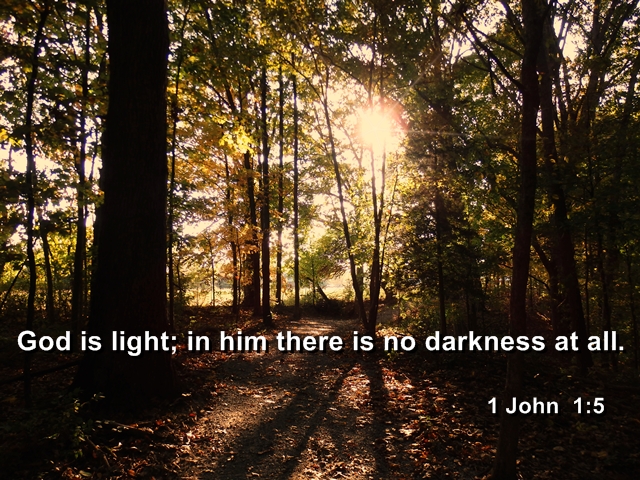
Photo of the Week: November 2, 2016

Posted in Photo of the Week | Tagged , , , , , , , , | Leave a comment

We Do Not Know When Good Things Will Happen

In the last passage, we saw that evil can come upon us at any time; that’s just the way it is. In this section, we will see that good can come upon us as well, and that we must not be so cautious about the potential of evil that we miss out on the good. This discussion begins with verse 3 of chapter 11 in which the laws of nature are used to illustrate the potential for bad times:

If clouds are full of water,
they pour rain on the earth.
Whether a tree falls to the south or to the north,
in the place where it falls, there it will lie.

Who knows exactly what will happen – who knows just where there will be rain, floods blizzards or danger? Nobody, that’s why we are being bombarded with warnings. This is the message of verse 3; you just never know what might happen. The next verse, verse 4 tells of our possible response:

Whoever watches the wind will not plant;
whoever looks at the clouds will not reap.

I remember a couple of years ago when a major winter storm was moving into the Washington, D.C. area; on the news they were listing (over and over) all of the closings and “late starts” for the incoming storm. Amazingly, the Federal government was open for business that day, and I must admit that I was a bit surprised, since they normally surprise me by how quickly they shut it down. Since the government wasn’t closed that day, I predicted that it would be a real major storm; they almost always guess wrong!

…Which is exactly the point that the Teacher is making. Using an agricultural metaphor, he is saying here that if you are always looking at the clouds and the wind, you’ll never get your fields planted, or to put it another way, if you are always looking for danger, than you can always find a reason not to try.

As you do not know the path of the wind,
or how the body is formed in a mother’s womb,
so you cannot understand the work of God,
the Maker of all things. (11:5)

This transitional verse is where the tide changes: None of us knows the workings of God, so we can’t easily predict what will come next. Even with advanced weather models and satellite tracking of storms, they don’t always get the forecasts right. How can any of us think we can predict the future?

Sow your seed in the morning,
and at evening let your hands not be idle,
for you do not know which will succeed,
whether this or that,
or whether both will do equally well. (11:6)

The conclusion is simply that we should get out there and give it our all in this life, and not worry about the storm clouds that come along, for who can say what will bring good and what will bring evil into our lives; do your best always.

With this Solomon brings this second section of Ecclesiastes to its close. Next time, our adventure will reach the third and final section of the book: The conclusion of the matter.

Posted in Bible, Christian Life | Tagged , , , , , , , | 2 Comments

We Do Not Know What Evil may Befall Us

Ecclesiastes 10:16-11:2

In this section, the Teacher continues with his elaboration of life’s uncertainties under the sun. Here, it would appear that he is talking about those who rule the nation; not all rulers are wise! The first verse in the text sets this out, and the (new) NIV gives us a bit of confusion right off the bat:

Woe to the land whose king was a servant[a]
and whose princes feast in the morning. (10:16)

To be fair, I left the footnote in place; it says “or king is a child”. The Hebrew word in question is na’ar which can be rendered as a boy, a lad or a servant. I don’t know this for sure, but my guess is that the newer translators went with servant because “boy” and “lad” are male, and “servant” can be either male or female. This would avoid offending the contemporary politically correct person, but in my view would lack historical accuracy, since boys or lads could be heirs to thrones, and young women or girls could only do so in rare and extreme circumstances. In certain cases, this Hebrew word can also be taken to be a child, so I’ll agree to a compromise; child it is! If you insist on “servant” here, it will still work in one sense; both a child and a servant are people who are not ready for leadership in so high a position as king, in which case they are vulnerable to manipulation by their advisors, and this was (and is) often the case. Now couple that with “princes who feast in the morning” and you have an immature king under the thumb of advisors who are the ancient equivalent of playboys, and you can see that things will not go well in the land. I’m thinking that some might see this kind of thing happening still in our time when someone comes into power who isn’t really ready for it, surrounded by people who don’t know how things actually work in the real world; it can be messy. Verse 17 is the contrast to 16, where the king is qualified, trained and ready to reign, and his nobles were sober and wise.

Verses 18-19 are a further elaboration of the circumstances referred to in verse 16, the result of that crisis of unwise leadership:

Through laziness, the rafters sag;
because of idle hands, the house leaks.

A feast is made for laughter,
wine makes life merry,
and money is the answer for everything.

Oh my, how did the Teacher phrase it? “There’s nothing new under the sun”!

Verse 20 provides us with a caution for such times, when an honest and hardworking person might be tempted to become frustrated or resentful bout the way things are going:

Do not revile the king even in your thoughts,
or curse the rich in your bedroom,
because a bird in the sky may carry your words,
and a bird on the wing may report what you say.

Yes indeed, and a childish ruler is a vengeful ruler…

This brings us to the final two verses of our text, and to be perfectly honest with you, these two innocent little verses have led me to more research that I intended to sign up for when I started blogging about Ecclesiastes. The reason is that the new NIV interprets these verses, and the rest of the chapter in a way I hadn’t encountered before. The thing is, translators aren’t supposed to interpret, and yet they must interpret, and anyone who has studied a foreign language in any great depth will understand this, for in any language I’m familiar with, there will be times when you can understand something in more than one way. In this case, we can take these verses as being a reference to business and commerce, or as a reference to benevolence. The way the new version of NIV takes it, Solomon is telling us to diversify our holdings in tough times, to engage in international business, with kingdoms that don’t have incompetent leadership ruining their economies, and that makes sense.

I tend, however, to take a historical – critical approach to texts like these and that keeps bringing me back to the fact that the real author of this text is the reigning King of Israel, and I’m having some trouble with this advice being understood this way, coming from an incumbent. Particularly in a kingdom that views everyone else as filthy dogs!  In addition, Solomon has given counsel in the Proverbs more like the benevolent understanding of such things, and of course I ask myself why he would suddenly be giving advice to only a few of his readers, when up until now, he has said things that could apply just as well to the poor majority as to the rich minority. Thus, to make a long story short, here’s how I see this; you are welcome to see it differently, as always…

Ship your grain across the sea;
after many days you may receive a return.
Invest in seven ventures, yes, in eight;
you do not know what disaster may come upon the land. (11:1-2 new NIV)

###

Cast your bread upon the waters,

For after many days you will find it again.

Give portions to seven, yes to eight,

For you do not know what disaster will come upon the land. (11:1-2 old NIV)


I think he is telling us that we should always practice benevolent acts, to help others out, and thus to make many friends, or as Benjamin Franklin said, that we should “do well by doing good”. Thus, when hard times come, we don’t have to stand alone; there will be those who are happy to help us as we have helped them.

The main principle will work in either interpretation, for in the commerce model, you will have friends in other lands should you need them, but in the meantime, you should still be profitable in your own land when the economy turns south, which seems to me to be the disaster the Teacher is talking about here, based up his remark in verse 19.

Posted in Bible, Christian Life | Tagged , , , , , , , , , | 8 Comments

No One Knows the Future

Ecclesiastes 9:13-10:15

In this section, the Teacher develops the idea that none of us knows our futures under the sun. He does this in four subsections, beginning with 9:13-10:1. Here, the Teacher tells a fictional story reminiscent of 2 Samuel 20:15-22 in which a poor but wise man saves his small city from certain destruction by a large and powerful army, only to be entirely forgotten once the city no longer needed him; fame and honor are indeed fleeting. Yet, even though the man was poor, and hardly powerful in the city, his counsel was more valuable in the crisis than the council of the city fathers, and it overcame the strength of arms. Thus the Teacher concludes: “Wisdom is better than strength” yet what did this man actually gain? Nothing.

10:2-7 shows us that there are impediments to wisdom under the sun. The wise person is guided by wisdom, is cool under fire and his heart and mind are steadfast, yet there is a very good chance that he is surrounded by fools. The primary example used here is that of an unwise ruler who appoints his friends and “yes men” to high places, and becomes angry with those who actually could have given him wise counsel. I think maybe we may still encounter this problem today.

The third section is in 10:8-11 and deals with the unexpected things that seem to take place so often in this life. The wording here is entirely self explanatory, and I think we can all identify; you just can’t be sure when misfortune might strike, no matter how careful you might be; it’s sort of an “occupational hazard” of being alive.

Finally, in verses 12-15, we see the futility of words. While a wise person’s words are gracious, most of the words we hear come from fools who get carried away and speak injudiciously about all sorts of things. If they are irritated or excited, they get carried away. If they are feeling down, they get carried away, if they are happy they get carried away: blah, blah, blah. Their endeavors come to naught, their projects fail, they become weary; they can’t win. Why?

Oh dear reader, that’s an easy one: because they are fools!

As a result of this, we are back where we started: Nobody knows what will happen next; that is the way of things under the sun.

Next time, we will see that nobody knows when evil will strike; nor does anyone know when good things will take place, for none of us can see the future.

Posted in Bible | Tagged , , , , , , , , | 5 Comments

There is Only One Certainty

Ecclesiastes 9:1-12

Our most excellent adventure now comes to the Teacher’s second conclusion: There is only one thing in this life that is certain.

That certainty is simply this: It doesn’t matter who you are or what you do in life, you are going to die and be forgotten.

This warm and cozy reality forms the basis of Solomon’s wisdom, at least in the wisdom of his teaching. He actually calls it “the evil in everything that happens under the sun: The same destiny overtakes all” in 9:3. I should remind everyone at this point that in Solomon’s day there was no concept of eternal life as Christianity understands the term; you only lived on through your children. Thus, with a fate of death in common, why be surprised that people are wicked, greedy and unrighteous? Why not eat, drink and try to have as much fun as you can? In the context in which Solomon says these kinds of things, this is logical, isn’t it? I think it is in his context, but it isn’t in our context as followers of Jesus Christ, yet that is exactly the attitude of most of us today.

Verses 4-6 discuss the fact that it is better to be alive than to be dead, but he can offer no hope of anything after that. Verses 7-10 tell us to enjoy our limited time here on earth as much as we can, and he is giving this advice to the godly ones, not the wicked, for there will be nothing when you’re gone. Verse 11 tells us that success and greatness aren’t just for the wise and talented, but rather that some will be lucky and some will not: Oh well…

Verse 12 tells us that some of us will be trapped by evil events that are out of our control: Oh well…

Thus begins the second section of the book, and as we continue in our adventure, the Teacher will develop this theme further. In the first section of the book, he taught us that we don’t know our present, in the rest of the book; he develops the conclusion that we also don’t know our future. Thus are the consequences of Man’s rebellion against God. I can say one thing in the midst of this cheerful narrative:

Boy am I glad that I didn’t come along until after Jesus Christ changed everything!

Posted in Bible | Tagged , , , , , , , , | 8 Comments

More Submission

Ecclesiastes 8:9-17

These verses seem to go on in a familiar refrain; everything is meaningless. Things happen under the sun that shouldn’t, people conjure up their schemes, and people die; what’s the point? The Teacher has been saying these things for over 7 chapters… and then it happens.

When I applied my mind to know wisdom and to observe the labor that is done on earth—people getting no sleep day or night—  then I saw all that God has done. No one can comprehend what goes on under the sun. Despite all their efforts to search it out, no one can discover its meaning. Even if the wise claim they know, they cannot really comprehend it.

Ecclesiastes 8:16-17

The most wise Solomon, the man who sought wisdom and received it, the great Teacher who has examined everything that goes on under the sun, using his great wisdom in a quest for understanding, has failed; his conclusion is that this simply cannot be understood.

With this sad admission, the first major section of Ecclesiastes comes to its conclusion, but before we rush on to the next section, let’s just have a look at one little thing in this text; we find it at the beginning of verse 17, a small little clue we might pass right over: “then I saw all that God has done”.

Wait a second: Hasn’t he been talking about what man has done?

Yes, he has been talking about what man has done! So why is that little clause in the sentence?

Has Solomon given us an additional riddle that has no solution, or is he trying to tell us something more concrete?

Oh my, there are more questions being raised than answers given, and this is always what happens under the sun, when men become philosophical, for philosophy seldom provides real answers to things, just questions. But there is an answer to this one.

The works of Man have been ordained by God in all of their futility.

Think about it: All of that labor under the sun; all of those sleepless nights. All of that wickedness, all of those schemes, all of the justice on earth, and all of the injustice; sin, rebellion against God, and godliness and righteousness: All of this was ordained by God when He created Mankind with free will. That is not to suggest that God is the source of sin, nor is it to say that God makes men do bad things, but God gave Man free will and was prepared to deal with the consequences. Why did God do it that way?

Ah, that is what the Teacher could not discover, in spite of all of the neatly packaged Sunday school answers; no one actually knows for sure why God set things up this way, but He did. This leads us that which our wise Teacher did succeed in discovering: We must live with this situation under the sun, which is to say that we must submit to it, for there is nothing else that we can do.

With all of that said, we now have some information that was not available to the Teacher, for in the many centuries that have passed since his time, God’s plan of redemption has been fully revealed, and as a result of that plan, we have the gift of the indwelling Holy Spirit that the Teacher did not have. That gift makes our jobs much easier than Solomon’s was!

I am pleased to be able to tell you, that this is about to become a lot more interesting, for the Teacher will reveal the next big conclusion he has come to in his quest, and our adventure will be a most excellent one when he does so in the next chapter…

Posted in Bible | Tagged , , , , , , , , , | 10 Comments

Submission: Everyone’s Favorite Thing

Ecclesiastes 8:1-8

Our adventure moves into chapter 8 and brings us to what no doubt will be a favorite subject for all of us: submission and obedience. As you can see, verse 1 is transitional; the meat begins to be seen in 2-4:

Obey the king’s command, I say, because you took an oath before God. Do not be in a hurry to leave the king’s presence. Do not stand up for a bad cause, for he will do whatever he pleases. Since a king’s word is supreme, who can say to him, “What are you doing?”

The Teacher gives some very practical advice here; don’t mess around with the king! I’m sure that everyone can understand this; the king was the last word on every matter.

I skimmed through a commentary or two to see if the commentators pointed out the obvious, and at least in the ones I could get hold of quickly, none did, but here it is: The Teacher who is telling us this is the king! My point in mentioning this is that the author in this case, will be the beneficiary of his own advice; you may do with this information what you like.

To be fair, this is good advice in any case after all, didn’t your Mama warn you not to go looking for trouble? Mine did.

Verses 5-6 amplify his point with the statement that the person who obeys the command of the king (comparable to our saying “is law abiding”) will come to no harm, and “the wise heart will know the proper time and procedure” of course is indicative of the fact the wise will know the rules to play by.  Playing by the rules is the most intelligent policy, even in times of difficulty. Our final two verses amplify this further by pointing out that in matters of submission to higher authority, we simply lack the power to prevail if we choose to oppose it, and once we act in a wicked way, we are pretty well stuck with a wicked outcome.

So far, chapter 8 seems fairly obvious to me; there isn’t really much for me to add to it to make it more interesting, which as you know, makes the writer’s job much more difficult. I’m tempted to do as any good preacher might and introduce a tangent that leads to a hobby horse, so I can take you all for a nice ride and ‘fill the time,’ but not today… I will tell you this, however: This writer sees a ray of hope in the next section, for we are about to come upon a subtle change in our text, but alas, that is for our next adventure!

Posted in Bible | Tagged , , , , , , , , | 4 Comments

Come into His Light

This is the message we have heard from him and declare to you: God is light; in him there is no darkness at all. If we claim to have fellowship with him and yet walk in the darkness, we lie and do not live out the truth.  But if we walk in the light, as he is in the light, we have fellowship with one another, and the blood of Jesus, his Son, purifies us from all sin.

1 John 1:5-7

This section is given context in verse 5: God is light; in him there is no darkness at all. Thus, this section is all about John’s declaration of light versus darkness, and it contains comparisons and contrasts.

Before we take a look at it, keep in mind what John wrote in John 1:4 “In him was life, and that life was the light of men.” All through the Gospel story, John used “light” as signifying the presence of Jesus, contrasted with “darkness” denoting His absence.  Keeping this in mind, let’s take a look at our text. After proclaiming that God is light, John gets down to his explanation by asserting that if we claim to be in fellowship with God, but walk in darkness, we lie, and are not in the truth.  This is a rather easy statement to understand, for if we are in darkness, then we aren’t in His presence, and if we aren’t in His presence, we couldn’t possibly be in fellowship: There is no half-way.

The contrast is that if we walk in the light, as He is in the light, we have fellowship… because we are with Him in the light.  If we have this fellowship in the light of His presence and truth, then His blood purifies us from all sin.  The reality of the statement is that we can’t be in fellowship with Him until our sins have been forgiven by His sacrifice on the cross.

Sometimes, we may walk a ways in darkness, and by this I mean that we may stray from time-to-time.  John doesn’t suggest that our errors kick us out of fellowship as we will see a little farther through this text, but that there is a way to return to the light of His presence, by confessing our sins, as we see in the next paragraph:

If we claim to be without sin, we deceive ourselves and the truth is not in us. If we confess our sins, he is faithful and just and will forgive us our sins and purify us from all unrighteousness. If we claim we have not sinned, we make him out to be a liar and his word is not in us.

1 John 1:8-10

I think we all would agree that a claim by any one of us to have never sinned would be little short of crazy.  John seems to think it’s worse than that.  All have sinned, but take heart, for there is a way out, confess your sins and He will forgive; this is our covenant promise.  There is simply no need for us to wring our hands and carry around a burden of guilt and shame before God, for when we confess our sins (acknowledge them) He will forgive; we have His Word on that!

Posted in Bible, Christian Life | Tagged , , , , , , , , , | 4 Comments

Random Ramblings: October 30, 2016

nz1cmki-lp

I’ve always been partial to autumn; I’m not quite sure why that is, but I have been.

As a youngster, I always looked forward to summer; I would imagine most kids do since school is out. mqcgayc-lpEven now I look forward to summer. I like the warm weather, being outside and everything being green with abundant life; I never want summer to end…

Even so, when summer does pass by and autumn begins to burst onto the scene with cooling temperatures and amazing displays of color, I sort of glory in its beauty. It is almost as though God sat down at his easel, mixed His paints and began to show us His artistic abilities, an artistry that no mere human can begin to compete with.

When I was young and growing up in Los Angeles, Fall was more subtle than it is in many places; the seasons are not nearly as drastic in their differences there. For one thing, the months of September and October are sometimes the hottest of months. For another, most of the trees do not turn, and the ones that do change color in late November and early December. I can recall nf7ipyylplooking at magazines as a youngster and seeing pictures of Fall in other areas, and I must admit that I marveled at them and looked forward to a date off in the distant future when I might travel and see such sights. The funny thing is that when I grew up and actually experienced the autumn landscape, I was shocked to discover that those photographers who took those pictures that I had seen in magazine must have been wearing coats; I had seen those things in a place where the days were in the 90’s and over 100.

I still chuckle at the memory.

I left California in my early 20’s and have experienced the wonders of autumn ever since, and I must say that it has become my favorite season of the year. I love the colors of the leaves, the landscapes, the pumpkins and even the cuisine.

There is more to the season than this, however. Autumn is a sort of metaphor for something far greater and more significant that just amazing sights, for to me anyway, it is demonstrative of the faithfulness of God. Every year the seasons come at their appointed times and do what they are supposed to do. When o3ewp14-t-lpspring comes, things begin to grow, the flowers display their color, and the grass of the fields begins to turn them green. Farmers plant their crops and they grow. Then summer comes and the days heat up as the grass and fields become lush with green life

Fall comes along and much of the plant life begins to grow dormant; grass turns brown, crops are harvested and the forest puts on an amazing display of glory; the grand finale of the year before their leaves fall to the ground and die. Finally the winter comes and cold grips the landscape reminiscent of the cold grave. Many animals hibernate, the rest struggle to survive the winter. In many places the ground is covered by snow; nothing is growing…

Then, spring returns and the land is reborn.

Aren’t our own lives on this earth much like that?

We are born, we grow and flourish for a time, and then we fade and die. Yet many of us go through this life process with the surety of hope that the day will come when we, like the plants of the fields, will come forth again to the glory of God.

I think of the autumn and I am filled with a childlike wonder when I consider how God takes such care to show off His paintbrush, for in doing so He reminds us that He is still in charge, and that when the winter has had its season, life will return to the earth.

Yes, the older I get, the more comfort I find in the autumn of the year.

Posted in Random Ramblings | Tagged , , , , , , , , , , , , | 12 Comments

The Value of Wisdom

All this I tested by wisdom and I said,

“I am determined to be wise”—
but this was beyond me.
Whatever exists is far off and most profound—
who can discover it?

Ecclesiastes 7:23-24

The value of wisdom is that we can search out everything that goes on around us, and draw conclusions about them; this is the Teacher’s quest. The Teacher will tell us of his search for wisdom in these last verses of chapter 7, and in this discussion, he reveals some interesting things, but not quite what we might expect. In the first 2 verses, he tells of the difficulty of the search and how it seemed to evade him. Verse 25 seems to be his goal:

So I turned my mind to understand,
to investigate and to search out wisdom and the scheme of things
and to understand the stupidity of wickedness
and the madness of folly.

He wants to understand the “scheme of things” and to understand the stupidity of wickedness and folly; all I can say is “good luck.” His results are in verses 26-27:

I find more bitter than death
the woman who is a snare,
whose heart is a trap
and whose hands are chains.
The man who pleases God will escape her,
but the sinner she will ensnare.

“Look,” says the Teacher, “this is what I have discovered:

“Adding one thing to another to discover the scheme of things—

To begin with, he mentions “the woman who is the share” an interesting illustration. It would seem that our wise Teacher has found that many fall victim to the allurements of lust and sensuality; some commentators might want to expand this to drink and drugs, but I’ll let the Teacher’s words stand alone without any help from me. A wise man of God will avoid this trap, but woe to the not so wise. I doubt much has changed since Solomon wrote these words…

And now, the rest of his results:

while I was still searching
but not finding—
I found one upright man among a thousand,
but not one upright woman among them all.
This only have I found:
God created mankind upright,
but they have gone in search of many schemes.”

Ecclesiastes 7:28-29

As for verse 28, let’s not shoot the messenger here gang; I didn’t write this text! It would seem that in Solomon’s investigation, he had a hard time finding upright men, and that he failed entirely to find an upright woman. I wonder how large his sample was… It is possible that he is using a little touch of hyperbole here, at least I hope so. In any event, people who are truly “upright” aren’t easy to find I suppose, even now. This brings us to verse 29, which seems to summarize the whole of his search under the sun. God created us as upright and moral people, certainly He intended that we should live this way, but humanity entered into sin and folly, and each of us knows what happened after that, for even these many centuries after Solomon breathed his last, we endure life in a world that is filled with the consequence of sin and rebellion against God.

Chapter 8 moves on to another topic: Submission, both to the king and to God. Will we receive a better report on the state of things? Will we be able to find a ray of hope there?

Let’s find out as our adventure continues…

Posted in Bible | Tagged , , , , , , , , | 6 Comments