It’s Getting Serious

Though you already know all this, I want to remind you that the Lord at one time delivered his people out of Egypt, but later destroyed those who did not believe. And the angels who did not keep their positions of authority but abandoned their proper dwelling—these he has kept in darkness, bound with everlasting chains for judgment on the great Day. In a similar way, Sodom and Gomorrah and the surrounding towns gave themselves up to sexual immorality and perversion. They serve as an example of those who suffer the punishment of eternal fire.

Jude 5-7

Jude isn’t messing around in this letter; he gets right into his indictment of false teachers and frauds.  In this paragraph, he cites three Old Testament examples to make the point that his recipients had best not listen to these people.  There is an underlying premise in all of this that isn’t entirely expressed, at least not for a modern audience. The only “new truth” comes from false teachers. Their new morality is little more than an old immorality (cf. Galatians 1:9; 1 John 2:19-28). If you are like most modern people, your defenses are up and there are warning lights going off in your head, but hang with me for a moment.

Jude mentioned in verses 3-4 that there are people in his readers’ midst who are trying to pervert the gospel message they have been entrusted with, just as John told his readers that they should hold to the gospel teachings they heard in the beginning− Paul also gave to his readers similar warnings.  So, if someone comes up with a different gospel, it can’t be right, for the gospel is “once for all”.   Leaving the gospel behind, along with the teachings of Christ will have certain consequences; Jude begins to make his case here with three examples from the past:

The first example comes from the story of the Exodus. God saved the people from Egypt and delivered the promised land to them, but they were too afraid to enter it.  Only Joshua and Caleb entered the land ultimately, for God led the people through the Wilderness for the next 40 years in punishment for their disobedience. You might recall that this same example was used in Hebrews 3 and 4 to make the same point.

The next example is that of angels who rebelled against God. They fell from their high position and await their doom.

Finally, he uses the example of Sodom and Gomorrah where the people turned their backs on God’s ways and fell into immorality, the result apparently of a “new truth” discovery.  They lost their relationship with God and were consumed by His judgment.

I would like to call to your attention something that might not have occurred to some: In each of these three cases, those involved turned their backs on a relationship with God that they had.  The Israelites refused to accept the promised land, a covenant promise God made to Abraham and his descendants who turned their backs on the covenant when they refused to enter.  The angels mentioned had a high place in heaven, but they turned their backs on this relationship when they decided they would take God’s place.  The people of Sodom and Gomorrah had favor with God until they turned their backs on Him and decided that they would decide what is right and what is wrong.

Do you remember how verse 4 ends? Here’s the whole verse, pay special attention to the end:

For certain individuals whose condemnation was written about long ago have secretly slipped in among you. They are ungodly people, who pervert the grace of our God into a license for immorality and deny Jesus Christ our only Sovereign and Lord

Jude’s point is that these teachers with their “new truth” are trying to make the people deny Jesus Christ by their actions which would amount to a repudiation of their covenant relationship.  In Scripture, this is always a very big deal: In life, it is the way to destruction.

Posted in Bible | Tagged , , , , , , , | 1 Comment

Photo of the Week: March 20, 2019

Spring begins today although were I am right now I must add, in theory. This photo seems to capture my hope that the season will change even in Iowa one these days…

Posted in Photo of the Week | Tagged , , , , , , | 2 Comments

Off to a quick start!

Jude gives us a typical greeting in the first 2 verses, telling us who is writing and extending his good wishes in love to his recipients.  Then he quickly moves to his purpose for writing:

Dear friends, although I was very eager to write to you about the salvation we share, I felt compelled to write and urge you to contend for the faith that was once for all entrusted to God’s holy people. For certain individuals whose condemnation was written about long ago have secretly slipped in among you. They are ungodly people, who pervert the grace of our God into a license for immorality and deny Jesus Christ our only Sovereign and Lord.

Jude 3-4

Although he wanted to write to them about the salvation we share in Christ, events have intervened. Notice the words he uses here, he felt “compelled” to write them to “urge” them to “contend” for the faith; words that imply a crisis of some sort. “Contend” comes from a word that would normally be used in either a military or athletic contest.  Yes, there would seem to be a crisis at hand.

That faith he wants them to contend for is the faith that was “once for all” entrusted to “God’s holy people.”

This statement is reminiscent of John’s “as you have heard from the beginning” the message of faith had been given to them by others when they came to believe the gospel; it does not change.  You could say that Jude isn’t going for any of the present-day notions of progressive revelation wherein the message changes or evolves over time. The gospel is the gospel, once and for all time.

There seems to have been certain people who have come within the church who have ideas about changing the message. We can clearly see two things from verse 4: These people wish to abuse the liberty we have in Christ to engage in immoral practices, and to deny Christ.  At this point, they sound quite a bit like “antichrist” in 1 and 2 John, and you will recall that they were Gnostics.

There is always a tension between liberty and going too far.  We have a great freedom in Christ, since the Law is gone and His laws are “written on their hearts.”  Can you have one “law” and I another− scholars have debated this for centuries:  What really is the difference between “liberty” and “license”? In verse 4 it would appear that one field of conflict was that of sexual practices, one that will be repeated in the verses that follow, and one that is very much under discussion in our day.  Where is that line?

In recent centuries within Western culture, that line was well-defined with lists of things you mustn’t do: “Don’t smoke or chew or go with girls who do” is one of the more amusing of these. I prefer another approach: Does an action glorify God? Does it build up His Kingdom, or will it tear the Kingdom apart? Apparently, Jude felt strongly that the Kingdom was in jeopardy.

Posted in Bible | Tagged , , , , , , , | 1 Comment

Jude: An Introduction

Jude is a strange little letter, nestled between 3 John and Revelation. It is seldom quoted, and sermons and studies of it are rarer still. It could be that it is neglected because of its size, only 25 verses, or its location, or because it is so similar to 2 Peter 2.  A more likely reason could be that it is just strange.

We don’t know for sure who wrote it, nor can we be certain of when it was written, nor can we quite understand some of its quotations, but we do know why it was written, for it was written to warn against false teachers.  We will consider these unanswered questions as we continue through it, and we’ll begin with author and date right here and now.

Who was Jude?

Jude, a servant of Jesus Christ and a brother of James

Jude 1a

Jude and Judas are forms of the name Judah, and we know Judah was one of the sons of Jacob and one of the tribes of Israel.  There are four men mentioned in the New Testament named Jude or Judas who could be the author.

1. He could be Jude, brother of Jesus. Mark 6:3 lists four brothers of Jesus, including Jude and James.

2. Judas son of James is mentioned in Luke 6:16 and Acts 1:13; this guy was an apostle. Some have suggested that the Greek is a little tricky and he could be the brother of James rather than the son of James, but personally, I don’t think so. Even if the Greek was tricky, the author of Jude doesn’t say he is an apostle; in fact he speaks of the apostles in v. 17 as though he weren’t one of them.

3. Judas Barnabas is mentioned in Acts 15:22 and maybe he was a “brother” of James in the sense of a brother in Christ rather than as a literal physical brother. That idea seems unlikely since “brother of” in the Greek appears more of an identification used to identify a literal brother.

4. Judas of Damascus from Acts 9 is the other one, but it would seem that he is way too obscure to have written an authoritative letter to a church, and oh, by the way, was he even a believer?

With these choices, it seems to me that our author must have been a half-brother of Jesus and brother of James. Some have also suggested that “Jude” could be a pen name for someone, but for me that involves way too much speculation to be considered, unless someone can find some evidence somewhere.

When was this written?

Beats me!  If we are right about which Jude wrote it, then it must have been between 55 and 80. Since he identified himself as the brother of James, we might think it would have been within James’ lifetime, so that narrows it down to 62 or before. Some have even suggested it might have been written in the second century by an entirely different Jude.  I doubt that, but the truth is we really can’t be certain.

There then, is a basic introduction to the book that answers, more or less, the standard questions we should ask about any book of Scripture, except for one: Why was the book written in the first place…

We’ll delve into that question as we go through the text next time…

Posted in Bible | Tagged , , , , , , , | 2 Comments

Final Thoughts on James

Old Testament Israel lived under the Law of Moses, very much a transactional system of law, violations, punishment and atonement. The great priority of that system was found in avoiding violations to curry God’s favor. Sacrifices were carried out continually to atone for these violations, but there was no permanent forgiveness, only the putting off of punishment; the concept of eternal life was not present in the Law. Then Jesus comes along and changes everything, so much so that the Jewish leaders refused to recognize Him as the Messiah and had Him put to death… and lo and behold, by doing so, He brought a superior sacrifice and established a superior covenant putting the cycle of law and violations to an end. With this, a new era was ushered in with that superior covenant in which sin could be taken away entirely and the gift of eternal life became effective.

Yet even in the early days of the church, there were those who attempted to bring the old system back into the picture, and Paul wrote the whole book of Galatians to combat them; a scathing rebuke is really what Galatians is, against the re-introduction of the Law into Christianity. A few centuries later when Constantine made Christianity the official religion of the Empire, it became a political necessity to force the Old Covenant into the church in order for Christianity to be a state religion, since the Law was the code of a theocracy and Christianity was not… and the battle began in earnest and is with us to this day between law and violation, and love and our response to it. Several of our Christian traditions are grounded in this legal approach to faith that should never have been there, and they see most things in terms of law and violation, resulting in what we would call today “legalism.”

I have neither the time nor the inclination to write a 50,000 word post to fully explain and document all of this, nor do I suspect you would read such a post if I were to write it, so let’s just cut to the chase: Do you define your identity in Christ in terms of Law or in terms of love and grace?

OK, perfect! Every one of you said love and grace… go ahead and admit it, I’m right.

That being the case, consider this one: Is the will of God for your life a list of do’s or a list of don’ts?

OK, you may not agree with me on much, but you must grant me this: I am the only human being in history who has read every single comment posted on this blog, not to mention a fair number that weren’t posted due to language. Since we agree that our identity in Christ is about love and grace, why do some send me lists of “don’ts”? (Aha, that’s how he can tell!)

The Ways of this World

In the world we live in today, almost every time something happens, somebody proposes a new law. If you turn back the clock 150 years, states were passing laws banning sodomy, now they pass laws to ban opposition to sodomy. Back in the day, they banned abortion, now they ban protesting abortion. They passed laws against civil rights for some people, and then passed laws to help those people. Somebody commits a mass killing and we pass another law that bans murder, as if the 20 already on the books were one short. And each time, somewhere, someone backed one of these stupid laws and claimed they got it from the Bible!

Did Jesus say any of this “legal stuff?”

Not exactly. Here is Jesus teaching:

Jesus replied: “‘Love the Lord your God with all your heart and with all your soul and with all your mind.’ This is the first and greatest commandment. And the second is like it: ‘Love your neighbor as yourself.’ All the Law and the Prophets hang on these two commandments.”

Matthew 22:37-40

As Christians, we live to a much higher standard than those living under the Law, for with us, it isn’t simply a matter of avoiding violations, for we respond to His love by loving our neighbor. If we really love our neighbor, nobody needs to tell us not to steal from them; it would be unthinkable! Nobody needs to tell me not to covet my neighbor’s wife, for that would be unthinkable. This is a vastly greater deterrent to ungodly behavior than another law!

James gives us some practical examples of problem areas that we might easily fall into and sends us back to the Master’s feet in prayer, both for ourselves and for one another. He tells us to be patient, to hang in there and take our problems, once identified to our Lord. This isn’t a list of “don’ts” it is the rule of love. If I harm my brother, I harm myself, and even worse I damage my relationship with my Lord whom I love above all else. Who needs a rule book?

Finally, please don’t accuse me of trying to condone sin, for when you do, I’ll know that you (sadly) still don’t get it.

Posted in Bible | Tagged , , , , , , , | 4 Comments

Summing Up

There are some misconceptions surrounding this book, and maybe that is why many modern-day teachers avoid it. Can Jesus be found in James? Well, let’s see… we saw the connection with the Sermon on the Mount a while back; remember the chart? Every verse from James 1:2 through James 5:18 has a direct parallel in the Sermon on the Mount… and commentators say Jesus isn’t in James… that only leaves three verse without a direct parallel!

Does James really stress works over faith?  Now be careful before you say that he does, remember the parallel with the Sermon on the Mount! If you’ve followed these posts you have seen that James teaches that salvation comes by faith, and that as Christians we put that faith into action, which is exactly what Jesus taught. It is true that James hasn’t used the “magic words” of certain teachers who came along centuries later, but the essence is the same, for there is no conflict between faith and works, unless you manufacture one yourself.

Here’s What I Think…

James gives us a whole bunch of moral teachings and then places priority on our relationship with Christ through intercessory prayer for one another: Love in action. Jesus said that the whole Law and prophets were fulfilled in the command to love your neighbor as yourself; James demonstrated this principle in action. If you approach Scripture the way many theologians do, you are looking for proof texts to plug into your systematic theology chart, and you miss this treasure “hidden” in the book of James.

Some commentators have claimed that James is a legalistic book, are they right?

Personally, I don’t think so, but I can see why they say it.  There seems to be an impulse in some traditions to assert rules and even condemnation of others at every opportunity, and James gives these good folks a great deal of highly quotable material, as long as context isn’t an issue for them… and context in James isn’t as easy to identify as it is in other places. My real question relates not so much to James as it does to the impulse to make rules to hold others accountable to.

Here’s another way of saying this: Why is it that some Christians read the Scriptures and see faith in terms of ordinances and violations while others see love and our response to love?

Obviously I’m not the first to ask this sort of question, and just as obviously I won’t be the last to have a stab at it, if nothing else I hope to encourage you to give this a though or two. In the next post, I’ll share mine…

Posted in Bible | Tagged , , , , , , , | 5 Comments

TLP Living: 3/18/19

Too Shocking to be Seen!!

Something happened yesterday that I thought I’d share with you, something you might wish to think about, or maybe just for a laugh.

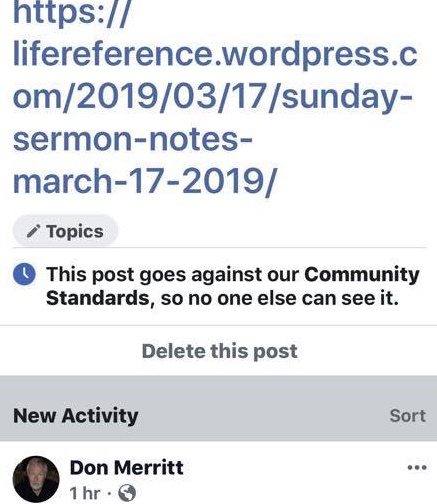
It seems that yesterday’s Sermon Notes were just too much for Facebook and had to be censored.

Yep, they blocked it for violating “Community Standards” which were no doubt established by someone a Corporate who has neither a face or a name.

I was running short on time, so I tried posting a little note instead saying that the Notes had been blocked, but here’s a link (to this site) if you are interested… and they blocked that too. Then I reposted the note without the link and that went through and remains on our Church Facebook page.

Later I wondered if Facebook has a new rule about links… after all, this was a rough weekend there since they had just been caught running a live stream of a mass murder spree in New Zealand. To test this, I posted a random link from the New York Times… and there was no problem.

Hmmm…

My cynical mind started wandering around and I wondered if this site is blocked, you know, because I’m some kind of counter-revolutionary element− Dangerous, unhinged, scary… and of course, my all-time favorite: “Right-Wing”.

After all this site is about Jesus and love and mercy and kindness− scary stuff!

To be sure, nobody at Facebook has ever read the post they blocked; the blocking was instantaneous. Ironically, the post is about the spirit of antichrist which is in the world we live in.

Well, it doesn’t really matter to me, I’ve never been a big fan of the site and I lost confidence in their integrity long ago, and have hardly been there since they blocked my posts from the Word Press “publicize” feature. I simply never bothered to go through the hoops to prove I’m a real person and who knows… maybe I’m only a figment of my imagination… maybe I’m a Russian agent or something.

Oh my!

OK fine, now I’m just making light of it all. Oh, and yes, I could have just copied and pasted the text without a link and it would probably have posted, and maybe I’ll do that later just to see. I guess my real question is this: Why is anyone still there on Facebook after everything we’ve learned about their operation over the last couple of years?

Ah well, I hope you all have a very pleasant Monday and a great week.

Posted in Christian living | Tagged , , , , , | 18 Comments

TLP Inspiration: March 18, 2019

Good Monday Morning from the Heartland.

Some time back I came upon a scene; this tree grabbed my attention because it was unusual…

The unusual thing about the tree isn’t the scar, but how well it has done in spite of the injury it sustained.  I’m not sure exactly what happened to the tree, my first thought was a lightning strike, but who knows.  It seems likely that whatever happened was storm related in some form…

We all deal with storms in our lives, sometimes literally, other times the storms are of a different sort.  Many of these are caused by our own actions and choices, many are not.  More important than anything else is how we respond to them.

When times are tough, do we let the circumstances keep us down; do we let circumstances defeat us?  When we are hurt by life’s storms will we dwell in our pain or rise again from it?  One of the most difficult lessons in life, at least in my life, was learning that we do have this choice.

Even more important than learning that we have a choice in how we respond to damaging storms in life is learning that we need not try to recover all on our own.  It may sound overly simplistic to some, but we can turn much of this over to our Lord, for His strength is greater than ours. We can rely on Him, we can lean on Him, we can trust in Him.   Living a Christian life is a life of setting self aside and serving the Lord Jesus Christ, and dealing with times of trouble is no different, so it stands to reason that He will sustain us all the more when we put our trust in Him and keep on serving others instead of serving ourselves.

Some may question all of this, but all I can say to them is “Come and see”

Incidentally, isn’t it interesting that medical science has noticed that people of faith have much greater survival rates from injuries and traumas than those who are not of faith?  It seems the same is true for heart attacks and strokes; where do we place our trust?

Posted in Christian living | Tagged , , , , , , , , | 2 Comments

Sunday Sermon Notes: March 17, 2019

Title: Test the Spirits

Text: 1 John 4:1-6

Dear friends, do not believe every spirit, but test the spirits to see whether they are from God, because many false prophets have gone out into the world. This is how you can recognize the Spirit of God: Every spirit that acknowledges that Jesus Christ has come in the flesh is from God, but every spirit that does not acknowledge Jesus is not from God. This is the spirit of the antichrist, which you have heard is coming and even now is already in the world.

1 John 4:1-3

Oh my word, what a timely text!  With the previous chapter ending by saying that we can know that Jesus lives in us because of the (Holy) Spirit He gave us, now John takes another step forward in our experience.  How can we tell who is right and who is not?

Simple: Test the spirits!

Well, it is actually simple, but at first it sounded a little creepy to me. On closer examination, however, it isn’t creepy and it isn’t hard.  Does a teacher or commentator acknowledge that Jesus Christ came in the flesh?  Do they acknowledge Him at all? If they do, they are from God; if they don’t they are not from God. If they don’t acknowledge Jesus, they aren’t from God, they are antichrist. If this is so, would we consider them a reliable source of insight?  Well, you can decide that one…

 You, dear children, are from God and have overcome them, because the one who is in you is greater than the one who is in the world. They are from the world and therefore speak from the viewpoint of the world, and the world listens to them. We are from God, and whoever knows God listens to us; but whoever is not from God does not listen to us. This is how we recognize the Spirit of truth and the spirit of falsehood.

1 John 4:4-6

John finishes this thought in these verses, making his point even clearer.  We have overcome the spirit of antichrist, because the Holy Spirit within us is greater by far that the spirit of antichrist could ever dream of being.  Interesting point to bear in mind when reading commentaries, blogs and books!  These false teachers speak from the viewpoint of the world, not from the viewpoint of God, and the world will listen to them. Yes, and while the world will listen to the false teacher, the spirit of antichrist, the world will not generally listen to us, for they simply can’t fathom what we are talking about, so let’s not be surprised by this.

I’ve spoken with many Christians who fear that they might be tricked and led astray, and I always tell them that they will not be tricked and led astray if they have a strong relationship with Christ.  That is precisely what John is asserting here.  It’s so simple to tell the difference, and when you were little, your mother or father probably told you how to recognize who is credible and who is not, for I’ll bet they told you to “consider the source.” To put it another way, I wouldn’t recommend that we take spiritual advice from an atheist, nor would I suggest that we should take Bible instruction from a non-believer.

Posted in Sunday Class Notes | Tagged , , , , , , , | 1 Comment

TLP Inspiration: 3/16/19

“You must follow me”

The other day I was reading John 21 which is really a simple story of the resurrected Christ appearing to seven disciples at the Sea of Galilee; it’s a story that is very familiar to everyone, and contains a passage that the preachers preach often (John 21:15-19).  In this passage, Jesus asks Peter three times if he loves him, and each time Peter says that he does, followed by Jesus saying either ‘feed my sheep’ or ‘feed my lambs’.  The third time Jesus asks, Peter’s feelings are hurt because Jesus keeps on asking…At the end of the passage Jesus tells Peter to “follow me.”

What really struck me was the part that came right after this usual passage.

Peter looks back and sees John trailing behind them and says to Jesus, “What about him?”  I wonder how many of us have done this sort of thing:  We know that we have been called to follow Jesus, and instead of quickly answering that call, we look at someone else and ask, “What about him?”  Now in Peter’s defense, Jesus has just indicated the manner of his death (v. 18) and maybe Peter understood this, the text doesn’t quite make that clear.  Maybe Peter was very sensitive at that moment because he felt guilty when it hit him that Jesus has just asked him if he loves Jesus the same number of times that Peter denied Jesus… The fact remains that Peter looked away from his call and tried to put the spotlight on someone else.

Answering a calling isn’t always convenient; it isn’t always what we want to do.  It may involve giving up a great deal to follow Jesus, a career, a great income, possessions, position and so on, and yet it is our call.  What must we do?

Jesus’ answer is classic: He tells Peter essentially that John’s relationship with Him is none of Peter’s business: “You must follow me.” (emphasis added)

Peter did.

What will we do?

Posted in Christian living | Tagged , , , , , , , , | 3 Comments