Peace Be with You

Finally, brothers and sisters, whatever is true, whatever is noble, whatever is right, whatever is pure, whatever is lovely, whatever is admirable—if anything is excellent or praiseworthy—think about such things. Whatever you have learned or received or heard from me, or seen in me—put it into practice. And the God of peace will be with you.

Philippians 4:8-9

Everybody wants peace in their lives. Peace to think, peace to live and to achieve their dreams. Peace to be happy and secure, to raise a family, to enjoy the fruits of their labors. Yet life has a way of barging in on us, of bringing problems, of pushing and pulling us into all kinds of stress and anxiety− how can we have peace in our lives and live in a world that is so full of problems?

I wish I could take all of your problems away, but sadly, I can’t. I have problems too, and they just keep on coming. I get one solved, and something else always seems to pop up.

There is some good news though; it’s right there in these verses…

whatever is true, whatever is noble, whatever is right, whatever is pure, whatever is lovely, whatever is admirable—if anything is excellent or praiseworthy—think about such things.

Yes, there are all kinds of problems, but that doesn’t mean that we must dwell on them, stew on them or be overcome by them; you see, we can still have God’s peace, even in the midst of the problems of this life. Focus on the kinds of things Paul mentions here. Set your eyes on the things that are from above, clothe yourselves with Christ, and… the God of peace will be with you.

See? I told you there was good news!

Take the problems of life to God, leave them with Him. Yes, that’s right, leave the problems with God. I’m not saying that everything will just be fine and dandy all the time, but you can have His peace with you through problems, and God’s peace is a lot more helpful in solving problems, that anxiety is. When did stress ever make difficulties or challenges easier to deal with?

Yet the peace of God will enable you to see solutions much quicker when you need them, and if nothing else, will help us to put things into a much better perspective.

So, think about such things…

Posted in Christian living | Tagged , , , , , , , | 3 Comments

Sunday Sermon Notes: April 25, 2021

Title: Searching for More Clues

Text Genesis 1:28-31

The Image of God and the Apostle Paul

The Apostle Paul was a Jew, in fact he was a Pharisee; everything about him was Jewish, including his mindset. He was the Pharisee who persecuted Christians, who met Jesus on the road to Damascus and who gave his life to Christ and became the apostle to the Gentiles, and in the process of all this, he wrote the largest part of the New Testament sending his writings to Gentiles. Ironic, isn’t it?

A common theme that runs through his writings is that of the old way of life versus the new life in Christ, and in discussing this, he used several ways of explaining it. Perhaps the most common of these was his dichotomy between “the flesh” and “the spirit”, but he also described the same thing in other terms; the first man v. the second man, the old man v. the new man, the Law v. life. In all of this, Paul makes essentially the same point: that we have choices to make.

On the one hand, we can continue to live according to the ways of this world, just like we did before we had a relationship with Jesus Christ, or we can live a new life in Him. We can worry about the transactional legalism of the Law, or we can be free in Christ; yes, that is our decision to make. None of that, however, tells us that our physical forms are anything other than the image of God, nothing Paul has written tells us that our bodies are bad, wicked, evil or terrible; actually, the opposite is true.

If God made us with physical bodies that are evil, wicked, shameful and oozing sin, then why would using our bodies for sinful purposes be “immoral”? In such a case, we could rightly say that God made us sinful and wicked, and we just can’t help being what God made us, but Paul (not to mention Jesus) taught the exact opposite. Paul not only gave us the problems, he also gave us the solution: “be transformed by the renewing of your mind”, and “set your mind on things that are above”. Humanity’s great challenge comes not from evil in our physical bodies, but from the wrong kinds of thinking, for we start our journey with Christ thinking like everyone around us, rather than seeing things from a more heavenly perspective. Consequently, our focus is on the things of this physical life; money, food, shelter, pleasure, entertainment, sex, luxuries, sensuality, emotions, feelings, passions and social positions… just like the pagans.

Does this kind of thinking describe Jesus? 

Paul did not contradict the notion that we were created, in every way in the image of God, for it is precisely because we were created in God’s image that this is important.

And we don’t have to do this on our own… that’s why we have the indwelling Holy Spirit.


Back to the Beginning

God blessed them and said to them, “Be fruitful and increase in number; fill the earth and subdue it. Rule over the fish in the sea and the birds in the sky and over every living creature that moves on the ground.”

Then God said, “I give you every seed-bearing plant on the face of the whole earth and every tree that has fruit with seed in it. They will be yours for food. And to all the beasts of the earth and all the birds in the sky and all the creatures that move along the ground—everything that has the breath of life in it—I give every green plant for food.” And it was so.

God saw all that he had made, and it was very good. And there was evening, and there was morning—the sixth day.

Genesis 1:28-31

By now, we have a pretty good idea that our having been created in the image of God applies to us as a total package; body, soul and spirit. If this is true, as it appears to be, then we should find evidence in the story of Adam and Eve, something that would confirm this image in action or application. These verses from Genesis 1 follow the text we looked at recently in which “image” and “likeness” were first mentioned, ending with both the male and the female comprising all or part of God’s likeness.

Right away, God tells them to “be fruitful and increase in number” which is an obvious reference to making babies. I’m pretty sure there is a clue here, what do you think? God continues to say that their increased numbers should fill the whole earth “and subdue it”, and I am thinking this is a second clue. Finally, God tells them that they (humanity) should “rule over” all of the creatures that God has created, or as the old King James said to “have dominion” over them.

Let’s begin with that one, that humans should rule over all of the creatures that God created, to “subdue” the earth. Who is it that rules over all of Creation?

That’s an easy one, for we all know that God rules the universe through the Person of Jesus Christ who rules as King of kings and Lord of lords. Thus, when God told Adam to “subdue” and “rule over” He was in effect delegating a portion of His divine prerogative to them. They would rule according to God’s will and purpose over the earth.

Stop and consider: These two original people, bearing the image of God Himself were to multiply through a physical act to fill the earth with more people bearing the image of God, to subdue and rule over all that God had created here on earth. In doing so, they would be (in His image and doing His will to accomplish His purpose) the very expression of who and what God is. This is why God created humanity; to express Him through fellowship with Him, and quite clearly that fellowship consists of both relationship and His purpose.

Why did Jesus come to earth in the incarnation?

Yes, He came to go to the cross so that God’s original purpose could be restored and attained. By the cross, fellowship between Man and God that had been broken (Gen. 3) was restored, and today it is back in place, only our purpose is to “subdue the earth” by making disciples for the Kingdom of Heaven which upon Jesus’ return will culminate in the removal of all evil from the earth.

Back to Genesis…

Verses 29-30 contain the terms of this arrangement: God gave us all of the trees and plants for food, and forbade them to eat from that one certain tree; follow the rule, and all is fine and dandy, break this one simple request, and there would be problems…

There is a parallel in Genesis 2; let’s take a look…

Genesis 2 gives us a more detailed account of Adam and Eve, the story goes along smoothly as we have already seen, until the end, where there are two comments that seem to come from left field. Here’s the first one:

The man said,

“This is now bone of my bones
    and flesh of my flesh;
she shall be called ‘woman,’
    for she was taken out of man.”

That is why a man leaves his father and mother and is united to his wife, and they become one flesh.

Genesis 2:23-24

Verse 23 is Adam’s comment in quotes; what a nice little ending to that part of the story: Next section…

And then verse 24 drops out of nowhere, the narrator is speaking suddenly in a way that doesn’t actually fit the rest of the chapter; if Moses was the author of Genesis, then why did Moses add that verse?

I took the liberty of a little research, and I discovered that this word string “one flesh” appears 5 times in Scripture, one is our text, and the other four are in the New Testament, and in two of those, Jesus was quoting Genesis 2:24. Hmm… interesting.

The first one of these is found in Matthew 19:

“Haven’t you read,” he replied, “that at the beginning the Creator ‘made them male and female,’  and said, ‘For this reason a man will leave his father and mother and be united to his wife, and the two will become one flesh’? So they are no longer two, but one flesh. Therefore what God has joined together, let no one separate.” (Matt. 19:4-6)

In this text, some Pharisees were trying to cause Jesus to say the wrong thing so they could accuse Him of something, anything, and they approached Him on the subject of divorce. Notice that in His answer, Jesus goes all the way back to Genesis 2:24 and highlights God’s intention that the male and the female shall come together and become “one flesh” in telling them that God is not so keen on divorce. For our purposes in exploring the image of God and its implications, knowing that male and female are bearers of the image of God, and that they are intended to become one flesh, it is hard to miss the presence of great significance in this statement. Mark also quotes Jesus using this verse in Mark 10:8 in answer to this same question.

Paul, in 1 Corinthians 6:12 ff. was discussing sexual immorality in a larger discussion of freedom in Christ. He makes the point that the human is intended for the Lord, and that each is one of the members of Christ and then asks, “Shall I then take the members of Christ and unite them with a prostitute? Never!” (6:15b). He goes on to say, “Do you not know that he who unites himself with a prostitute is one with her in body? For it is said, “The two will become one flesh.”  But whoever is united with the Lord is one with him in spirit.”  (6:16-17). There is a clear connection being made between bearing God’s image, becoming one flesh with a spouse and being united with God in His purpose. One more text:

Paul gives instruction for marriage in Ephesians 5:21-33; everything he wrote in these verses is about marriage, husbands and wives… until the surprise ending:

After all, no one ever hated their own body, but they feed and care for their body, just as Christ does the church—for we are members of his body. “For this reason a man will leave his father and mother and be united to his wife, and the two will become one flesh.”  This is a profound mystery—but I am talking about Christ and the church. However, each one of you also must love his wife as he loves himself, and the wife must respect her husband.

Ephesians 5:29-33

Once again, the text moves along very smoothly and with no surprises, and Paul drops a bombshell: He isn’t really talking about marriage at all; he’s talking about our relationship with God, as pictured by the relationship of Christ and the Church. Even more amazing than that, the aspect of marriage that is the clincher in all of this is the husband and wife being “one flesh”. Put another way, when husband and wife unite sexually, we have a picture of Mankind uniting with Christ. Can you think of any other word that would mean the same thing as “picture”?

Two come to mind right away: One is “image” and the other is “likeness”.

I think this is a really good place for us to stop and reflect, so I’ll end for now.

Oh wait! I almost forgot the other odd statement, Genesis 2:25:

Adam and his wife were both naked, and they felt no shame.

You know what? After reading these verses all together, this isn’t such an odd addition to Genesis 2 after all; why would they feel any shame; they were an expression of God’s glory!

Posted in Sunday Class Notes | Tagged , , , , , | 1 Comment

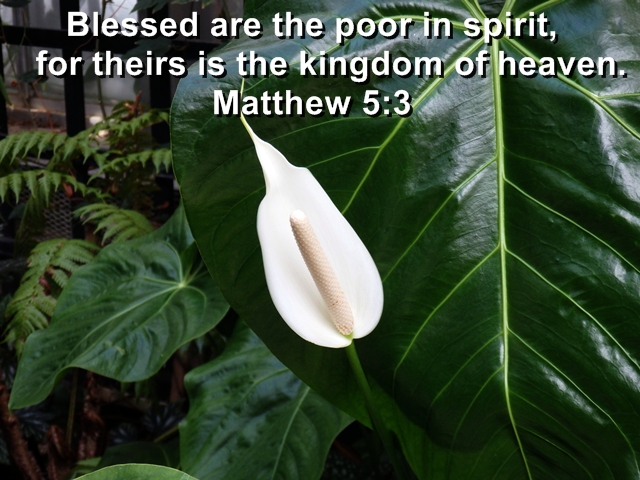
Poor in Spirit

The first Beatitude speaks of those who are “poor in spirit”. Much has been made about the difference between Matthew’s language and that of Luke in Luke 6:20, for Luke merely says “the poor”. Does Matthew have more in mind than mere economic circumstances?

I’m happy to let others argue, but it seems to me that Matthew, a Jew, might be aware of the Old Testament idea of poverty not only in literal terms, but as a state of mind, for the Hebrew word for “poor” has this additional connotation to it. In those days, a poor person not only had to deal with bad economic circumstances, they also had to contend with the fact that they had fewer rights in society, for then as now, they lacked the resources to enforce their rights; consequently, they were at the mercy of others.

Living in such a state made it clear to anyone who could fathom the notion, that the poor must depend entirely upon God. Most of us today, even those of us who don’t enjoy material abundance, live in circumstances far better than those of a poor person in ancient times, and maybe we too have a hard time seeing what Matthew means; let’s look at it this way: In our world, a person of very limited means is never far from being destitute, while a rich person has a much larger buffer to get through tough times. The poor person knows they live close to the edge; the rich person can convince himself that everything is wonderful, that he is the master of his own life, and in doing so, he only deceives himself, for God is the master of everything. We see time and again in Scripture that a rich person has a great obstacle to overcome in following God, for he thinks he is the one in control, while a poor man has no such delusion to overcome, and no great wealth to hold him back. The poor person is free to follow the Lord, while the rich person carries his wealth as a millstone around his neck; woe is he.

The kingdom of heaven is both a present reality and a future hope, for it is with us today in Christ, and will be fully realized in its ultimate fulfillment when He returns. For the person who recognizes his or her current dependence upon God for everything in life, it is a present reality indeed, and a source of great joy, “for theirs truly is the kingdom of heaven.”

Posted in Bible | Tagged , , , , , , | 3 Comments

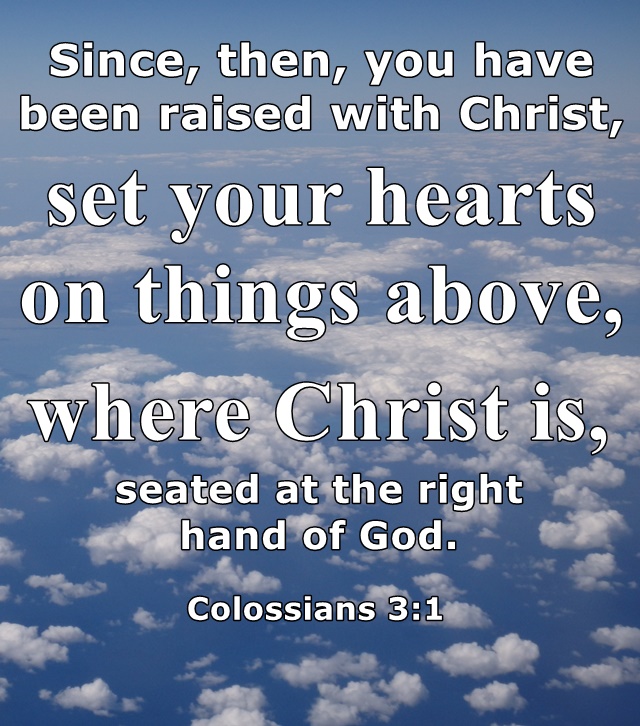
Set your hearts

donmerrittonline.com
Posted in Christian living | Tagged , , , , , | Leave a comment

It is good…

It is good to praise the Lord
    and make music to your name, O Most High,
proclaiming your love in the morning
    and your faithfulness at night,
 to the music of the ten-stringed lyre
    and the melody of the harp.

Psalm 92:1-3

As he often did, David has given us a psalm of praise. This one is a little different from some of them, just as it is a little different from most modern songs of praise. Notice that in this one, David isn’t putting the praise in the future tense. Sometimes I read his psalms or hear modern songs that say we (I) will praise the Lord, and then it never really seems to take place; just a promise that at some future point we’ll get around to it.

It may interest you to know at this point that I irritate my wife frequently reacting to what she says instead of what she means. Anyway, this time, David is clear that it is a good thing to praise the Lord both in the morning and in the evening.

The praise in this case is through music, in the morning for God’s great love, and in the evening for God’s steadfastness or faithfulness. That way, we begin our day reminded of God’s love for us, setting a certain tone for the day, perhaps reminding us that He has commanded that just as He has loved us, so too should we love our neighbor. In the evening, when the darkness comes and we prepare to lay down and sleep, David would have us be reminded that God is faithful and steadfast, watching over us through the night, no doubt a great comfort to a man who spent so many years being hunted by his enemies.

Yes, this is a good thing for us too, for what better way is there to begin and end each day by giving all praise and glory to God for all that He has done for us?

Posted in Christian living | Tagged , , , , , , , | 5 Comments

Photo of the Week: April 22, 2021

Posted in Photo of the Week | Tagged , , | Leave a comment

The Lord is my Shepherd- 3

You prepare a table before me
    in the presence of my enemies.
You anoint my head with oil;
    my cup overflows.
Surely your goodness and love will follow me
    all the days of my life,
and I will dwell in the house of the Lord
    forever.

Psalm 23:5-6

Speaking directly to the Lord our Shepherd in these final two verses, the Psalmist refers to God’s amazing provision for His people in the face of the trials and hardships that are faced in every life in this world of ours. None of us sail through life without problems; none of us gets a free ride. Yet even in the face of our enemies, the Lord provides all we need. In the midst of hard times, we sometimes forget that, but when we look beyond our circumstances, there He is; He never lets us down.

I really appreciate the last verse; it sums up our relationships with our Shepherd in a wonderful way. Just the notion of being followed around by goodness and mercy sets the imagination free to experience the wonder of His presence. Even so, most of the time when I look around me, I do not see goodness and mercy− but think for a moment. Who embodies both goodness and mercy?

Exactly! It’s Jesus, our Good Shepherd who is always with us, in times both good and bad, in times when we feel worthy of His presence, and when we do not.

We are never alone in this life, nor will we ever be alone through eternity, for we dwell in His house forever.

I don’t know about anyone else, but all of the sudden, today isn’t looking all that bad.

Posted in Christian living | Tagged , , , , , , , , | Leave a comment

The Lord is my Shepherd- 2

Even though I walk
    through the darkest valley,
I will fear no evil,
    for you are with me;
your rod and your staff,
    they comfort me.

Psalm 23:4

The Lord is my shepherd; He leads us, He provides for us, He protects us…

Even so, there are times in every person’s life when we find ourselves at our lowest point, our darkest hour, yet even there our Lord is with us: You and I are never alone. Things may go wrong, our friends might turn against us, our families might walk away from us, we might lose all our worldly goods, but He is always there.

It could be a natural calamity or an illness. Maybe it’s our finances or employment, or perhaps persecution or injustice, yet He still provides: The Good Shepherd never abandons His flock. By His very faithfulness, no matter how dark the moment may be, His presence is like a banquet set before our enemies, for in His presence what can they really do to us?

There He is, the Lord our Shepherd. With His rod He will deal with those who pursue us, with His staff He will lead us back to His light; we take comfort and refuge in Him.

When you think about it, we really do have nothing to fear in this life since He will never abandon us. Come to think of it, the only real question is, will we be as faithful to Him as He is to us?

Posted in Christian living | Tagged , , , , , , , | Leave a comment

Weekly Bible Study Notes: April 21, 2021

Dirt and Spit

Act 1

John 9:1-12

There was a man who was born blind, reduced to beggary, and walking along one day; the disciples ask Jesus who sinned that he should be blind, he or his parents. Jesus corrects their false premise telling them that no one sinned, but this man would give glory to God through his condition. Then Jesus did an odd thing; He spit into the dirt and made a muddy paste which He rubbed on the man’s eyes, then He told the man to wash his eyes off in the Pool of Siloam and he would be able to see.

Yet just before doing this odd thing, He had something else to say to the disciples:

As long as it is day, we must do the works of him who sent me. Night is coming, when no one can work. While I am in the world, I am the light of the world.

John 9:4-5

As we will see, John will use day and night, light and dark, to illustrate Jesus’ presence or absence. As we continue to move closer and closer to the time of His arrest, Jesus will continue to say things like “while it is still day” and “the night is approaching.” In fact, as we will see later in the book, Jesus describes the period from His arrest up until His resurrection as “night” or “darkness”. So, at the point of this story, it is still day and there is work to be done to glorify God.

There is some very interesting imagery in this account, there must be since spit and dirt are seldom known as a restorative for sight; if they were I’d have tried them myself! When Jesus spit into the dirt, that saliva came from His mouth, as does His Word. Recall the Word in the beginning that was with God, and which was God, and then which became flesh and made its dwelling among us? That is what is being pictured here. As for the dirt, do you recall what God made Adam from? Ah yes, it was dirt! So, the Word comes from the mouth of Jesus and is combined with the soil which represents humanity and is applied directly to the part of the man that isn’t whole. Then the man, who has never seen Jesus, does what Jesus has commanded him in perfect obedience, and is made whole again, in this instance receiving his sight for the first time. In fact, we wouldn’t be far off track if we said here that the man had seen the light.

Did you notice verse 7? The Pool of Siloam “which means sent.” Think about this for just a moment: Jesus combined His Word with humanity and then they are sent out on a mission.  What happens when we receive Christ? His Word combines with our humanity and we are sent to make disciples, and when we respond in obedience, we are made whole. Now in saying this, I don’t mean just that our sins have been forgiven, for that is only the first step in life’s adventure with Christ. For it is within the adventure of following Him, over time you might say, that we are made entirely whole, as we see the light of His Truth at work within us… and so it was with this man.

What an amazing little story this is!

The man’s neighbors had lots of questions, and so do our neighbors when they see Jesus at work in us, but unfortunately, the Pharisees are about to weigh in on this, and that is a whole different story, just as it is for us when the modern-day Pharisees get involved…

Act 2

John 9:13-34

Jesus’ giving sight to a blind man came to the attention of the Pharisees; an official investigation of this lawlessness has been opened.

What’s that you say- what’s lawless about healing a blind man?

Oh sorry, didn’t I mention it? Jesus healed the guy on the Sabbath, and we know how they feel about that don’t we?

Look at this text; can’t you just see these Pharisees who have already decided the outcome, trying to get the answers they need to justify what they have already decided they are going to do? Those Pharisees might even make a Congressman blush!

They question the man, but not satisfied, they question his parents, after all how can they be sure he was ever really blind? The parents say he was blind and he is their son; they should know.  Yet when asked who had healed their son, they are afraid to be associated with Jesus, for the corruption of their leaders is well known; they throw the question back to their son. The Pharisees question him a second time.

They ask him again to tell them who did this, only this time, they want the truth:

He answered, “I have told you already and you did not listen. Why do you want to hear it again? Do you want to become his disciples too?” (v. 27)

This is one of those times I wish I could see their faces; would you like to become His disciple too?

Then they hurled insults at him and said, “You are this fellow’s disciple! We are disciples of Moses! We know that God spoke to Moses, but as for this fellow, we don’t even know where he comes from.” (vv. 28-29)

If you have been following along, then you will remember that it was only a couple of chapters back that the Pharisees were sure Jesus wasn’t the Messiah because they knew where He came from; a tangled web indeed!

The man answered, “Now that is remarkable! You don’t know where he comes from, yet he opened my eyes. We know that God does not listen to sinners. He listens to the godly person who does his will. Nobody has ever heard of opening the eyes of a man born blind. If this man were not from God, he could do nothing.” (vv. 30-33)

The parents might have been afraid of the Pharisees, but this guy is on fire! If I were advising the Pharisees, I would tell them to end this interview in a hurry before they screw it up even further… and they did:

To this they replied, “You were steeped in sin at birth; how dare you lecture us!” And they threw him out.

Like any other group of mediocre politicians, they avoided the truth by calling the guy some names and having him tossed out. After all, isn’t that what you do when the issue becomes too hot to handle?

We’ve already seen the way that the issue of healing on the Sabbath plays out between the Pharisees and Jesus, yet the Pharisees just know they can trip Jesus up so they will have an excuse to murder Him. Their minds are closed, their hearts are hardened and their backs are turned on God, now it’s just the small matter of doing away with the inconvenient truth. Does this remind you of anything today?

Act 3

John 9:35-41

When He next sees the man, the man came to believe in Him and worshipped Him. This brings us to verse 39; why doesn’t anyone ever quote it?

Jesus said, “For judgment I have come into this world, so that the blind will see and those who see will become blind.”

John 9:39

Of course, He also said that He had not come to judge: Here to judge, or here not to judge?

What shall we say?

This is an unusual context, isn’t it? Jesus is playing on these words to show that the Pharisees have condemned themselves by their ruthless arrogance, for they claim to know all and see all, and yet when confronted with an amazing manifestation of the power and glory of God, as they were when this poor man received his sight, all they can think of is how to downplay the whole thing so they can keep their influence. So, they conjure up their little investigation into the facts of the case, but not before they have already determined its outcome, and in the end, they have kicked the once blind man out of the assembly because he had the audacity to tell the truth.

There were some Pharisees present who overheard this exchange; look at their condescension:

Some Pharisees who were with him heard him say this and asked, “What? Are we blind too?” (v. 40)

Can you imagine having that much attitude at that precise moment? Jesus explained:

Jesus said, “If you were blind, you would not be guilty of sin; but now that you claim you can see, your guilt remains. (v. 41)

In a simple one-liner Jesus smashes any hope they might have of saving the situation. Have you ever noticed that often it is the very person or persons who should know best, who refuse to accept the obvious if it proves a threat to their position and influence? Since they admit they have the knowledge, that they should know better, they cannot claim innocence, no, not ever.

Posted in Bible | Tagged , , , , , , | 1 Comment

The Lord is my Shepherd

The Lord is my shepherd, I lack nothing.
 He makes me lie down in green pastures,
he leads me beside quiet waters,
 he refreshes my soul.
He guides me along the right paths
    for his name’s sake.

Psalm 23:1-3

With these three verses, we begin one of the most memorable pieces of writing in all of recorded history, words of comfort, of safety, of enduring hope and peace.

Yes, peace; that’s what we feel in reading these words:

The Lord is my Shepherd…

Have you ever wondered why the Lord used sheep and a shepherd as metaphors to illustrate the relationship that He desires with us− it’s kind of interesting, isn’t it?

The shepherd leads the sheep; the sheep don’t lead the shepherd. The sheep are part of a flock, they don’t all run off to do their own thing. The shepherd decides where they will all lie down to rest; not the flock. The shepherd provides for the needs of the flock, the sheep don’t decide what they want and go for it; the shepherd restores their souls in the process. The flock allows the shepherd to lead them, they follow wherever He leads them: They surrender control to the shepherd.

I really can’t say how people reacted to this when it was first written, but in our time and place, most of us have trouble doing that− trusting, following, surrendering. I don’t know about you, but I want to be in green pastures, beside still waters with my needs met and my soul restored. Yet I’m inclined to make my own plans, my own paths and to be in control of my own destiny.

Yes, that’s it: I want to be in control.

The sheep do not lead the Shepherd, but I want the peace, the provision, the restoration…

O Lord, grant me the strength, the courage, to surrender to your leading this day, and all the days to follow…

Posted in Christian living | Tagged , , , , , , | 1 Comment