
Shining in the Darkness

John 1:5-9

Verse 5 begins the next little section of John’s text, a section that continues through verse 13. The theme is that of the manifestation of the Word in this dark world, and in this it is interesting to note the transition from the Word, to God and then of Word-God into “light’. We can easily see through this device that the three terms, Word, God and light are being used interchangeably to describe attributes of God, thus they are One in their reference to Christ, who is as yet unnamed in the text.

The light shines in the darkness, but the darkness has not understood it.

John 1:5

Once again, John has put into one simple statement a fact that theologians have struggled with for centuries; the world around us just doesn’t “get it”. OK, those poor souls who live in the darkness of this world don’t understand the light; why does this surprise us? At the same time as we are surprised that this world struggles with the message of Christ, some of us are surprised that we should be called to reach out to the world around us to deliver the message of light to them and help them to see it for what it is; grace and truth. Why should we be surprised to be called to help others understand it? Why should we resist this calling?

There was a guy who did not resist the calling, and his name was John. This John is not the same guy who wrote the gospel, yet both of them were only too happy to share the light with a dark world. Verses 5-9 set up what follows by pointing out that this John (the Baptist) was sent to prepare the way for the Messiah who was about to burst upon the scene in the person of Jesus. John was not the light, just as you and I are not the light, yet he was sent to prepare the people to hear the message that would come in Christ.

In our time, the light has already come, and we have received it and received grace as a result. We are sent to share that light, and to help those around us to comprehend it that some should receive it also and share in its blessing. When you think about, this is an awesome calling.
Posted in Bible | Tagged , , , , , , , | 7 Comments

In the Beginning

In the beginning was the Word, and the Word was with God, and the Word was God. He was with God in the beginning. Through him all things were made; without him nothing was made that has been made. In him was life, and that life was the light of all mankind.

John 1:1-4

John begins his account with the words, “in the beginning” with a very different beginning in mind than we find in Genesis 1:1, for while Genesis begins with the creation, John begins with God alone.  The “God” that John refers to here is first called the Word (logos) God, the uncreated Creator, before the creation of anything… The Word. That “Word” was there first of all… with God; in fact the Word was and is God.

We throw those terms around in our day, don’t we? “The Word” referring to the Scriptures, and we seem to like to use it to prove our various points in arguments with each other as though the  “Word” is our own very precious tool for debating. Yet John, the Apostle of Jesus Christ uses it as a name for Almighty God.

Notice how the Word becomes God, and then in the next verse God becomes “he.” He was with God in the beginning. The Word was with God in the beginning: “The Word” “God” and “He” were all together in the beginning, before anything had been created.

They are One.

Jesus is God’s messenger to mankind, as well as being the embodiment of God’s message (Heb. 1:1-4)  It was by His Word that the universe came into being, and it is by His blood that we may enter into relationship with Him, as told in His Word.  Thus, we may say that the Word is not only God’s person, essence and power, but that it is one and inseparable from the person of Jesus Christ, who is entirely one with God. Verse 2 is set up as transition in the sense that it begins the move from “what” to “whom”; from “the Word” to “he”: Jesus was there.

Now it becomes clear and unambiguous that this “he” is the one through who all things have been made.  This is stated positively “all things” and negatively “without him nothing…”  Within him was life which reminds us of God breathing life into Adam. (Gen. 2:7)  “He” contained life, was its very source, and this essence will be the light of the world.  Life and light are two themes that carry throughout the entire gospel of John, and will become more and more clear as we go on.  For now, suffice it to say that His very essence is “Truth” and that will illuminate a dark world that carries on without either Truth or God’s presence, since fellowship with God had ceased after the entry of rebellion into the world.

I hope that you have noticed how much theological truth that John has expressed in four simple, clear and easy to understand little verses; scholars write volumes and can’t say so much. This is precisely why I always tell my students that John’s gospel is very much a “Big Boy” book.

Posted in Bible | Tagged , , , , , , , , | 7 Comments

A Brief Introduction to the gospel of John

Of all of the Gospels, John’s is without a doubt my favorite, just as John is my favorite New Testament author. John just has a certain way with words. His language isn’t the best grammar, and sometimes he has a way of writing in circles, yet as he does so, he leads to major revelations in which he takes the complex and makes it so very simple that it’s not easy to miss the point. Of course, much of the theology written in the centuries that have passed has succeeded in doing so, but it usually takes an awful lot of education and training to miss John’s points!

His Gospel is unique in that it is not synoptic, which is to say that it is the only one of the four that is not always in chronological order. It is a biography of sorts, but it is not merely the story of the life of Jesus, it is a revelation of deeper significance than one would gain from a recitation of narratives as Mark’s contains, for instance. John relates Jesus’ life from a heavenly point of view, while Matthew relates it from a Jewish point of view, Luke from a Greek point of view, and Mark from a Roman viewpoint. As a consequence, John is the only Gospel author who wrote to a universal audience. Why did he write the book? Here is John’s answer to that question:

“These are written that you may believe that Jesus is the Christ, the Son of God, and that by believing you may have life in his name.”

John 20:31

Simple enough.

He wrote the book sometime between 85 and 95 AD, with a clear New Covenant orientation, and begins in a way that only John writes about; a deeper view of the birth of Christ. He introduces Jesus Christ to us in a way that is similar to Hebrews 1:1-4 and 1John 1:1-4 which provides us with a Heavenly overview of His nature, position, identity and purpose, beginning with the words, “In the beginning….”  The “Christmas story” is usually told from Luke chapter 2, but in John chapter one you see the theology of that story.  Thus we can easily say that Luke, the historian gave us the facts, but John the Apostle of love gave us the behind the scenes background that gives Luke’s account a significance that is the reason this birth is celebrated 2,000 years later.

We’ll get started in earnest next time, when we go back to the very beginning…

Posted in Bible | Tagged , , , , , , , , | 25 Comments

Final Comments

Brothers and sisters, I urge you to bear with my word of exhortation, for in fact I have written to you quite briefly.

I want you to know that our brother Timothy has been released. If he arrives soon, I will come with him to see you.

Greet all your leaders and all the Lord’s people. Those from Italy send you their greetings.

Grace be with you all.

Hebrews 13:22-25

We don’t know for sure who wrote this letter to the Jewish Christians of Rome, but we do know why he wrote it. He was concerned for the people there who were dealing with such a terrible ordeal at the hands of Nero, one of history’s great villains.  These brothers and sisters in Christ had been pushed to the wall and were in danger of losing much more than their lives, so he wrote one of the most amazing letters ever written.

The author gave them a real glimpse of glory, God’s glory through Jesus Christ, and also of the glory that awaits His followers.  With his continuing message of holding on to what we have in Christ, he hoped to see these people through their ordeal and to come with them to the ultimate glory beyond this earthly vale, that true glory which is forever ours in Christ.

As we read these last few verses, how can we miss the love with which he writes?  Here is a man who is feeling for his flock, here is a man who truly cares about God’s people. Have you noticed that the word “love” is not mentioned in these verses?  Yet it is evident in the emotion behind the words:  This is love in action! This man knew of the suffering in Rome, felt for his people and took up his pen.  He didn’t simply say “I love you,” he showed them his love through his concern, and in the process he gave them the strength to carry on.  Yes, dear reader, we can learn so much from our study of this great letter to the Hebrews!

Posted in Bible | Tagged , , , , , , , , | 1 Comment

A Prayer of Purpose

Now may the God of peace, who through the blood of the eternal covenant brought back from the dead our Lord Jesus, that great Shepherd of the sheep, equip you with everything good for doing his will, and may he work in us what is pleasing to him, through Jesus Christ, to whom be glory for ever and ever. Amen.

Hebrews 13:20-21

The author of Hebrews is now in the final part of the letter, and he opens it with a prayer of purpose.  Let’s take a closer look, for it is quite instructive.

Our God is identified as the God of peace, something we might want to keep in mind, and then goes on to an interesting statement that has a way of summarizing the letter. “The blood of the eternal covenant” is a reminder that God has committed Himself to the New Covenant and its promises.  Notice that it was through the blood of the covenant, the superior sacrifice of our superior high priest, that brought Jesus back from the dead; you don’t see that spelled out very often, for usually we see God’s power cited for this.  Think about it: Jesus arose from the grave by the power of an indestructible life, He was raised by the power of God… and now He is brought back by the blood of the covenant.  What does that tell you about His blood?

I don’t know about you, but it strikes me as pretty powerful stuff.  It is the same stuff that all of our hopes are based upon… so what does that tell you about our hope and God’s promise?

“Powerful” is one word I can think of.

Next, Jesus is called “the great shepherd of the sheep,” reminding us that He is our Lord, our Master.  Here we come into the “what” that the author is praying for: May God “equip you with everything good for doing his will, and may he work in us what is pleasing to him”.  Notice that the author is asking only for things that accomplish God’s will and that please Him. He is not asking anything for himself. This, dear reader, is a prayer of power and purpose.  Jesus told us many times that whatever we ask for in His name will be given to us, but each time He said this, the context was clearly upon doing God’s will.  I have no doubt whatsoever that God answered this prayer directly. Obviously, praying in Jesus’ name is what follows when the author adds, “through Jesus Christ…”

I wonder how often we pray like this: Boldly for God’s purposes to be done and not our own; in power for God’s will in our lives, as opposed for our list of goodies.

Yes indeed, this is a prayer of purpose and power, may all of us pray such prayers.

Posted in Bible | Tagged , , , , , , , , | 5 Comments

Leaders

Have confidence in your leaders and submit to their authority, because they keep watch over you as those who must give an account. Do this so that their work will be a joy, not a burden, for that would be of no benefit to you.

Hebrews 13:17

This is a tough verse for me to comment about; I was in church leadership for roughly 20 years, and I doubt I ever once quoted it unless I was teaching Hebrews 13:  We live in cynical times…

Over the years, there have been great leaders in the church; there have also been some who were not so great; leaders can suffer from the same issues that everyone else may suffer from. Some may be in leadership for all of the wrong reasons, some may think that being a leader in the church makes them a big shot or an important person, and yes I have met a few like that.  In my experience, many church members are critical of their leaders, no matter what those leaders do, but I must tell you that in my experience, that sort of criticism usually said much more about the critic than the leader.

This simple verse has two points to it. First is the injunction for us to submit to Biblical authority within the church. Dear reader, if we cannot do this, there will never be unity in our churches. The second is that leaders must understand that they will give an account for their leadership tenure, for it is a heavy responsibility.  It occurs to me that I should say that when I speak of leaders in the church, I refer not to leaders within a denominational structure somewhere, but rather at the local congregational level, and this is because these are the ones this verse refers to, not denominational authorities. I can say this because at the time of writing, there were no denominational structures or authorities.

To be a leader in the church is not for everyone; it means that you become the servant of all. It involves making sacrifices that few will give you credit for, few will ever even know about. It means that you will be unfairly criticized by those you serve, and it will result in many sleepless nights and lots of prayers for guidance. In short, it is possibly the most wonderful experience anybody can have on the earth… but it isn’t for most people.

It is a whole lot easier if people complain and criticize less and focus on Jesus Christ more, that’s for sure.

Pray for us. We are sure that we have a clear conscience and desire to live honorably in every way. I particularly urge you to pray so that I may be restored to you soon.

Hebrews 13:18-19

Please read these 2 verses carefully, and you will detect a heart that yearns to be with the people of the church, apparently a church in which the author has served as a leader.  In verse 18 it is clear that he fully comprehends the responsibility of leading, the parental love he feels for his people, and in verse 19 you can easily see his longing to return to them in these difficult times of testing through which they are travelling. I can tell you from experience that this is how it “feels” to have been a leader in the church.

Posted in Bible | Tagged , , , , , , , , | 12 Comments

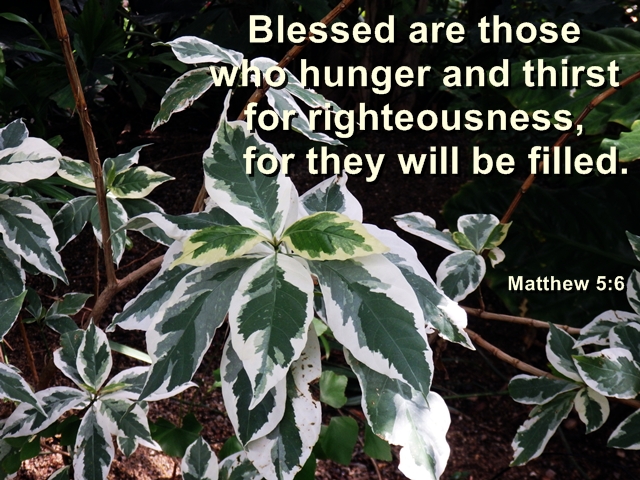
For They Will Be Filled


I doubt that I need to discuss what it means to “hunger and thirst for righteousness” so let’s jump directly to what will become of the one who has no such desire. I think we can safely assume that the one who has no such desire will not be blessed, and one who hungers and thirsts for wickedness will not only find what they are looking for, but they will also find God’s curse in His judgment. Such a person will always need to be looking over his shoulder, will be running from the law, and will seldom have a restful night’s sleep; if they are lucky, they’ll live long enough to die from stress related illness, if not they will die by the sword. Anybody want to sign up for that?

As with the other beatitudes, there is an apocalyptic element to this (see Isaiah 61). God’s ultimate gift to Mankind is the gift of righteousness, for when Jesus returns and culminates his Church, all evil will be eliminated and the righteous will abide eternally in His Kingdom without pain, suffering, oppression or death: Blessed indeed!

Posted in Christian Life | Tagged , , , , , , , , | 4 Comments

Pleasing Sacrifices

Through Jesus, therefore, let us continually offer to God a sacrifice of praise—the fruit of lips that openly profess his name. And do not forget to do good and to share with others, for with such sacrifices God is pleased.

Hebrews 13:15-16

Wonderful verses! Our author is wrapping up his exhortations now, thus the “therefore.” A sacrifice of praise; this isn’t really an Old Testament concept as much as it is a recognition of the reality that has come in Christ.  What is left to do but praise Him?  This is a sacrifice that pleases God…

But there is something of a “catch” in the second part of the sentence. This pleasing sacrifice is the “fruit of lips that openly profess his name.”  Think about those original recipients in Rome during Nero’s persecution.  Wouldn’t it make sense to keep your mouth shut if you were in their situation? Of course it would, there’s no need to invite trouble, right?

Well dear reader, that’s why the author called it a sacrifice; it was truly a dangerous thing to do.

Fast-forward to the 21st century…  How is it exactly that so many who live in freedom justify not speaking out in praise of Jesus Christ…? Yeah, I know, I’ve heard all of the excuses.

There is another new sacrifice mentioned in verse 16. We must “do good” and “share with others.”  Please take careful note of the word “do.”  As I’ve mentioned previously, the whole faith versus works argument is an argument based entirely on a false premise, for the two are not mutually exclusive.  We don’t earn anything by what we do… clearly!  We “do” because we love.  We love because He first loved us, therefore the “do” part is a response to His love.  Stop fighting it; it has nothing to do with earning something, it is a sacrifice that is pleasing to God.

As true as that is, there is more, for in serving others and “doing good” there is an added benefit, we grow closer to Him in relationship when we humble ourselves and put others ahead of ourselves. When the Body of Christ lives this way, the testimony to the world is powerful to say the least, and many more come to receive His love.  You see, dear reader that is what Christ’s Ambassadors are here to do in this strange and foreign land we call earth.

Posted in Bible | Tagged , , , , , , , , | 6 Comments

Do not be carried away

Do not be carried away by all kinds of strange teachings. It is good for our hearts to be strengthened by grace, not by eating ceremonial foods, which is of no benefit to those who do so. We have an altar from which those who minister at the tabernacle have no right to eat.

Hebrews 13:9-10

As he continues in his exhortations, the Hebrews author now moves into the area of “strange teachings.” This follows from his remarks in verses 7-8 in which he told us to “remember” our leaders who “spoke the word of God to you.” Strange teachings seem to refer to teachings that are at variance with the Truth, that are at variance to the pure Gospel of Jesus Christ.  Very clearly, any teaching that re-imposes the Old Covenant Law onto the New Covenant would count as “strange” indeed. He continues by pointing out that it is better for our hearts to be strengthened by grace, rather than by eating ceremonial foods which are of “no benefit.”  In trying to follow this, we might keep in mind that Jesus, the Living Word came to us “full of grace and truth.”  He didn’t bring us ceremonial regulations like those contained in the Old Covenant, He brought “grace and truth.”  The reality of grace and truth replaced the ceremonies, feasts and festivals; why put any reliance upon these things now that the New has come? In light of this, it always strikes me as interesting when I think of our special days, special meals and special ceremonies today…

The author underscores this with his comment about the altar that we have, that the Old Covenant priests have no access to; the real one in heaven that they cannot approach, as opposed to the “illustration” in the Temple. And now, the author has set up what comes next:

The high priest carries the blood of animals into the Most Holy Place as a sin offering, but the bodies are burned outside the camp. And so Jesus also suffered outside the city gate to make the people holy through his own blood. Let us, then, go to him outside the camp, bearing the disgrace he bore. For here we do not have an enduring city, but we are looking for the city that is to come.

Hebrews 13:11-14

In this little paragraph, the author makes a comparison between the sacrifice made in the earthly Temple and the fire consuming the sacrifices outside of the earthly camp, with the New Covenant sacrifice outside the city… with our being “strangers” on earth.  In order for us to fully appreciate this, recall that contrast of Covenants: The Old Covenant is an earthly exercise in every respect. It has outward laws, outward sacrifices and outward, physical promises.  It has a physical Temple and a physical earthly nation.  The New Covenant brings the reality of what was pictured in the physical aspects of the Old Covenant.  We are no longer citizens of an earthly realm, being now citizens of a heavenly Kingdom. We no longer have human priests presenting animal sacrifices in a physical Temple, we have the superior sacrifice of Christ, and we can now present ourselves in the heavenly Temple, in the actual presence of God. With this in mind, let’s look at verses 13-14:

Let us, then, go to him outside the camp, bearing the disgrace he bore. For here we do not have an enduring city, but we are looking for the city that is to come.

We leave the earthly city and go outside to where Jesus bore our sin and its disgrace in perfect humility, as servants.  We have no city here, for we are not citizens of earth, but citizens of heaven, and we look forward to the day when we will go “home” to our true heavenly home. Think about the impact of this to his original readers, in their trial of persecution.

Now, think about what this means for us…  Only our earthly circumstances are different, the Truth of these things is the same.

Posted in Bible | Tagged , , , , , , , , | 4 Comments

Persevere!

Marriage should be honored by all, and the marriage bed kept pure, for God will judge the adulterer and all the sexually immoral.  Keep your lives free from the love of money and be content with what you have, because God has said,

“Never will I leave you;
never will I forsake you.”
So we say with confidence,

“The Lord is my helper; I will not be afraid.
What can mere mortals do to me?”
Remember your leaders, who spoke the word of God to you. Consider the outcome of their way of life and imitate their faith.  Jesus Christ is the same yesterday and today and forever.

Hebrews 13:4-8

The Hebrews author continues to wind up his letter to Rome with exhortations, and at first glance this selection seems a little random, almost out of context, in fact.  We’ve been going through the amazing reality of the New Covenant, sweeping through redemption history, coming into the very presence of God… in a context of remaining faithful to the end, even through terrible persecution; even unto death.  Then the author suddenly begins to tell us to respect marriage, be pure, not to love money and to respect our leaders in the faith.  Circle the piece in the picture that doesn’t belong…

But don’t be too hasty!

You could say that these things are mentioned to remind the recipients not to slip into sin, and who could argue with that?  Yet it still doesn’t quite fit in context, does it?  Yes, yes, not slipping into sin is the correct Sunday school answer, but it hardly gets to the point; Sunday school answers usually don’t get to the point.

Remain faithful to the end, even unto death.  Faithful is a covenant term meaning t keep covenant.  Adultery is a violation of the marriage covenant. Have you ever known (or been) someone who is involved in an extra marital affair? These things seem to require a web of deceit and deception to keep them going, and there seems to be a certain drive to keep them going.  When the guilty party is found out, there is great carnage in their homes, relationships and in their lives in general. These things take a lot of work and attention, and I can say with great confidence that they do not promote or advance anybody’s relationship with Jesus Christ.  Sexual immorality tends to have the same kinds of attributes even if there is no marital issue involved.  How about the love of money and things?  While this may not always require secrecy, it does require attention and effort; a great deal of it, actually. Does it enhance one’s relationship with our Lord?  Hardly!

The author has been teaching us not to neglect our covenant relationship he has been encouraging us to remain faithful. Sexual immorality of whatever kind and the love of money are things that can become so all-encompassing in a person’s life that they can easily cause one to slip away from Christ, their faith and even to “fall away” entirely; thus these are not random exhortations at all. The quotations from Deuteronomy 31 and Psalm 118 take the exhortation to the next step, for they remind us that in Christ, we have the help we need to stand firm in our faith, to remain faithful and to persevere. Even the mention of our leaders who stand tall in their faith to teach, encourage and exemplify what it is to live in Christ is there to give us encouragement.  Leaders, this should also remind you of your responsibility to emulate Jesus Christ in everything that you do and say.

As we pause here to reflect, can you see how this all fits together?  It is as though the author is telling us to keep our eyes on Jesus, not to be drawn off track by the temptations of this world, but to persevere through any kind of trial, whether it is a trial of persecution or a trial of temptation so that we can remain faithful to the end. What he is not really doing here is citing mere “violations”, for he is going much deeper than that. He is asking us to consider our innermost priorities, just as Jesus taught in His Sermon on the Mount.

Posted in Bible | Tagged , , , , , , , | 4 Comments