More Images

In our last Revelation post, we saw that John ate and swallowed a “little scroll” that was as sweet as honey to taste, and that went “sour” in his stomach. After this, John was told “You must prophesy again about many peoples, nations, languages and kings” (10:11). He ate that scroll so he could prophesy, and the chapter ends. In chapter 11 we have his prophecy concerning “many peoples, nations, languages and kings.” (cf. Rev. 11:9)

Before we continue, I must ask you to keep two things in mind: First, that these passages are not literal, they are apocalyptic and use imagery to convey a message. Second, we are still in the interlude between the sounding of the sixth trumpet and the sounding of the seventh and final trumpet. OK, got it? Here we go…

There is both a “sweet” element to this passage, and one that isn’t so sweet; a positive and a negative message. John will frame this present evil age and the Christian’s experience in it, in the light of all that God has in store for us at the culmination of the church.

I was given a reed like a measuring rod and was told, “Go and measure the temple of God and the altar, with its worshipers. But exclude the outer court; do not measure it, because it has been given to the Gentiles. (11:1-2a)

Upon reading this, we might recall that in Ezekiel 40-43, the prophet is shown a vision of the temple and told to measure it with a measuring rod. In a similar way, John adapts this image to his subject here. The temple that John had known was divided up into several courts that were clearly marked. There was the Court of Praise, located just outside of the main building into which only Levite priests could enter. Here was located the Altar. Just outside the Court of Praise was the Court of Israel where only Jewish men could go. Outside that was the Court of Women, where Jewish women could gather to pray. These three courts were reserved for Jews only, which is to say only for people who were in a covenant relationship with God.  Farther away from the inner courts was the Court of the Gentiles, where even Gentiles could come; this was the court John was not supposed to measure.

While all of this is interesting history, we must remember that this is a prophetic vision, not a history lesson; John is not concerned with the literal temple and its various courts, he is giving us an image that makes an important distinction by comparing the temple with a present day reality. Just as there was a separation between God’s covenant people and everyone else in the temple, in our existing world there is a separation between God’s covenant people and everyone else. God’s covenant people in this age has nothing to do with literal Jews and literal Gentiles, for God’s covenant people are both Jew and Gentile, for they become His covenant people by entry into the New Covenant that was established by the blood shed by God’s Son on the cross. There is a very big distinction between those who have accepted God’s grace, and those who have refused God’s grace, certainly there is a big distinction from God’s point of view.

John is taking the measure of who is and who is not sealed with the seal of God, parallel to the 144,000 of Revelation 7. The fate of those included in John’s count will be quite different than those on the “outside’ and we will see this unfold shortly when we look at the two witnesses…

Before we can do that, however, we have a little more to consider here:

They will trample on the holy city for 42 months. (11:2b)

Clearly, “they” are the “Gentiles” the ones outside of covenant relationship with God… non-Christians. They will “trample” the “holy city”. The “holy city” Jerusalem in apocalyptic writing is much more than a dot on a map. Jerusalem came to be identified with Israel, almost the embodiment of the Nation of God. It was “holy” in that it was “set apart” for God’s service, the home of the temple, which was the very dwelling place of the presence of God on the earth in the midst of God’s people. In Revelation 11, it isn’t a literal place at all, it is representative of the place where God dwells on earth now, which is in the midst of His Church, and therefore, the “holy city” is the people of God. “Gentiles” trampling the “holy city” means non-Christians mistreating Christians.

Finally, we come to “42 months”. This is a very important symbol in Revelation, one we will see many times. It has a parallel with Daniel 12 that we have seen already (Dan. 12:6-7). In Daniel, we found “time, times and half a time”. What is 42 months? Three and a half years. Expressed as Daniel expressed it, this becomes 12 + 24 + 6 = 42. Generically, time, times and half a time looks like this: 1 + 2 + ½ = 31/2. The unit of measure determines the outcome, and since John mentions months, we have 3 ½ years, but John doesn’t always use this formula with months, sometimes it is years, other times it is days, as we will see.  In John’s day, time was reckoned with a lunar calendar that had 12, 30 day months thus 1,260 days become 3 ½ years as in 11:3.

This symbol in Revelations appears as follows: “Time, times and half a time” (Rev. 12:14. “Three and a half days” is in Rev. 11:9 and 11:11. “42 months” appears in Rev. 11:2 and 13:5. “1,260 days” appears in Rev. 11:3 and 12:6.

It is vital that we understand that all of these symbolize the same thing: In every case, they represent the period of time between John receiving the revelation of this book, and the final consummation of the Church; this entire age in which we live.

Therefore the message of 11:1-2 is that Christians will be persecuted from the first century AD until Jesus returns to the earth. That was the case for John, who received this revelation while in exile (being persecuted) on Patmos, and continues today, and will continue until Jesus returns.  In verses 3-6, John will elaborate on this, but we’ll have to wait until next time for that discussion; see you then!

Posted in Bible | Tagged , , , , , , , , , | 6 Comments

A Nostalgic Morning

I will soon be returning to Illinois after a few years in the Washington, DC area, and since I am about to leave here, I’ll let you in on the “secret” to seeing the sights of Washington. Oh yes, millions come here from all around the globe to see the sights, the great public buildings, the landmarks, the memorials and museums. They descend upon the city in huge numbers, only to fight tremendous crowds and steamy hot summertime temperatures. If you want pictures to take home with you of the great sights, it can be almost impossible to get an unobstructed view in the summertime, especially on the weekend.

If you can, visit Washington in the off-season, when the kids are in school, then do your sight-seeing in the middle of the week, after rush hour, and you’ll be fine. But if you are taking the family on a summer Saturday, just show up early, at say, 6 or 6:30 in the morning. This has two great advantages: First, you will have the place virtually to yourself; the tourists are still asleep! Second, you can cover the great sights while it is cool; great time for your “walking around” part of the day. Then, as the temperature begins to climb, the museums open up and you can spend the hot portion of the day seeing the museums of the Smithsonian.  Yes, they will get crowded, better a Tuesday morning in October, but if you can only come in the summer, this is the best way to see things… like the “natives” do.

This past Saturday, Mrs. M. and I took our last trip into town… that is, unless we do it again next week. At this hour (we arrived in town at about 6:15 am) there are actually parking places… everyplace… something that is normally only a dream. We parked near West Potomac park, very near the Lincoln Memorial. Right next to our parking spot, I was greeted by this scene…

…and a bit of nostalgia as recollections of a Saturday morning over 30 years ago came to mind. I remembered being on a walk one fine October morning, and as I walked by this place, I came upon a group of young  Congressional staffers, roughly my age, who were trying to make up a touch football game; they were a man short. I volunteered to play, and the game was on. Nine Congressional staffers, one White House staffer; opponents during the week, playing football together on Saturday; Washington was different in those days.

One of the really neat things about taking pictures early in the day, particularly when there are clouds in the sky, is that as the sun rises and the clouds move, you can stand in one place for 10 or 15 minutes and take several completely different pictures of the same thing as the light and colors shift before your eyes.

The Arlington Memorial bridge only looked like this for about 45 seconds. After that, it looked just like every other picture you’ve seen.

Here, the Lincoln Memorial has a pinkish hue as the sun struggles to poke out above the low clouds.

Standing in front of the Lincoln Memorial and looking down the reflecting pool towards the Capitol, the Washington Monument is in silhouette against the rising sun, lost behind the clouds giving a different effect than you usually see from here.

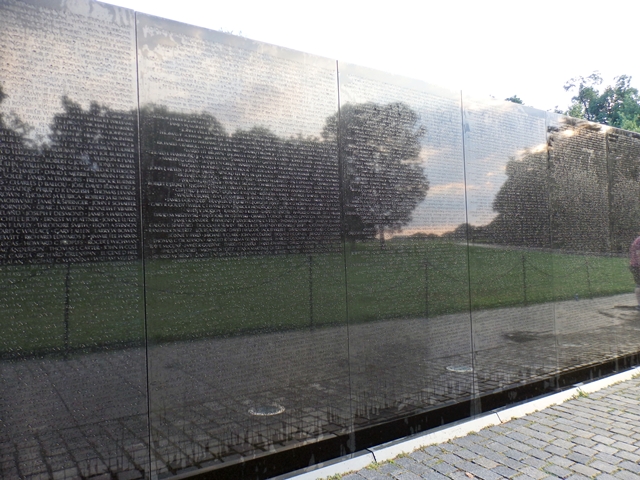
Millions come to Washington to visit the Vietnam Memorial. At this time of day, the only other people here are the crew cleaning the wall. In this light, the black wall becomes a mirror, as you can see.

In addition to the cleaning crews and the garbage collection crews, the squirrels are busy looking for tasty tidbits before all is collected…


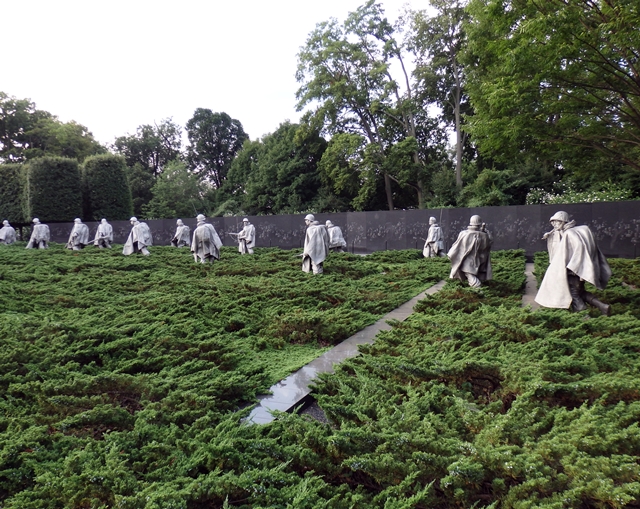
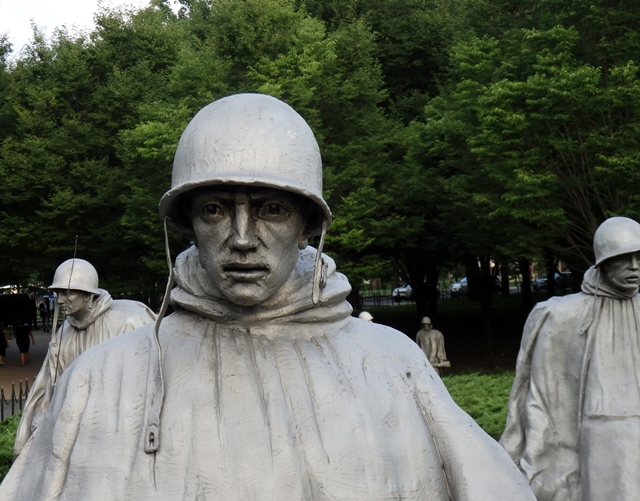
Of all of the war memorials for which Washington is famous, my favorite is the Korean War Memorial. Since the Korean War is often called the “forgotten war” I suppose I shouldn’t be surprised that it is not nearly as well attended as the others. Yet at least for me, it is by far the most poignant and moving. I don’t think there is any particular glorifying of war here, nor is there the great sadness of the Vietnam wall. This one is all about the men who fought. The central part of the Memorial is a life-sized group of figures in winter gear; a patrol. Here, nothing is way up on a pedestal, there is only you and the guys. They didn’t ask to be there, they aren’t the policy-makers calling the shots, they are the men who paid the price for the decisions and orders of others. This one is up close and personal; you can look these guys right in the eye.


We headed back to the car, there was still time for mobility. As we left the Korean Memorial, the Lincoln Memorial was in “regular” sunlight, and was beginning to look its normal self…


We moved to the Tidal Basin for a view of the Jefferson Memorial and a beautiful stroll along the water…

…and the reflections on the calm water, stirred only by the ducks that live there in the middle of the busy city. As in each of the other places we visited Saturday, memories flash through my head of earlier visits, earlier times, earlier experiences in a city that has vanished as time moves on and the world around us changes. Those were times that were not so bitter, not so divisive, in which people on different sides of politics could still work together to solve a problem… but that is all gone now… Maybe these are the tired reflections of an old man recalling the days of his youth in his sunset years. But then again, maybe not…

We know of course that our Lord rules this universe; if only He would open the eyes of Mankind to see the folly of our ways under the sun! But then, we also know that He sent us to bring His light to our dark world; so that He could shine through us.  Maybe, instead of wistfully wishing He would do something, our time would be better spent doing the work He has called us to…

I have no idea whether or not I will ever see these sights again, but I took quite a few photos, many more of which will no doubt find their way into one of my blogs in the coming months. Yep, they are digital so they will last forever, which as we all know, really means until the hard drive crashes!

Posted in Christian Life | Tagged , , , , , , , , | 18 Comments

An Interlude

Revelation 10

As we saw in the last vision, there is an interlude between the sixth and seventh seals. The scene opens with a great angel, providing us another look at the Lord Himself. Notice how the angel is described: The angel’s appearance is described in language we have already seen in Revelation. He has “a rainbow above his head” (see Rev. 4:3).  His face shines “like the sun” and his legs are glowing “like fiery pillars” (see Rev. 1:15-16). He is “robed in a cloud” just as God is described so often in the Old Testament. His voice is “like the roar of a lion” the very animal John compares Jesus to in Rev. 5:5. Amos also refers to the voice of God as like a lion’s roar in Amos 3:8. When he speaks, John uses the image of the “seven thunders” another common Old Testament image; God’s voice is often likened to thunder. This angel represents the Lord, no doubt about that.

The message that John is allowed to tell us has to do with the “little scroll” that John is told to eat. It is sweet in the mouth but turns his stomach “sour” because the little scroll contains a message that is revealed when the seventh trumpet sounds; the bittersweet message of the final judgment and the consummation of God’s people.

There is a very interesting parallel between Revelation 10 and Daniel 12:1-7. It looks something like this:

Daniel 12 Revelation 10
The angel is located above the water of a river (v. 6) The angel straddles the land and the sea (v. 2)
The angel predicts the culmination of history from the “labor pains” through to the final judgment and the consummation of God’s people. (12:1-3) The angel holds the little scroll containing the prophecies of the end. (10:2, 8-11)
The angel commands Daniel to seal the prophecy and hold it until the time of the end. (v. 4) The scroll is not sealed, but open.  The angel commands John to “eat it” so that he may reveal its contents to others. (10:2, 8-11)
When asked how long it will be before these things take place, the angel raises his hand toward heaven and swears by the God who “lives forever” that the fulfillment would be delayed, that it would happen in the future, after a time, times and half a time. (12:6-7) The angel raises his hand toward heaven and swears by “him who lives for ever and ever” that there will be no more delay. In the days when the seventh seal is about to be opened, the mystery of God will be accomplished. (10:5-7)


In Daniel’s time, the “labor pains” leading to the resurrection of the dead, the final judgment and the consummation of the church had not yet begun; these events were in Daniel’s future. By contrast, in John’s time, these events had already begun, even the resurrection of the dead, as Jesus, the firstborn of many brothers had already arisen from the dead. Thus, by John’s day, the “labor pains” leading up to the final events were in the present. For John… and for us… we are living in the “labor pains” (tribulation) the sounding of the first six trumpets. Yes, these are the days when the angel is “about to” sound the seventh trumpet and usher in the final events; it could happen today as a matter of fact.

As for the seventh trumpet, we will see what will happen when we get back together tomorrow. In the meantime, I’ve scheduled a little photo essay for 2 pm Eastern time for your amusement (at no extra charge) J

Posted in Bible | Tagged , , , , , , , , , , | 2 Comments

Subordinate Images: The Sounding of Seven Trumpets

One last subordinate image remains before we continue into chapter 10; the trumpets themselves. In this vision, John describes the future from his day until the final judgment and consummation of the ages within the context of seven trumpets, imagery that runs deep in Jewish tradition. There are several possible meanings that can be cited, each of which may make sense in understanding John’s intentions. Among them are these:

First, trumpets were used as a call to celebration, as in Num. 10:10. If this is John’s intent, then the sounding of trumpets could be a call to celebrate God’s kingdom rule.

Second. Trumpets were used as a signal of danger (Ez. 33:3; Amos 3:6; cf. Joel 2:15). If this was his intent, John might be using the trumpets as a warning of the present troubles and calling on us to take shelter in Christ.

Third, trumpets were part of the theophany of Mount Sinai (EX 19:6). If so, then John would be using the trumpets as a means of letting us know that God is present in all that is going on in this age.

Fourth, trumpets were used to mark the crowning of a new king (2 Sam. 15:10; 1 KI 1:39; 2 KI 9:13).  If this is so, then perhaps

John intends to show us of the impending crowning of our King at His consummation.

It is quite reasonable to assert any of these… or even all of these as John’s intention in chapters 8-9. Even so, I think that a fifth possibility makes even more sense. As I see it, the seven trumpets together are announcing the coming of the Day of the Lord. In Old Testament prophecy, the “day of the Lord” is used to describe any time when God is judging His enemies. One example of this is found in Joel 2:1-2, 10-11:

Blow the trumpet in Zion;
sound the alarm on my holy hill.

Let all who live in the land tremble,
for the day of the Lord is coming.
It is close at hand—
a day of darkness and gloom,
a day of clouds and blackness.
Like dawn spreading across the mountains
a large and mighty army comes,
such as never was in ancient times
nor ever will be in ages to come.


Before them the earth shakes,
the heavens tremble,
the sun and moon are darkened,
and the stars no longer shine.
The Lord thunders
at the head of his army;
his forces are beyond number,
and mighty is the army that obeys his command.
The day of the Lord is great;
it is dreadful.
Who can endure it?

New Testament writers identify the Day of the Lord with the Second Coming of Christ and the final judgment. Passages such as 1 Cor. 15:50-57, 1 Thess. 4:13-18, and possibly Matt. 24: 29-31 help to illustrate this.  We know that the number “seven” is the number of completion, so it may well be that John, by describing the entire time from his day to the final consummation of the church as “seven” trumpet blasts, may be telling us that this entire messy age is one long announcement of the coming of the Great Day of the Lord.

Posted in Bible | Tagged , , , , , , , , , | 6 Comments

This “Present Evil Age, perseverance and Answered Prayers

July  25, 2015 6:20 am

July 25, 2015 6:20 am

It’s a real shame that so many Christians in our time see Revelation as God’s people always under attack, and the consummation of this age as an assault on believers, for nothing could be further from the truth. I’m not a betting man, but if I was, I’d bet the house that John would be surprised and saddened by this, for he wrote Revelation is an encouragement for Christians.

When these things begin to take place, stand up and lift up your heads, because your redemption is drawing near.”

He told them this parable: “Look at the fig tree and all the trees. When they sprout leaves, you can see for yourselves and know that summer is near. Even so, when you see these things happening, you know that the kingdom of God is near.

Luke 21:28-31

Based on these words, I’d bet Jesus would be right there with John.

Think about it: the plagues of Egypt must have been frightening for the Israelites as well as for the Egyptians, but as soon as the plagues were complete, they were able to leave Egypt and head for the Promised Land. As Christians who are learning more about the Revelation story, we have come to understand these first six trumpets as plagues, with the understanding that as soon as they are complete, we will see the consummation of the Kingdom of Heaven; the culmination of redemptive history, what could be better than that?

Yes, there are problems in this life, and our world is a mess; there will be hardships, but those hardships aren’t anything like the end of the story. The end of the story is nothing short of glorious, and you have a seat at the party.

We haven’t really talked about it yet, but maybe we might find another interesting aspect to the Revelation 8-9 story if we do so…

And I saw the seven angels who stand before God, and seven trumpets were given to them.

Another angel, who had a golden censer, came and stood at the altar. He was given much incense to offer, with the prayers of all God’s people, on the golden altar in front of the throne. The smoke of the incense, together with the prayers of God’s people, went up before God from the angel’s hand. Then the angel took the censer, filled it with fire from the altar, and hurled it on the earth; and there came peals of thunder, rumblings, flashes of lightning and an earthquake.

Revelation 8:2-5

Consider this picture, the censor with the incense that is the prayers of all the saints of God is offered on the altar to God and cast down to the earth. What comes next, beginning in verse 6?

The sounding of the trumpets.

The events we’ve been looking at are in answer to the prayers of the saints: Your prayers!

I’ve made much of the Satanic and demonic nature of what is going on in this age, and any reasonable person might ask why God is allowing all of this to take place. Do you see it? In reply to our cries for deliverance, He allows the enemies of God and His people to do their worst, within limits, and in the end, they destroy themselves, and are powerless before the final judgment of God.

Now isn’t that an interesting thought for a Sunday?

Posted in Christian Life | 12 Comments

Subordinate Images: Demonic Forces

As we continue looking at the subordinate images in the first six trumpets, we find a great deal of the demonic at work in the present evil age in which we live. The images John uses to show this are:

The burning mountain, falling stars, Wormwood, demonic locusts, from the Abyss, Abaddon, Apollyon, and a demon army.

Throughout chapters 8 and 9, John has sought to emphasize the demonic nature of the affliction of the earth. Examples such as those of stars falling from heaven in the third and fifth trumpets make this clear. As we have already seen, stars in apocalyptic language usually represent angels, falling stars represent fallen angels; demons. The first of these turns the water bitter; John calls it “Wormwood”. It is interesting to note that the Greek word used is apsinthion meaning bitter or calamity. It is associated with the English word “absinth” which is the name of a plant that is said to be bitter yet delicious and both intoxicating and toxic. The Hebrew word is la’anah meaning bitterness; accursed, poisonous and is found in Lamentations 3:15 and Amos 5:7.   Other appearances of “Wormwood” (la’anah) in the Old Testament are Amos 6:12; Jer. 9:15; 28:15; Deut. 29:18 and Prov. 5:4. In the New Testament, the word (apsinthion) is only found in Rev. 8:11.

The second falling star (Rev. 9:1 ff.)  opens the Abyss meaning the “deep”  and in John’s time, this was thought to be the dwelling place of the dead or of demons. The Abyss is opened and a horde of demons comes forth into the world. This demonic army is led by the “king over them” who was called “Destroyer”. Is this Satan? Scholars debate this of course; it is certainly possible. In either case, notice that they can only do so much. You might find it interesting to compare Rev. 9:1 ff. with Job 26:26; 28:22; Prov. 15:11and Psalm 85:11 in which “Destruction” (Abaddon) is equated with death.

At the second trumpet blast, something like a mountain all ablaze is thrown into the sea (Rev. 8:8) This would appear to be another reference to demonic power and comes from 1 Enoch 18 which describes evil angels as “burning mountains” being imprisoned until the final judgment. In the OT, there are a couple possible sources for this imagery as well: Jer. 51:24-25 and Amos 7:24.

In Rev. 9:15, “four angels” are released to lead a demonic army of 200,000,000 to kill a third of the earth’s population. Throughout chapters 8 and 9 John shows us that God has allowed these demonic activities to go forward, but within limits. With this in mind, you might find it interesting to read and consider the story of Job in Job chapters 1 and 2, in which God allowed Satan to test Job, but within strict limits. Job’s experience was a terrible one, but at the end of the story, Job was doing just fine, thank you very much.

In the next post, let’s consider these subordinate images in the light of the New Testament theme of perseverance.

Posted in Bible | Tagged , , , , , , , , | Leave a comment

Subordinate Images: The “Present Evil Age” and Nature

In the vision of the seven seals, John gave us a picture of the church in this age and violence perpetrated by men, governments, powers and human society. Here, in the first six trumpets, John shows us another aspect of the age and how the natural world will be affected. There are several images that are involved in this discussion:

Earth, trees grass, springs, rivers, sea and sea creatures

Trees and green grass are destroyed (8:7), sea creatures die (8:9), water supplies become “bitter” (8:11): Are these only images based upon the plagues of Egypt, or are these also wrongs inflicted upon natural creation by sinful humanity? Consider:

The time has come for judging the dead… and for destroying those who destroy the earth

From Rev. 11:18

Sobering thought, don’t you think?

It is not only God’s people who are afflicted in this present evil age, for the very creation has been warped by sin; it is not only humanity that needs redemption, but the entire Creation. Human beings in their sin have polluted and exploited the creation for their evil purposes; human beings in their sin twist and pervert God’s good creation for their evil desires. Human beings turn the present age into the present evil age. There are various Old Testament texts that seem to take this view, among them are the following:

To Adam he said, “Because you listened to your wife and ate fruit from the tree about which I commanded you, ‘You must not eat from it,’

“Cursed is the ground because of you;
through painful toil you will eat food from it
all the days of your life.

It will produce thorns and thistles for you,
and you will eat the plants of the field.

Genesis 3:17-18 (emphasis added)

The earth is defiled by its people;
they have disobeyed the laws,
violated the statutes
and broken the everlasting covenant.
Therefore a curse consumes the earth;
its people must bear their guilt.
Therefore earth’s inhabitants are burned up,
and very few are left.

Isaiah 24:5-6 (emphasis added)

Many of us yearn for Christ’s return and an end to this present evil age; so does the entirety of Creation.

For the creation waits in eager expectation for the children of God to be revealed. For the creation was subjected to frustration, not by its own choice, but by the will of the one who subjected it, in hope that the creation itself will be liberated from its bondage to decay and brought into the freedom and glory of the children of God.

We know that the whole creation has been groaning as in the pains of childbirth right up to the present time.

Romans 8:19-22

This is the first group of subordinate images; next time, we’ll have a look at some more.

Posted in Bible | Tagged , , , , , , , , , | 2 Comments

The Next Three Trumpets… and Then Some

Continuing on with our synopsis of the first six trumpets…

The fourth trumpet sounds and “a third of the sun was struck, a third of the moon, and a third of the stars, so that a third of them turned dark. A third of the day was without light, and also a third of the night” (Rev. 8:12).  Does this remind anyone else of the ninth plague, where a darkness that could be felt descended upon the land? (EX 10:21-29)

The fifth trumpet sounded and a star falls from heaven with keys to the Abyss. When the Abyss is opened, smoke rises as though from a great furnace and darkens the sun and sky. Locusts emerge from the smoke and sting those who do not bear the seal of God on their foreheads (Rev. 9:1-12). Remember the sixth plague? There was a great furnace, the smoke of which rose up and became a fine dust that fell on everything, creating terrible boils on both man and beast (EX 9:8-12). How about the eighth plague, the plague of locusts (EX 10:1-20)?

The sixth trumpet sounded and a “third of mankind was killed by the three plagues of fire, smoke and sulfur that came out of their mouths. The power of the horses was in their mouths and in their tails; for their tails were like snakes, having heads with which they inflict injury” (Rev. 9:18-19). This is reminiscent of the tenth plague, the plague of death, in which the angel of the Lord kills every firstborn male of both people and livestock. This was the final plague before the exodus of Israel from Egypt. In Revelation, the sixth trumpet is the last one before the seventh, which marks the consummation of God’s People; the “New Exodus.”


The trumpets of Revelation contain a good amount of language and imagery that is similar to, but not identical to that of the plagues in Exodus. Revelation, unlike Exodus has direct eschatological implications, with the result of having the images kicked up several notches in their intensity. For example, hail in Exodus becomes hail mixed with blood in Revelation. Locusts in Exodus are normal locusts that attack vegetation, but in Revelation they are locusts on steroids that attack people. This is also seen in the way the entire era is portrayed. For example, Daniel 12:1 speaks of “labor pains” a time of distress “such as has not happened from the beginning of nations until then” (cf. Matt. 24:21). By adopting this manner of writing, John communicates to his readers that these are times that lead directly to the end of this world and the consummation of the fullness of God’s Kingdom.

The first six trumpets deal with partial and not total destruction; note how many of these plagues affect a “third”, for instance. There are definite limits to how far the destruction and privation can go, and the time of their effects is limited; this is a crucial point. Consider Revelation 9 and the torment suffered by those with the seal of God; they could not be killed, and their time of suffering would be limited to “five months” (Rev. 9:5, 10); there are limits being imposed on all of this. In contrast, Revelation 11 speaks of total destruction: “At that very hour there was a severe earthquake and a tenth of the city collapsed. Seven thousand people were killed in the earthquake, and the survivors were terrified and gave glory to the God of heaven.” Remember that the number “seven” and its multiples represent “completeness” thus the all of those who refuse to follow Gad are destroyed. Now note that in the early part of the vision, trumpets 1-6, there is partial destruction and at the end there is total destruction. This is because the first six trumpets tell us what is going on throughout this “present evil age” and at the end of the vision we have God completely destroying all evil, after which nothing will ever be the same again.

To put this in a different light, the first six trumpets tell us about the spiritual war we are living through. God against Satan, the agents of Satan against the agents of God; we are on the front lines. When the time comes, and may it come soon, God will defeat His enemy in detail; there will be nothing left of Satan and his charming little friends.

Posted in Bible | Tagged , , , , , , , , , , | 2 Comments

The First Three Trumpets

I remember once when I was in the first grade, the teacher showed us a picture and then turned it so we couldn’t see it anymore, and asked us what it was. She picked me first, asking what that was a picture of, and I told her it was a picture of a train. I knew there were other things in the picture, but the train was the only thing I had paid any attention to…

I was a little surprised when other kids said it was something different, in fact nobody else mentioned the train at all! When she turned the picture around again, all of us were surprised, because nobody seemed to have identified what it really was; a cityscape. Oh yes, there was train, and roads and cars and people and a grocery store and a bay with ships and an airplane overhead… oh and city buildings too… and a policeman. None of us saw much beyond the one or two things that we were particularly interested in; none of us saw the picture, because we got hooked by one detail of the picture.

The same thing can happen with apocalyptic literature. To avoid this, I thought I’d try an experiment with you. I’m first going to write a brief synopsis of each of the first 6 trumpets, not discussing the specific images. Then, I’ll discuss the subordinate images in groups, by category of images and hopefully we won’t lose sight of the picture itself. It’s worth a shot, anyway…

The first trumpet sounds, and there is “hail and fire mixed with blood”. This storm burns up “a third of the earth, a third of the trees, and all of the green grass”. (Rev. 8:7) That might sound a bit like the seventh plague, which consisted of thunder, hail and lightning that destroyed the crops in the fields (EX 9:13-25).

The second trumpet sounds and “something like a huge mountain, all ablaze, was thrown into the sea. A third of the sea turned into blood, a third of the living creatures in the sea died, and a third of the ships were destroyed.” (Rev. 8:8-9) That sounds a little like the first plague, when the water in the Nile was turned to blood, killing all the fish. (EX 7:14-24)

The third trumpet sounds and “a great star, blazing like a torch, fell from the sky on a third of the rivers and on the springs of water— the name of the star is Wormwood. A third of the waters turned bitter, and many people died from the waters that had become bitter.” (Rev. 8:10-11) This also might remind us of the first plague, and of the 10th plague in which so many Egyptians died. (EX 11-12).

In the next post, we’ll have a look at the fourth through sixth trumpets, and then begin our examination of the subordinate images. See you then!

Posted in Bible | Tagged , , , , , , , , , | 10 Comments

Revelation 8-11 as a New Exodus

I mentioned earlier that there is a parallel structure between the story of the Exodus and John’s vision in Revelation 8-11 that might help us to understand this section better or more easily. To show you what I mean I have set out the parallel below. Take a look, and let’s see what you think…

Exodus Story Revelation 8:2-11:19
1. Israel, the people of God, suffer oppression in Egypt (EX 1-6) 1. The Church, the people of God suffer the oppression of evil in this world. (Rev. 8:2-11:14)
2. God sends the 10 plagues to Egypt to force Pharaoh to let the people  go (EX 7-12) 2. John describes the “present evil age” in ways that remind us of the ten plagues in trumpets 1-6 (Rev. 8:2-9:21)
3. God’s people are spared from the plagues; they aren’t affected. (EX 8:22-23; 9:4-7, 26; 10:23; 12:13, 23, 27) 3. God shows us that there is a sense in which His people are spared the “plagues” of this present age, in the meaning of the temple in Rev. 11:1 and the resurrection of the two witnesses in 11:11.
4. In the face of the ten plagues, Pharaoh hardens his heart and refuses to let the people go (EX 7:22-23; 8:15, 19, 32; 9:7, 12, 34-35; 10:10-11, 20, 27-28). Even when Pharaoh relents, he soon changes his mind and pursues the people to the Red Sea (EX 14:5-23) 4. John shows that even in the face of the struggles of this age, many harden their hearts and refuse to repent of their sin and turn away from their false gods. (Rev. 9:20-21)
5. God destroys Pharaoh and his armies in the Red Sea, and the people respond with songs of praise and declare “The Lord will reign for ever and ever” (EX 14:29-15:21) 5. John describes the final judgment and consummation of the Kingdom of God, which frees His people from their slavery to the ways of this world. (Second Exodus) The people respond in a song of praise in which they declare that God will rule for ever. This is the seventh trumpet. (Rev. 11:15-19)
6. God commands His people to build a tabernacle containing the ark of the covenant, where God will be present with His covenant people. (EX 25-40) 6. After the final judgment and consummation of the church, God’s people are given access to His temple and the ark of the covenant, signifying the Lord’s presence with His covenant people. (Rev. 11:19)

It may be helpful if I mention here that in apocalyptic passages, “Egypt” represents “the world” and “Pharaoh” represents “the king of this world”.

I am quite confident that many of you dear readers, who read through this post, this section of Revelation… and this whole study of Revelation, are reading some things that you haven’t come across before. Here, let’s just go ahead and name names: If you are more familiar with a Premillennial view of Revelation, then what I am saying here is not what you are used to. It should have been obvious to any fan of Premillennialism from the very beginning of this study that I wasn’t approaching Revelation from that point of view, for early on I pointed out that Revelation is neither literal nor chronological in nature. Literalism is the very fundamental premise of Premillennialism.

If you are a fan of the premillennial approach, that’s perfectly fine by me; my purpose is not to say I’m right and you’re wrong; far from it!  I hope very sincerely that everyone will be willing to consider the possibility that Revelation contains a great deal of insight about the world around us through the entire history of the church age from John’s time to ours, in the present day, and on to the future until Jesus returns… by whatever process that entails.

Can we do that?

By the way, if you are a premillennial fan and you wonder how I could have missed the mark as I have, you might be interested in a very old post of mine: True Confessions of a Former Premillennialist. Enjoy! 🙂

Posted in Bible | Tagged , , , , , , , , , | 11 Comments