
Rejoice Always

1Thessalonians 5:12-28

Paul closes out this first letter to the Thessalonian church in these verses; the NIV calls this his “Final Instructions” yet somehow to me at least, that doesn’t quite describe it. It might be that in a technical sense, these are indeed “instructions”, but if that is true, they are nor the sort of instructions that we can very well check off on a “to do” list. To me, this reads a lot more like a recipe pr a formula.

This reads to me like the recipe for brotherly love, or the formula for a church community of unity and selfless service. No, “instructions” just doesn’t quite do it for me.

In verses 12-13, Paul admonishes the people to love and respect their teachers and leaders in the Body of Christ, something that many would rather not do these days. In 14-15, he seems to be encouraging the people to put others first, even when that is hard, and even if that might mean saying what they do not wish to hear, always in selfless love. And then, Paul says this:

Rejoice always, pray continually, give thanks in all circumstances; for this is God’s will for you in Christ Jesus. (5:16-18)

Why did Paul write this letter to the Thessalonians; do you remember? If you do, does this surprise you? Would you have written this to the Thessalonians?

If you don’t remember the reason for the letter, it was to encourage these mostly new Christians to hold onto their faith in a time of serious persecution. The recipients of this letter were being arrested, beaten, tortured, murdered… and Paul tells them to rejoice and be thankful!

Once again, our modern view might be a little different, for we have difficulty rejoicing and being thankful when someone is rude, or we don’t get something we wanted, but the Thessalonians were apparently made of sterner stuff than we.

Or… maybe they had a much better appreciation for all they had in Christ, and we are more oriented  to comfort and convenience, and the things of this world; it strikes me that we might need an attitude adjustment, and I include myself in this remark.

Verses 19-24 are an exhortation to hold firmly to the faith, and he ends the letter asking for prayer. Taken in its entirety, this letter may give us a great deal to ponder and contemplate. Not the least of these ponderings should be about just how seriously we take our faith, and just how much more we can do to give Him glory on this earth, in our own communities. I will admit to you, dear reader, that as daunting a task as this may be, I am thankful for having read this amazing letter, for this morning it is my number one tool in the never ending fight against complacency in the faith.
Posted in Bible | Tagged , , , , , , , , | 10 Comments

Blessed Are You

20141121_090503-lp

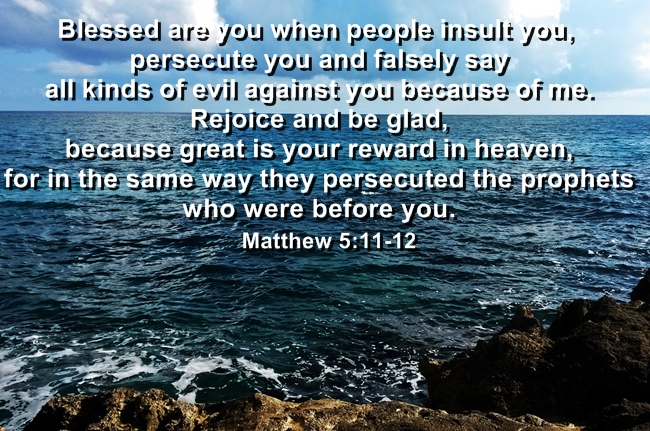
In verse 10, Jesus said that those who are persecuted for righteousness are blessed; here He gets personal, for now He isn’t referring to someone else, or some group of individuals, now it is about “you”. People may speak all sorts of evil against us as followers of Jesus; what should our reaction be  should we pop ‘em right in the mouth?

It wouldn’t seem so; Jesus says we should “rejoice and be glad”, of all things.

Really? We should rejoice and be glad when people are speaking against us because of our faith in Christ?

Yes we should, for great is our reward in heaven.

Jesus didn’t exactly say so here, but our reward here on earth won’t be so bad, since it is a relationship with Him. In the old days, people spoke against the prophets in the same way that they spoke of Jesus’ followers; both were persecuted, sometimes killed in the process, but they seemed to be OK with all that, for they knew that they had a great reward awaiting them, and because they, like Abraham, believed God’s promises.

So now we conclude the Beatitudes, with an implied question dangling: The prophets believed God’s promises and endured. The early Christians believed God’s promises and endured. Do we believe God’s promises?

Posted in Christian Life | Tagged , , , , , , , , , , | 2 Comments

Bonus Post: Conditions in Thessalonica

Thessalonica was located on the Macedonian coast with a large natural harbor, which would explain its founding there in 315 B.C. by Casander, a general of Alexander the Great.  In 146 B.C. the Romans made it the capital of Macedonia and when the Egyptian Way was constructed along the length of Macedonia, Thessalonica was a main point along the highway that connected Rome with the East. Having both a great harbor, and being a key point on the main highway, Thessalonica was a main transportation hub. It was also situated beside a large fertile plain which could not only supply the needs of a large city, but the surrounding region as well.

The city was a major center of pagan worship with major influence from the cults of Dionysus and Cabirus, and it also included a Jewish community that was large enough for at least one synagogue according to Acts 17. Being large, vibrant and prosperous, Thessalonica was ideally situated for the Gospel to take hold there… and for the Gospel to be strongly opposed, both of which were clearly the case at the time 1 Thessalonians was written.

Acts 17:1-9 tells the story of Paul’s arrival there, and both the fertile ground that it was for the Gospel, and the violent reaction of some of the Jewish leaders that resulted in a riot.  An interesting point from the Acts account is found in 17:4 where “God-fearing Gentiles” are found accepting the gospel. There  apparently were a large number of these God-fearing Gentiles there, who were Gentiles that accepted the God of Israel, but who never became Jews; it would seem that they became Christians instead.

From the tumult of Thessalonica, Paul went onto Berea (Acts 17:10-15) and the opponents from Thessalonica followed him there with the result being that after initial success, the crowds were again agitated into violence and Paul left there and travelled to Athens, leaving instructions for Silas and Timothy to meet him there. By the time they were reunited, Paul was in Corinth, and their report is discussed in 1 Thessalonians, as we have already seen in chapter 2.

One final note about Paul’s travels is that he appears to have been following the main highway, stopping in the towns along the way to preach and establish churches that are connected to the transportation systems so they would be situated to make it easy for the Gospel to spread throughout the region; clearly Paul had a strategic plan for his missionary activities.

Posted in Bible | Tagged , , , , , , , | 7 Comments

More Encouragement from Paul

1Thessalonians 5:1-11

Paul continues the discussion he began in 4:13-18 and in a sense repeats himself in slightly different words. He has been talking about what happens with those who have died, and as we saw last time, this is a continuation of his theme throughout the letter, which is encouragement in a time of persecution. Once again, his priority has been on the people remaining steadfast in their faith during this trial. He spoke of the dead to encourage people to hold onto their faith so that death will be powerless over them at the time of Christ’s coming; he continues along those lines here…

Now, brothers and sisters, about times and dates we do not need to write to you, for you know very well that the day of the Lord will come like a thief in the night. While people are saying, “Peace and safety,” destruction will come on them suddenly, as labor pains on a pregnant woman, and they will not escape. (5:1-3)

Since we are keeping our study in context, this is an easy passage to understand: We don’t know when Jesus will return to raise the dead, it will be quite sudden and entirely without warning, so don’t waste any time or energy trying to figure it out; it could happen this very minute! If you’ve held onto your faith, it will be great. If you’ve turned your back on your faith, judgment will be problematic for you.

See, this is simple!

The next several verses use a metaphor of night and day; darkness and light to illustrate our situation in Christ. Those who are in darkness, in the night sleep or get drunk, and when the thief comes will be in a bad state. Those of us who hold onto our faith will be people of the day, so we will remain “awake” and when the Lord should come for us, we will have nothing to fear. You see, dear reader, there is no great mystery to these verses. Paul continues:

But since we belong to the day, let us be sober, putting on faith and love as a breastplate, and the hope of salvation as a helmet. For God did not appoint us to suffer wrath but to receive salvation through our Lord Jesus Christ. He died for us so that, whether we are awake or asleep, we may live together with him. Therefore encourage one another and build each other up, just as in fact you are doing. (5:8-11)

Paul has told the Thessalonians to live as they have been taught, not as they did before they responded to the gospel. Here, he is simply telling them to keep it up and everything will turn out just fine for them. Notice in particular verse 11 where he draws essentially the same conclusion that he drew at the end of chapter 4: Keep living in Christ and you have nothing to fear either now or in the future, for death has no hold on you.

In our day, we love to argue about these verses, and we love to use them to teach all kinds of theories, and who knows, maybe those theories are right. But, if we just assign these verses to an end of the world theory, might we be missing the greatest of blessings? That great blessing that assures us that if we remain faithful, no matter what may happen in this life we will spend all eternity with our Lord in glory.

I couldn’t possibly speak for anyone else, but the way I see it is that with such a blessing as this, who cares about a bunch of theories?

Posted in Bible | Tagged , , , , , , , , | 1 Comment

Those who Have Died

1Thessalonians 4:13-18

This passage (and the next for that matter) can either be simple to understand or difficult; the choice is ours to make. If you prefer simple, as I do, then all we need to do is to remember Paul’s purpose for writing this letter. If on the other hand, you like your texts to be hard, then forget the context and have at it…

Why did Paul write to the Thessalonians?

They were a new church that came very quickly under serious persecution, and Paul wrote to encourage them to hold onto their faith. So far, they had been able to do this, much to Paul’s relief and thanksgiving, and Paul is encouraging them to continue, even to increase their faith and good works, as I’m sure you will remember. I’m also sure that you will remember that when he mentioned the persecution they have been experiencing, that he was primarily interested in the condition of their faith, and not their physical condition; at least he hasn’t mentioned it yet. Now, he is suddenly writing about what happens when you die: Does this strike you as odd, or does it strike you as a sudden discourse on eschatology?

Here, let me put that another way: He hasn’t mentioned anything about the physical realities of a persecution in the first century up to this point, for that really isn’t his main concern, for his main concern is the condition of their faith. This is because if they keep their faith in Jesus Christ intact, they have nothing to fear even if they are killed in the persecution. Thus, this section is neither odd, nor is it a sudden discourse on eschatology; it is an encouragement to hold onto their faith, just as the rest of the letter is.

Guess what? This passage just became simple to understand.

Brothers and sisters, we do not want you to be uninformed about those who sleep in death, so that you do not grieve like the rest of mankind, who have no hope. (4:13)

Persecution was a violent and bloody thing; people were being killed for their faith. Even so, death has no power over us, so do not grieve like the pagans do.

For we believe that Jesus died and rose again, and so we believe that God will bring with Jesus those who have fallen asleep in him. According to the Lord’s word, we tell you that we who are still alive, who are left until the coming of the Lord, will certainly not precede those who have fallen asleep. (4:14-15)

Jesus rose from the grave, and this confirms that we also will rise from the grave, in fact, the dead will rise first!

For the Lord himself will come down from heaven, with a loud command, with the voice of the archangel and with the trumpet call of God, and the dead in Christ will rise first. (4:16)

When the Lord returns, and that could happen at any time, He will return with those who have died before His coming.

After that, we who are still alive and are left will be caught up together with them in the clouds to meet the Lord in the air. And so we will be with the Lord forever. (4:17)

When Jesus returns, which may happen at any time, the dead will rise from the grave first, and then those of us who are still alive will meet Jesus in the heavens, where we will remain with Him forever.

Therefore encourage one another with these words. (4:18)

During this terrible time of persecution and death, encourage one another with this: Death has no hold on us! By the way, this verse confirms that the context is to encourage those in persecution, and is not intended as an eschatological (End Times)dissertation, because “therefore” denotes Paul’s conclusion from the evidence he has cited.

This is a message of hope and joy for all us as we go through our lives and deal with grief, sorrow, illness, and eventually with our own mortality, rather than an opportunity to jump on our hobby horse and ride off into the nearest tangent.

Posted in Bible | Tagged , , , , , , , , | 2 Comments

Turning to other matters…

1Thessalonians 4:1-12

The time has come for Paul to give instruction more explicitly and in a way we are familiar with in his other letters. Notice as we go through these verses, however, that unlike some of the other churches he writes to, the Thessalonians are doing quite well, even under persecution. Of course, we can always do better and we must keep growing; this is the major emphasis in the section.

The first 2 verses bear this out: They had been taught how to live to please the Lord, and they are doing so. Now gang, let’s kick it up a notch and do even better!

Verses 3-8 provide a warning reminder that they should not go back to their old pagan ways, living in sexual immorality, passions and lust, and they must never take advantage of other people. With these words, Paul is reminding them (and us) of what they were taught from the beginning, that we are to live as a holy, set apart people; set apart from the ways of this world, for God.

For me, the real crux of this passage is found in verses 9-12:

Now about your love for one another we do not need to write to you, for you yourselves have been taught by God to love each other. And in fact, you do love all of God’s family throughout Macedonia. Yet we urge you, brothers and sisters, to do so more and more, and to make it your ambition to lead a quiet life: You should mind your own business and work with your hands, just as we told you, so that your daily life may win the respect of outsiders and so that you will not be dependent on anybody.

God has shown them that they should love one another, and they have, and continue, to do so. Let’s do so even more! Notice that this is linked to living quiet lives, working with your hands and being respected by outsiders and a burden to no one. Loving one another and living quiet lives: What do these have in common? If we love one another in community, then we must necessarily be considerate of one another, for to do otherwise wouldn’t be loving. People who lead quiet lives are people who aren’t creating controversy, showing off or lording it over others. To work with one’s hands means that they are self-supporting and not a burden on the community, which unless I am mistaken, is also being considerate of others. A quiet, steady community of hard working people who don’t cause problems and who demonstrate selfless love for one another would surely earn the respect of outsiders; it might even gain a hearing for the gospel, and isn’t that ultimately the point?

I should say so!

Posted in Bible | Tagged , , , , , , , , | 1 Comment

Paul’s Love for the Thessalonians

1Thessalonians 2:17-3:10

Paul takes this opportunity to express his love for the church as he laments his absence; he misses them.  He has wanted to return to them, but Satan has prevented it. Oh how I wish he would have mentioned the how and why of this, but since he didn’t, I guess we’ll never know exactly what Satan did to prevent his return to Thessalonica. It is interesting however to note that Paul clearly attributes his inability to return there to the work of Satan. Think about it: Paul left the city and persecution came upon the church, and now Paul cannot return. I can only assume that Paul had done a mighty work there, mighty enough that Satan was making a major effort to destroy it; thus goes the spiritual battle that still rages today.

For what is our hope, our joy, or the crown in which we will glory in the presence of our Lord Jesus when he comes? Is it not you? Indeed, you are our glory and joy.

1Thessalonians 2:19-20

The church in Thessalonica is Paul’s “glory” for in starting that body of faithful believers, he has indeed done the Lord’s work to build the Kingdom and give glory to God, so much so in fact, that Satan has found it necessary to become involved personally.

We should pay close attention to Paul’s words in 3:1-5, for in these verses he reveals something very interesting. It was driving him crazy that he couldn’t get back to Thessalonica, and when he could stand it no longer, he sent Timothy there to find out about their faith! If I had started a new church somewhere and then heard that it was under persecution, I would worry about their health, if anyone had been hurt or killed, but Paul was worried about their faith; would they falter and return to the old ways? Paul’s priorities were not the same as mine! Doesn’t that mean that I need to rethink my priorities?

Next Paul tells them of the occasion of his writing: Timothy has just returned to him with the news that their faith is secure. Notice that he doesn’t say anything about the physical effects of the persecution; was anyone hurt or killed… just that their faith is firm. Paul expresses quite intimately how thankful he is that their faith is secure, about his joy at the news, and how he prays that he may return to them so that he might provide for their spiritual needs.

I can’t recall the last time I heard anyone talk like that in my lifetime, can you?

So what do we have so far? In 2:1-16 we have Paul talking about putting the message of the gospel into the way we live our lives, and in this passage we have Paul placing spiritual truth above physical distress in an act of love. Then he offers a prayer both for himself and for his readers:

Now may our God and Father himself and our Lord Jesus clear the way for us to come to you. May the Lord make your love increase and overflow for each other and for everyone else, just as ours does for you. May he strengthen your hearts so that you will be blameless and holy in the presence of our God and Father when our Lord Jesus comes with all his holy ones.

1Thessalonians 3:11-13

He prays that he will be able to return to Thessalonica in v. 11. He prays that their love would increase and overflow in v. 12. He prays that God will strengthen them so they will be “blameless” when Jesus returns in v. 13.

Is there anything missing in this prayer, something we would pray for that Paul didn’t?

Hint: Did Paul mention anything about their persecution?

Posted in Bible | Tagged , , , , , , , , | 10 Comments

Reminders of Paul’s Visit

1Thessalonians 2:1-16

At first glance, this is an odd section; is this part of the introduction or has Paul been challenged somehow? Has someone called him a fraud since he left them? When he wrote to the Galatians and Corinthians that was the case… but not here, for as far as we know, Paul’s authority and motives had not be challenged in Thessalonica. Thus, if that is the case, why would he write like this?

In the section, Paul reminds the Thessalonians how he behaved in their midst. He had been badly treated in Philippi and had come to their city. In Thessalonica, his message was quickly opposed, but Paul preached the gospel anyway, because it was pleasing to God. He didn’t concern himself with the approval of people, for God’s approval was enough. He wasn’t looking for money; indeed he supported himself by working while he was there.

Many received the gospel message, and these he cared for as though he was their father, with encouragement and loving concern, yet now he feels it necessary to remind them of this. Has he suddenly felt a need to hear their praise?

I think the answer to this riddle will provide us with some fascinating insight into both the psyche of Paul and into what is expected of all Christians  as well as helping to achieve the purpose for which Paul is writing. You will no doubt recall that Paul is writing them to encourage everyone in Thessalonica to remain in their faith while under persecution, and so this part of the letter should encourage them, but how?

Look carefully at the passage and you will see that Paul has linked together the message of the gospel with the way he is living his life. Notice in particular that he is trying to show that his motives are in harmony with his message, and that he acted it out. The message of the gospel is a message of love on God’s part, but delivering the gospel message was an act of love on Paul’s part, even more so after his treatment in Philippi and with the opposition in Thessalonica; he did it anyway to please God and so that they might be saved because Paul loved God and because Paul loved the Thessalonians: This was Paul’s love in action. There is no greater act of love than to share the gospel message.

What should the church at Thessalonica do to hold firm to the faith while being persecuted? Live their faith in love every day. What should we as Christians be doing every day? We should be living our faith in love in all that we do.

By taking this approach, Paul is also setting up the emphasis of the remainder of the letter.; again, his message to them (and to us) is that we must put the message we preach into practice in our lives.

Posted in Bible | Tagged , , , , , , , , | 2 Comments

Greetings and Thanksgiving

1Thessalonians 1

Paul begins the letter with the customary greeting, identifying himself along with Silas and Timothy as its source. I highly doubt that the three of them co-wrote the letter; however Silas and Timothy had actually spent more time in Thessalonica than Paul had, and by mentioning them here, he probably intended to convey that they all stood as one in the things he was writing about.

Verses 2-10 contain the balance of Paul’s greeting in the form of thanksgiving to God for the Thessalonians themselves. This is not quite as perfunctory as it might seem at first, for in these few verses, Paul tells the brief history of the church, and begins to reveal why he has written this letter to them.

Very quickly Paul mentions that they, apparently more than many other churches, jumped right into the work of the gospel, as a response to the love of Christ. Notice verse 5 in which Paul says the gospel came to them with more than words, but with power and the Spirit since they immediately became imitators of Paul, and thus of Christ. Wouldn’t it be something if our churches today were more prone to this! They knew how Paul lived among them, and they copied Paul’s way of living, right off the bat. As they did this, they encountered opposition in the community in the form of persecution, but they kept at it, and in so doing the church in Thessalonica became the model for all of the churches in the region; quite a success story.

It would seem that they had so completely turned from Pagan worship to being followers of Jesus Christ that news of this spread far and wide, beyond their own provinces, so Paul makes it clear that he is not writing to correct the way they have responded to the gospel; there is something else on his mind. Paul will have more to say about the Thessalonians as he continues into the next chapter, and we will pick up his narrative in the next installment…

Posted in Bible | Tagged , , , , , , , , | 6 Comments

Paul Writes to Thessalonica

Note: With all of my recent adventures, I haven’t been doing my “normal” writing routine, and I don’t know about you, but I’m tired of that; it’s time for me to get back to work. I thought I’d begin by updating my study of Paul’s letters to the Thessalonians and thus we begin a new adventure together this morning…


The letters that Paul wrote to that church are much discussed today, if for all of the wrong reasons. His first letter, written about 50 – 51 AD is very likely Paul’s first pastoral letter. This was done during the time of Paul’s second missionary journey, after he had visited Thessalonica, and while he was staying in Corinth. We can easily see what occasioned his writing: The Thessalonian church was a very young church, having been in existence for only a short time. It was located in a challenging environment, where it was finding itself under serious persecution right from the start. Paul wrote to this church to urge them to remain in the faith to urge them to continue down the road of discipleship as followers of Christ. As we read this letter, it is vital that we keep this in mind, lest we make the mistake of reading it in light of current day theories about things that Paul is not discussing in the letter.

The letter follows the typical Pauline pattern, one common in his day of letter writing. It begins with a greeting in which the writer identifies himself, and then moves on into a thanksgiving passage. Next comes the body of the letter, and it ends with a final greeting. Paul varies from this format only once in chapter 2 where he includes a second thanksgiving and we’ll cover it when we arrive at that point.

This is a letter that all of us should concern ourselves with for it has much to teach us. Of course, you can say that about any book of Scripture, but the letters to the Thessalonians have more than most that applies directly to our circumstances in the modern world. Most of us don’t live under anything that can be called persecution, but I would imagine that most of us experience temptations similar to those of Thessalonica, namely to avoid standing out in our communities as being “different” so as to avoid embarrassment or the wagging tongues of those who are not followers of our Lord. Obviously, the Thessalonians had far more serious repercussions to deal with than most of us do, and as I see it that should make the silliness of our fears all the more starkly obvious.

Well dear reader, there is the “preview”: We’ll begin in earnest tomorrow as we charge ahead into chapter one of a most amazing new adventure into Paul’s first letter to the Thessalonian church; see you then!

Posted in Bible | Tagged , , , , , , , , | 3 Comments