Poor in Spirit

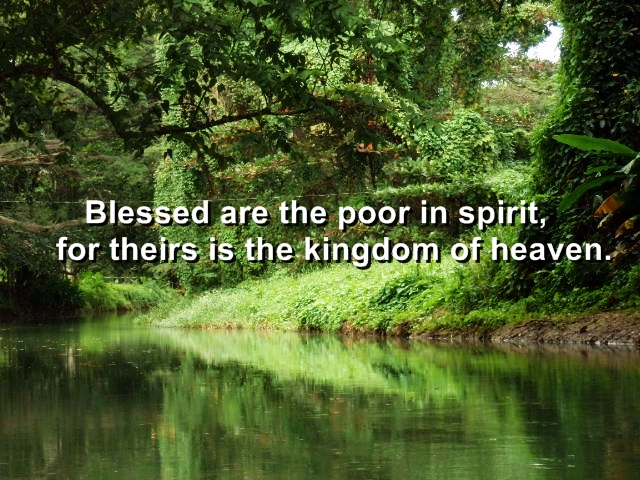
Blessed are the poor in spirit,
for theirs is the kingdom of heaven.

Matthew 5:3

The first Beatitude speaks of those who are “poor in spirit”. Much has been made about the difference between Matthew’s language and that of Luke in Luke 6:20, for Luke merely says “the poor”. Does Matthew have more in mind than mere economic circumstances?

I’m happy to let others argue, but it seems to me that Matthew, a Jew, might be aware of the Old Testament idea of poverty not only in literal terms, but as a state of mind as well, for the Hebrew word for “poor” has this additional connotation to it. In those days, a poor person not only had to deal with bad economic circumstances, they also had to contend with the fact that they had fewer rights in society, for then as now, they lacked the resources to enforce their rights; consequently they were at the mercy of others.

Living in such a state made it clear to anyone who could fathom the notion, that the poor must depend entirely upon God. Most of us today, even those of us who don’t enjoy material abundance, live in circumstances far better than those of a poor person in ancient times, and maybe we too have a hard time seeing what Matthew means; let’s look at it this way: In our world, a person of very limited means is never far from being destitute, while a rich person has a much larger buffer to get through tough times. The poor person knows they live close to the edge; the rich person can convince himself that everything is wonderful, that he is the master of his own life, and in doing so, he only deceives himself, for God is the master of everything. We see time and again in Scripture that a rich person has a great obstacle to overcome in following God, for he thinks he is the one in control, while a poor man has no such delusion to overcome, and no great wealth to hold him back. The poor person is free to follow the Lord, while the rich person carries his wealth as a millstone around his neck; woe is he.

The kingdom of heaven is both a present reality and a future hope, for it is with us today in Christ, and will be fully realized in its ultimate fulfillment when He returns. For the person who recognizes his or her current dependence upon God for everything in life, it is a present reality indeed, and a source of great joy, “for theirs is the kingdom of heaven.”


Posted in Bible | Tagged , , , , , , , , , , | 14 Comments

Random Ramblings: September 16, 2017

According to every sign I know of, it’s going to be an early Fall this year in our area. We’ve had temperatures well below “normal” for several weeks now, I’ve seen geese heading south already, and some of the trees are beginning to turn roughly a month earlier than normal; see for yourself with these three pics I took yesterday without ever leaving my own yard…

And now summer has returned.

No, really it has…

A week ago we were having highs in the low 60’sand lows in the low 40’s. Now we have highs in the upper 80’s and lows in the low 60’s: Go figure!

In years past it was fashionable to discuss the crazy weather. You’d hear people say that “around here the weather is crazy, wait 5 minutes and it will change”. Now of course we don’t talk like that, because if you do there’s always someone who says, “OMG it’s global warming!” Invariably that becomes a rant about how the Capitalist-Imperialist class is going to kill us all for profit… Wanna know what I think?

We’re having a blast of summer weather in NE Iowa, Yippee!

There’s one thing I really wonder about though, and it might seems silly to you, but how can the trees change color a month early if it’s the hours of sunlight that trigger the change? When I was in school, that was the scientific “consensus”; it was “established scientific fact”, and yet here we are…

OK, they aren’t all changing, but enough are to make you wonder how it could be.

Well that’s my little nonsense for this Saturday, have a great weekend; I’m going to go outside and enjoy summer’s return!

Posted in Random Ramblings | Tagged , , , , , | 6 Comments

The Beatitudes: An Introduction

Now when Jesus saw the crowds, he went up on a mountainside and sat down. His disciples came to him,  and he began to teach them.

Matthew 5:1-2

The Sermon on the Mount begins with nine “Beatitudes” in which Jesus describes the present reality of the Kingdom in the midst of the people who were listening to this sermon. Notice how Matthew has connected the previous section with what is about to happen: Jesus had begun His ministry, He’s been preaching and healing and the crowds have grown and grown. He looks around and there is a big crowd, so He climbs up a hill, sits down and begins to speak to the people.

His opening is a series of nine Beatitudes that break nicely into two main sections. The first section, comprising the first four beatitudes, (5:3-6) focuses on our relationship with God, the second group of four (5:7-10) focus on horizontal relationships, with the ninth expanding upon the eighth. Each is comprised a statement identifying the character that is blessed by God (e.g., “blessed are the poor in spirit”) followed by a clause explaining the basis of their blessing (e.g., “theirs is the kingdom of heaven”). The section is bracketed by “for theirs is the kingdom of heaven” in verses 3 and 7 which clearly define this introduction to the rest of the Sermon on the Mount discourse.

I’ve noticed over the years that people read these without an actual understanding of what the word “blessed” means. I did some research on the word to discover its meaning, and more often than I’d like to admit, people use the word in its own definition, even sometimes in dictionaries, which, when I was in school, was strictly frowned upon. One definition said that “blessed” means “blest”. Gee, thanks for clearing that up!

The Greek word used here is makarios, which means: “fortunate, well off:—blessed, happy”. Thus, when Jesus says “blessed is (or blessed are)” He means that they are fortunate, well off, happy. When we read through these beatitudes, we need to be asking questions like, “Why would being poor in spirit make me happy, and what is the alternative to being poor in spirit?”

When we approach the Beatitudes like that, we will very likely discover a mine of great wealth to be explored. Consequently, as we go through these one by one, we will be exploring with those types of questions in mind. The reason is more than just our getting some good teaching; Jesus isn’t just teaching here, He is telling the people about the present state of the kingdom. It wasn’t that God would change our earthly circumstances if we would follow Him, it was that God would be in a close and personal relationship with the people in this age, and ultimately change the paradigm in the next age, this passage, therefore is not only messianic, but apocalyptic as well, and most deserving of our careful attention. We will kick it off when we next get together; you won’t want to miss a single installment!

Posted in Bible | Tagged , , , , , , , , , | 6 Comments

Kingdom, Teaching, Healing

Jesus went throughout Galilee, teaching in their synagogues, proclaiming the good news of the kingdom, and healing every disease and sickness among the people. News about him spread all over Syria, and people brought to him all who were ill with various diseases, those suffering severe pain, the demon-possessed, those having seizures, and the paralyzed; and he healed them. Large crowds from Galilee, the Decapolis, Jerusalem, Judea and the region across the Jordan followed him.

Matthew 4:23-25

This interesting piece of text provides a transition into the next scene that covers chapters 5-7; the Sermon on the Mount, as it is commonly called. As we consider these verses,  we have a device that Matthew uses several times in the his book, that of a generalized summation of events that leads into the next scene which in turn, provides a more specific look at what has been generalized (cf. 8:16; 9:35; 12:15; 14:35-36; 15:30-31; 19:1-2).

In this particular case, we have a generalization in 4:23 that has a parallel in 9:35 that describes Jesus’ early ministry in very messianic terms, providing a sort of literary book ends to the content in between. As we move into chapters 5-7, we will have a very specific example of one of His teaching sections; the kind of teaching the people of Galilee were hearing as Jesus traveled from place to place. Then, in chapters 8-9 we will shift the focus onto the miracles He was performing in their midst, and when you put the two sections together into Matthew’s messianic context, we can see not only what was going on at the time, but what the Kingdom of Heaven is all about.

Notice verse 23 where we see that Jesus is moving through the region teaching and proclaiming the Kingdom, and healing the sick from every sort of sickness. Then in the remaining verses we find that the news of Jesus’ activities spread throughout Israel and into neighboring Syria to Jew and non-Jew alike. Then we discover that Jesus isn’t only healing illnesses, He is making the lame walk, giving sight to the blind and chasing out demons as well.

People come from every region to hear Him, to see Him and to be healed.

Before we move on, let’s pause just a moment to consider what was happening: The long awaited Messiah had come to Israel. He went out into the countryside preaching the good news of the Kingdom of Heaven, and whenever He did this, people heard God’s Truth and were healed of whatever consequence of sin that afflicted them; that is what the Kingdom of Heaven does when it is filled with the power of grace and truth, for grace and truth bring with them love, and love builds community, and community brings fellowship and healing.

Posted in Bible | Tagged , , , , , , , , | 7 Comments

Calling Disciples

As Jesus was walking beside the Sea of Galilee, he saw two brothers, Simon called Peter and his brother Andrew. They were casting a net into the lake, for they were fishermen. “Come, follow me,” Jesus said, “and I will send you out to fish for people.” At once they left their nets and followed him.

Going on from there, he saw two other brothers, James son of Zebedee and his brother John. They were in a boat with their father Zebedee, preparing their nets. Jesus called them,  and immediately they left the boat and their father and followed him.

Matthew 4:18-22

As we continue with Matthew’s account of Jesus, we come to the time when He began calling disciples, and no matter how many times I read these accounts whether it be here in Matthew or in one of the other Gospels, I am always struck by the fact that Jesus called and they came immediately. No excuses, no arguments, nobody had to “pray about it” (so they could avoid saying no): Jesus called, they responded.

This short account begins with the calling of Peter and Andrew, two fishermen who were out on the Sea of Galilee fishing. Jesus calls them and says that He will make them fishers of men. Notice they had nets in the water at that moment and they just left them there and went with Jesus. Let’s be clear, they were fishermen, not sportsmen; fishing wasn’t their hobby, it was their livelihood. When they just left everything and followed Jesus, they lost their business. They also left their boat behind… they sacrificed greatly to follow Jesus, and they did it without hesitation.

Next, Jesus called John and James who were fishing with their father, and once again, without hesitation, they left not only their profession but they left their father to follow Him. If walking away from your livelihood is big, turning your back on your family is bigger still. There is a cost to following Jesus; we may not like to talk about it, but it is true nevertheless.

So to recap, these four disciples responded to Jesus immediately, and in doing so, they gave up everything they had in this world to follow Him. In our day, what do we give up to follow Him? Cussing? An hour a week?

Yet often we say following Him is too hard!

Next time, we’ll see how His early ministry was doing; see you then!

Posted in Bible | Tagged , , , , , , , , | 8 Comments

Jesus Heads to Galilee

When Jesus heard that John had been put in prison, he withdrew to Galilee. Leaving Nazareth, he went and lived in Capernaum, which was by the lake in the area of Zebulun and Naphtali— to fulfill what was said through the prophet Isaiah:

“Land of Zebulun and land of Naphtali,
the Way of the Sea, beyond the Jordan,
Galilee of the Gentiles—
the people living in darkness
have seen a great light;
on those living in the land of the shadow of death
a light has dawned.”

Matthew 4:12-16

As the first section of Matthew’s Gospel draws to its close, Matthew inserts some transition, and in so doing, he continues his pattern of linking the story of Jesus with Israelite history; in this case using geography as his means. It would seem that Jesus heard that John had been arrested, and then headed for Galilee. Let’s not b e too hasty to assume that He did so because He feared arrest or danger Himself; there is something much greater in play here, for John’s arrest put an end to his mission to “prepare the way of the Lord” and thus, with everything in readiness and the fullness of time having arrived, it was time for Jesus to step into center stage.

In fulfillment of Isaiah’s prophecy found in Isaiah 9:1-2, Jesus travels there, but He doesn’t resume His residence in Nazareth, He sets up shop in Capernaum which will be His base of operation during His Galilean ministry. Notice the inclusion of the tribes that once lived in this region, among the very first to be taken into captivity, along with the reference to “Galilee of the Gentiles” with its obvious reference to the universal nature of Jesus’ messianic mission and its fulfillment of God’s promises to Abraham.

There is also the observation that these are people, both Jew and Gentile, who are living in darkness, in the very “shadow of death” for whom a new light is beginning to dawn. This is not only the dawning of hope, but it is also the dawning of the truth of God’s redemptive plan coming into its final phase of execution. Matthew sums the whole first section of the book up in one wonderful sentence:

From that time on Jesus began to preach, “Repent, for the kingdom of heaven has come near.”

Matthew 4:17

Posted in Bible | Tagged , , , , , , , | 1 Comment

Jesus in the Wilderness

Matthew 4:1-11

After His baptism by John, Jesus heads out to the Wilderness (desert) to be tempted by Satan. In this narrative, we see once again Matthew’s fondness for connecting his story about Jesus with the history of Israel, in this case, with the 40 years of wandering. I truly doubt that God was, as some might suggest, testing Jesus to make sure that He could be fully trusted; it was a little late for that. Instead, it seems to me that God was drawing a contrast between the faithfulness of Jesus His Son, and the people who for forty years wandered in the Wilderness because of their lack of faithfulness to God. In fact, we will see this tendency in Jesus all through the story of His life.

Satan plays an interesting role in all of this, but then he played a behind the scenes role in the original story as well, as seen by the constant grumbling and complaining of the Israelites. In our story, Satan interacts with Jesus in the role of tempter; yes, he seems focused on pulling Jesus away from his Father and into Satan’s orbit and service. I can’t say whether or not Satan really thought he could succeed in this; he must have known it was a long shot, but he tried.

The drama begins after Jesus has fasted for forty days and forty nights. Now that Jesus is really hungry and physically weak, Satan drops in to taunt Him saying “If you are the Son of God, tell these stones to become bread.”  Jesus replies by quoting Deut. 8:3: “It is written: ‘Man shall not live on bread alone, but on every word that comes from the mouth of God.”

If Jesus can quote the Scriptures, it might interest us to know that Satan can as well, and in his second taunt, that is exactly what he did, after transporting the scene to the highest point of the Temple:  “If you are the Son of God,” he said, “throw yourself down. For it is written:

“‘He will command his angels concerning you,
    and they will lift you up in their hands,
    so that you will not strike your foot against a stone.” (cf. Psalm 91:11-12)

Jesus isn’t buying Satan’s twisting of the Word of God, this time quoting Deut. 6:16: Jesus answered him, “It is also written: ‘Do not put the Lord your God to the test.’”

At this stage in the story, Satan is about to get to his actual point; it was never his mission to test Jesus to see if He was really the Son of God; he knew exactly who Jesus was, after all, why else would old Herod have been so anxious to kill Jesus as an infant? No sir, Satan knew exactly who he was talking to, and his whole reason for being there was to try and “turn” Jesus, to gain His worship, just the way he had “turned” Adam and Eve, and so he comes to his point:

Again, the devil took him to a very high mountain and showed him all the kingdoms of the world and their splendor. “All this I will give you,” he said, “if you will bow down and worship me.” (4:8-9)

When we think about this, it seems a little strange for Satan to make such an offer as though he actually held the power to deliver on his promise, but then he is a liar and the father of lies. Jesus, as God’s Son is heir to the entire universe and beyond, but His path to His destiny is not by stealing or betrayal, it is the path of service, a path that, as we will see, leads to the cross. This is the path that Matthew is leading us on through the rest of His account of Jesus’ story, but even more than that, it is our path as disciples of Jesus today, for we too have become co-heirs with Christ to everything, but our path to inheriting everything is not through stealing, scheming or conquest, but by the path of service.

At this point in the story, Jesus is done with Satan:

Jesus said to him, “Away from me, Satan! For it is written: ‘Worship the Lord your God, and serve him only.’”

Then the devil left him, and angels came and attended him. (4:10-11)

Quoting Deut. 6:13, Jesus equates Satan’s “offer” with idolatry and dismisses him. An obvious, but often overlooked aspect of this is that even in His weakened condition, Jesus told Satan to leave, and Satan obeyed.

Interesting isn’t it?

So here we are, followers of Christ, indwelt by the Holy Spirit, and we think we have so many problems and that the devil is so strong, unstoppable and alluring, but all of that is the devil’s lie! What did James say about this?

Submit yourselves, then, to God. Resist the devil, and he will flee from you.

James 4:7

Posted in Bible | Tagged , , , , , , , , | 11 Comments

Photo of the Week: September 13, 2017

Posted in Photo of the Week | Tagged , , , , , , , | Leave a comment

Jesus Appears on the Scene

Then Jesus came from Galilee to the Jordan to be baptized by John. But John tried to deter him, saying, “I need to be baptized by you, and do you come to me?”

Jesus replied, “Let it be so now; it is proper for us to do this to fulfill all righteousness.” Then John consented.

Matthew 3:13-15

So far, we have seen John’s ministry and teaching, and we have seen the response of so many people to his work. Then Jesus bursts onto the stage. It is abundantly clear in verse 13 that Jesus departed from Galilee for the express purpose of receiving John’s baptism during the time that he was preaching in the wilderness, and it is also clear that the work of John is linked strategically with the arrival of Jesus.

John’s reaction to this does him considerable credit; he seemed to be surprised that one so much greater than he would want to submit to his baptism. Rather, John knew that he needed what Jesus could offer; not the other way around. That is when Jesus speaks for the very first time in Matthew’s Gospel; for the time being anyway, it was right and proper that Jesus submit Himself to John’s preparatory baptism so that all righteousness could be fulfilled.

It seems clear, at least to me, that Jesus wasn’t making any sort of legal argument, for there was no Jewish Law that said He had to be baptized, there wasn’t any specific prophecy that had to be fulfilled or anything like that, rather it was righteous for Jesus to submit to the baptism of John to prepare Him to step forth from the shadows into the bright lights of His own ministry as the Messiah, the Son of God, for you see, Jesus was not there to do His own will, but to submit to the Father’s will and purpose. Isn’t it interesting that when Jesus in obedience submitted to John, John immediately submits to His request to be baptized?

So then, why did God want this little scene to happen?

As soon as Jesus was baptized, he went up out of the water. At that moment heaven was opened, and he saw the Spirit of God descending like a dove and alighting on him. And a voice from heaven said, “This is my Son, whom I love; with him I am well pleased.”

Matthew 3:16-17

Jesus submits to John’s baptism, John submits to Jesus’ request to be baptized, Jesus is immersed… and as soon as He comes up out of the water, heaven was opened. It seems to me that this is one of those “wow” moments…

“Heaven was opened” is used several times in Scripture to signal a divine revelation (cf. Ezek. 1:1; Is. 63:19; Acts 7:56; Rev. 4:1) and this time is no different; God has a little announcement to make. First, the Spirit descends upon Jesus “like a dove” and alights on him. Some have suggested that this is when Jesus actually became God’s son, but to me that seems unlikely, particularly considering the great pains Matthew has gone to already to show the Sonship of Jesus from the time of His conception. What seems more likely to me is that this anointing of the Holy Spirit is done in conjunction with His commissioning, which follows immediately when the voice of God speaks forth from Heaven pronouncing His pleasure with His Son.

It isn’t every day that you see all three Persons of the Godhead manifested together in one place at the same time; thus began the earthly ministry of Jesus, the Messiah.

Posted in Bible | Tagged , , , , , , , , | 4 Comments

Preparing the Way of the Lord

Matthew 3:1-12

Matthew skips over nearly 30 years between 2:23 and 3:1 and in so doing he has emphasized for us his priority on the identity and role of Jesus over that of providing mere biographical information. This is further emphasized for us in that Matthew picks up all these years later not with Jesus, but with John, for John’s story serves to underscore the messianic role and function that Jesus will fulfill.

A common form of Jewish messianic hope is represented by the notion that Elijah would return as a precursor to the arrival of the Messiah (cf. Matt. 11:14; 17:10-13; Mal. 3:23-24; 4:5-6). Matthew takes care to present John in this light to underscore ultimately, the identity of Jesus, for in presenting John as he did, Matthew shows that John’s emergence upon the scene marks the beginning of a whole new paradigm in Israel. Consider the fact that John has come to the territory of David (3:1) in the spirit of Elijah (cf. 3:4; 2Kings 1:8) preaching a message of repentance (3:2, 7-10; cf. Mal. 3:1-5; 4:5-6), in the context of the nearness of the Kingdom (3:2) and the ultimate judgment of the “mightier one” to come (3:11-12).  As Matthew’s story continues to unfold in the chapters that follow, John’s work will continue to give us focus on the character and mission of Jesus (cf. 3:14; 11:1-19; 14:1-12; 16:14-20; 17:9-13; 21:23-27). Matthew breaks his description of John the Baptist into two parts: 3:1-6 highlight John’s ministry, and 3:7-12 his message.

3:1-6: There is no coincidence in the fact that John appears in the “wilderness of Judea” (or “desert”) for it had long been expected that the precursor to messiah’s arrival would come from the Wilderness (Is. 40:3-4; 42:14-55:13; Ezek. 20:33-44; Hos. 2:14-15). This also provides us with a connection between Moses in the Wilderness and the story of Jesus. The Kingdom of Heaven (mentioned by Matthew 33 times in his Gospel) was near; there was urgency in John, an urgency that came from the very nature of his calling, as seen in the quotation from Isaiah 40:3.

John is further connected to the prophets of old in Matthew’s description of his wardrobe and menu. His dress is associated with that of Elijah (2Kings 1:8; cf. Zech. 13:4). His menu is that of a prophet fully consecrated to God. The impact of John’s ministry out in the desert was profound indeed; people came from all around to hear his message. They not only heard it, but they responded to it as well, confessing their sins and repenting, being baptized in the Jordan River.

3:7-12: Yes indeed, John’s ministry was having quite an impact, and when a radical message has a significant impact upon the people, the authorities will be looking into the situation, and that is what happens in these verses. Matthew tends to present the Pharisees and Sadducees as a united front throughout his Gospel, but to be sure, they would have only been united if they felt threatened, for they were rival factions that didn’t usually see eye-to-eye on very much. John, as Jesus would later, saw right through their façade.

In verses 7-10, John essentially launches a broadside at them; his message, crafted in apocalyptic terms they would understand was simply that they must repent of their unrighteousness like everyone else, or face judgment. This is made even clearer in vv. 11-12 where John clearly tells them that his baptism is all about repentance, but there will shortly appear one who is far greater than he, who will baptize with the Holy Spirit and with fire. There are various interpretations of the issue of “Holy Spirit” and “fire” that John speaks of here and whichever you prefer is fine by me. As for me, as simple-minded as I am, I simply see a very tight context here that is illustrated in verse 12:

His winnowing fork is in his hand, and he will clear his threshing floor, gathering his wheat into the barn and burning up the chaff with unquenchable fire.”

Using a simple agricultural metaphor that would be understood by most anyone in that day, John is telling the religious leaders that they will soon be able to repent and receive Jesus’ baptism and the Holy Spirit, or they can refuse and face the consequences; it would be their choice, just like it is our choice. This same tension will come up time and again in Matthew’s story.

In the next scene, John will have an entirely different kind of visit; see you there!

Posted in Bible | Tagged , , , , , , , , | 5 Comments