Enough of that stuff!

Therefore, since Christ has suffered in the flesh, arm yourselves also with the same purpose, because he who has suffered in the flesh has ceased from sin, so as to live the rest of the time in the flesh no longer for the lusts of men, but for the will of God. For the time already past is sufficient for you to have carried out the desire of the Gentiles, having pursued a course of sensuality, lusts, drunkenness, carousing, drinking parties and abominable idolatries. In all this, they are surprised that you do not run with them into the same excesses of dissipation, and they malign you; but they will give account to Him who is ready to judge the living and the dead. For the gospel has for this purpose been preached even to those who are dead, that though they are judged in the flesh as men, they may live in the spirit according to the will of God.

1 Peter 4:1-6

Peter is now summing up what we covered last time: Therefore…

Jesus as our great example suffered death so that many would be saved from sin and death; therefore, we need to take on the same purpose as He, which is to say that we too need to concern ourselves with the salvation of those who have not yet found it, even in our times of trial and suffering. This somewhat awkward sentence goes on to tell us that since those who suffer for Christ have put an end to living for the allures of this world, they will now live for the will of God.  This is another way of saying that we set aside the things of this world to serve Christ.  We have already had our chance for worldly living, that is now over… and our former associates will sure be surprised!

I’ve run into many who hesitated to commit to Christ for fear that their family and friends will think them crazy, and I’ve always assured them that they are probably right.  When they commit to Him anyway, and over time their lives change, friends and family often follow them to the cross. Let’s be clear, this doesn’t usually happen overnight, but it often happens with time. These former associates may also “malign” you, but this is something for which they will ultimately be called to account for.

This is why the gospel has been preached to those who live without Christ, even though they are dead in their sins, they may respond to the gospel and live as children of God.  To be perfectly honest, this is our calling, to take the gospel to those who have yet to commit to Christ, or as Jesus Himself said, to “make disciples.” It is what we do because we love our fellow humans, even when they do not first love us.

That might sound familiar to some of you…

Posted in Bible | Tagged , , , , , , , , | 1 Comment

Jesus’ Example

For Christ also suffered once for sins, the righteous for the unrighteous, to bring you to God. He was put to death in the body but made alive in the Spirit. After being made alive, he went and made proclamation to the imprisoned spirits— to those who were disobedient long ago when God waited patiently in the days of Noah while the ark was being built. In it only a few people, eight in all, were saved through water, and this water symbolizes baptism that now saves you also—not the removal of dirt from the body but the pledge of a clear conscience toward God. It saves you by the resurrection of Jesus Christ, who has gone into heaven and is at God’s right hand—with angels, authorities and powers in submission to him.

1 Peter 3:18-22

As the chapter concludes, Peter continues his discussion of opportunity and suffering, with the ultimate example of Jesus.  Jesus suffered greatly that we might be saved from sin and death, and He did this while deserving none of the suffering, but accepted it anyway for the opportunity to redeem humanity.  As a result, He was killed in the body, but made alive again in the Spirit. This is a familiar story for a Christian I hope…

I really try to avoid complicating these lessons with discussions of various translations and Greek… but to understand verse 19, I can’t see a way to avoid it.

The NIV goes on to say: After being made alive, he went and made proclamation to the imprisoned spirits— In the NIV, there is a footnote after the words “…made alive…” that I have edited out (but probably shouldn’t have) that reads, “Or but made alive in the spirit, 19 in which also.”  

The more literal translation of the NASB says, in which also He went and made proclamation to the spirits now in prison.  Looking at the Greek, I found the words, ᾧ καὶ (hos  kai) which mean “in which also

Thus, I conclude that what Peter is telling us is that Jesus died in the body and was made alive again in the Spirit, in which also (in the Spirit) he preached to those who are now dead, but who were disobedient in Noah’s day.  The introduction of Noah’s day is important in Peter’s overall point as we will see in a minute.  Sorry for this little excursion, but this is a verse that is often misunderstood, as some do teach that Jesus died and went to Hell to redeem the lost there, and while that might be a nice thought, it isn’t the point Peter is making here, I’m afraid.

Jesus, in the Spirit, or as the Spirit, preached repentance to those who were acting in rebellion against God while Noah was building his ark, as God was about to judge the earth and wanted to save as many as possible from His judgment, but in the end, only eight would follow God and they were saved through the waters of the flood (being in the ark). The waters of the flood now symbolize baptism, which saves us also, not the removal of dirt from the body but the pledge of a clear conscience toward God. It saves you by the resurrection of Jesus Christ… You will surely recall that Paul makes similar comparisons between our “death” in baptism, and our being raised out of the water to a new life.

As a result of what Jesus did, He now sits in majesty in heaven… and in due course we, as His co-heirs will join Him.  This is the ultimate opportunity for suffering, should God will it for us, to become a testimony of our faith in Him, that others who see this will come to belief and repentance.  Therefore, should suffering come your way, take heart, for God is working through you, and you will receive the prize for which we all strive.

Posted in Bible | Tagged , , , , , , , , | 2 Comments

TLP Living: September 17, 2018

Posted in Christian living | Tagged , , , , , , , | 1 Comment

TLP Inspiration: September 17, 2018

To Be Blessed

In verse 10, Jesus said that those who are persecuted for righteousness are blessed; here He gets personal, for now He isn’t referring to someone else, or some group of individuals, now it is about “you”. People may speak all sorts of evil against us as followers of Jesus; what should our reaction be − should we pop ‘em right in the mouth?

It wouldn’t seem so; Jesus says we should “rejoice and be glad”, of all things.

Really? We should rejoice and be glad when people are speaking against us because of our faith in Christ?

Yes we should, for great is our reward in heaven.

Jesus didn’t exactly say so here, but our reward here on earth won’t be so bad, since it is a relationship with Him. In the old days, people spoke against the prophets in the same way that they spoke of Jesus’ followers; both were persecuted, sometimes killed in the process, but they seemed to be OK with all that, for they knew that they had a great reward awaiting them, and because they, like Abraham, believed God’s promises.

So now we conclude the Beatitudes, with an implied question dangling: The prophets believed God’s promises and endured. The early Christians believed God’s promises and endured. Do we believe God’s promises?

Posted in Christian living | Tagged , , , , , , , , | 1 Comment

Sunday Sermon Notes: September 16, 2018

Title: To Be Defiled

Text:Mark 7:1-23

Parallel Texts: Matthew 15:1-20; John 7:1

Mark’s account changes it’s focus at this point, as does Matthew’s and Luke’s, for from this point forward up to Jesus’ final arrival in Jerusalem, Jesus focuses on training His disciples. Here, He begins to demonstrate the differences between the Kingdom and the traditional religious teachings of His day. Our first glimpse of this change of focus begins when Jesus and the disciples return from their sojourn to the other side of the Lake.

This is a great story… we could spend a week going over it piece by piece. A group of Pharisees have come up from Jerusalem and in our first glimpse of them they are looking for a fight. They approach Jesus complaining that His disciples are eating before they have gone through the proper hand washing ceremony… of all things. Jesus is having none of that:

He replied, “Isaiah was right when he prophesied about you hypocrites; as it is written:

“‘These people honor me with their lips,
but their hearts are far from me.
They worship me in vain;
their teachings are merely human rules.’
You have let go of the commands of God and are holding on to human traditions.”

Mark 7:6-8

It didn’t take Jesus very long to come to the point; He calls them hypocrites in the first sentence. The point is that they, who are such great law-keepers, just ask them and they’ll tell you, are pushing customs and traditions that aren’t in the Law. First, He quotes Isaiah 29:13 to set up His counter-charge, and then goes right to the point:

And he continued, “You have a fine way of setting aside the commands of God in order to observe your own traditions! For Moses said, ‘Honor your father and mother,’ and, ‘Anyone who curses their father or mother is to be put to death.’ But you say that if anyone declares that what might have been used to help their father or mother is Corban (that is, devoted to God)— then you no longer let them do anything for their father or mother.  Thus you nullify the word of God by your tradition that you have handed down. And you do many things like that.”

Mark 7:9-13

Here He quotes the commandment, and then reminds the nice Pharisees of their tradition. A man could set aside part of his property as a gift to God (Corban) and be relieved of his obligations to his elderly parents… and the Pharisees are perfectly fine with that, which of course defeats the purpose of the commandment. And here they were, trying to use one of these idiotic traditions to condemn His disciples! Well, now… we’re making friends today aren’t we?

Nothing outside a person can defile them by going into them. Rather, it is what comes out of a person that defiles them.” 

Mark 7:15

It didn’t make any difference whether His disciples did the traditional hand washing before eating their meal; what good is a ritual? The food would not make them unclean in any way, they would swallow it and nature would take its course. It’s what comes out of a person that makes them unclean, for what comes out of us reveals the condition of our hearts. If a man sees a beautiful woman, the sight of her does not make him a sex-crazed maniac… unless a sex-crazed manic was already inside of him.  If a person performs all of the right rituals and ceremonies and goes through all of the perfect motions on Sunday morning… so what?  Those will not cause anyone to love God and love their neighbor unless the love of God was already within their hearts.

Oh, sorry, did I make this about us instead of about those dastardly Pharisees?

Dear reader, all too often, we are the Pharisees!

So let’s see, what do we have here? Not only was Jesus some kind of a revolutionary preaching this new kingdom of His, not only was He healing the sick and lame, making the blind see, chasing out demons, forgiving sins and even raising the dead, and not only did He give out free food to his fans, now He was attacking the status quo by which the elites kept everyone in line:

Here’s another report back to Jerusalem that I wish we could read together!

Yep, those Pharisees were looking for a fight, and Jesus didn’t disappoint them.

Posted in Sunday Class Notes | Tagged , , , , , , , , | Leave a comment

TLP Inspiration: September 15, 2018

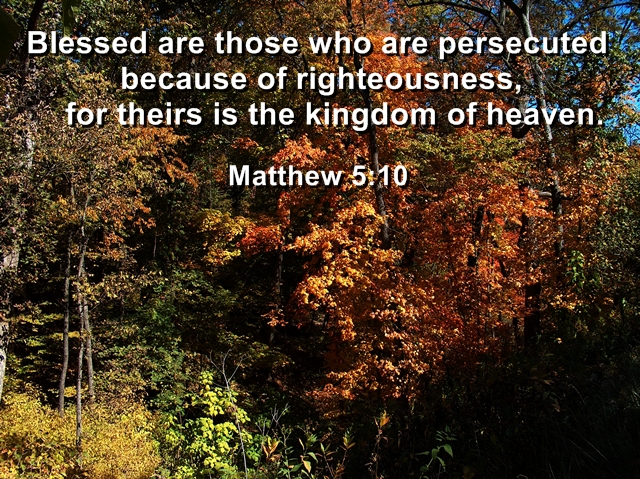
Persecuted Because of Righteousness

As a rule, do you expect to see a righteous person persecuting another person because the persecuted person is righteous? My guess is “probably not.” If this is true, then what sort of person persecutes another because they are righteous? Again, my guess is that it would have to be an unrighteous person; it stands to reason, right?
God does not bless unrighteousness.
Righteousness happens when a person lives in accordance with the will of God, and when a person lives this way, he or she is considered by God to be “righteous”, and relationship between that person and God is in place; thus in this life such a person is blessed. Theirs is the kingdom of heaven in the here and now, in spite of persecution and they are blessed for all eternity.

Posted in Christian living | Tagged , , , , , , , , , | 7 Comments

Opportunity and Suffering

Who is going to harm you if you are eager to do good? But even if you should suffer for what is right, you are blessed. “Do not fear their threats; do not be frightened.” But in your hearts revere Christ as Lord. Always be prepared to give an answer to everyone who asks you to give the reason for the hope that you have. But do this with gentleness and respect, keeping a clear conscience, so that those who speak maliciously against your good behavior in Christ may be ashamed of their slander. For it is better, if it is God’s will, to suffer for doing good than for doing evil. 

1 Peter 3:13-17

In our earlier post, Peter told us what it looks like to love one another in the form of a lesson or instruction, and he continues the theme here asking who would want to harm you if you are doing good?  He continues with transition, into an implied question of “What if they harm me anyway?”  Peter’s answer to that unwritten question is that you will be blessed in spite of everything. The result of course, is that even if we suffer for doing the right thing, as sometimes happens in this life, we will be blessed.

In telling us not to fear their threats (or the things that others fear) Peter is quoting from Isaiah 8:12, and if you think about it, this is a very apt quote, for we who will live even though we die, and to whom blessings are assured, need not fear what the world can do to us for doing right. It may seem odd what Peter says next: always be ready to tell people, who ask, why you have this hope in Christ, and do it with gentleness and respect…

It may be that Peter is thinking that the way we react to problems will serve as a catalyst for such questions; after all, shouldn’t we be afraid?  Everyone else would be− that makes “evangelism” look quite different from handing out leaflets and knocking on doors. Those who slander you may become ashamed and… who knows? They might come to see things quite differently than before.

In any event, if God wills it, it is better to suffer for good than to suffer for wrong… so always do what is right in the eyes of the Lord.

Now, when you view this in its fuller context of 3:8-17, the whole thing becomes clear:  Love one another, live your life in the love of Christ so that the world may see His love through you.  If the world should react badly, you have nothing to fear because of what you have in Christ… and it might even give you a better chance to share.  In any event, living our lives as Christ would live is better than doing wrong.

Posted in Bible | Tagged , , , , , , , , | 3 Comments

Life 101

Finally, all of you, be like-minded, be sympathetic, love one another, be compassionate and humble. Do not repay evil with evil or insult with insult. On the contrary, repay evil with blessing, because to this you were called so that you may inherit a blessing. 

1 Peter 3:8-9

In these two verses, Peter is telling us what it looks like when we love one another.  What may confound us at times is that He has set this out as an imperative, making it a lesson or instructions. When a group of people share real fellowship, what happens, what do they look like to others?

Well, let’s see, they are in harmony, they aren’t fighting, they are gentle and they are humble in their demeanor, caring for one another.  They are forgiving of one another, and they are blessings to one another.  Isn’t that about what he said? OK, maybe you are thinking that I simply found different words and re-wrote the text… a kind a paraphrase. Fine, then let’s think about it.

To love is to put the interests of others ahead of our own interests.  So, when it comes to opinions, we are not going to argue and fight to “win” every point, we are going to respect the views of other people, and in this we are “like-minded.”  That love involves being sympathetic with those whom we love is pretty much a given, right?

Can you love a person and not have compassion when they are hurting?  Of course not, because you care about them.  Isn’t the same true for humility?  If you are putting their interests ahead of your own, you aren’t going to be cramming things down their throats are you?  It would seem not…

If someone you love sins against you, aren’t they usually the first ones that you are willing to forgive?  So, there is no evil for evil and insult for insult.  No, you would try to be a blessing to those you love, even when they aren’t being good to you… forgiveness again.

See it now?  Peter is describing love in action:

For,

“Whoever would love life
    and see good days
must keep their tongue from evil
    and their lips from deceitful speech.
They must turn from evil and do good;
    they must seek peace and pursue it.
For the eyes of the Lord are on the righteous
    and his ears are attentive to their prayer,
but the face of the Lord is against those who do evil.”

1 Peter 3:10-12

Lord, may we become the people you would have us to be, loving one another as you loved us, so that in all that we do, we would be pleasing in Your sight.

Posted in Bible | Tagged , , , , , , , , | 2 Comments

Marriage

1 Peter 3:1-7

Peter moves on from his discussion of Christian slaves and their masters in which he called upon slaves to be good and reliable workers who respect their masters for the sake of the Gospel, and now applies the same thinking to marriage.

Marriage is an interesting relationship: Two people love one another, live together and relate on multiple levels with each other… and they get to know each other for all of their faults, and all of their strengths.  They see each other at their worst and at their best, and they have times of bliss and times of turmoil. Peter teaches that each is to put the other first.

He tells wives that they should submit to their husbands, as Paul says that wives should obey their husbands. Peter says that husbands should be considerate to and give respect to their wives. Paul says that husbands should love their wives as Christ loved the church and gave His life for her.  Even though some today would be critical of these comments, in truth, allowing for the fact that Peter and Paul wrote in a very different cultural context, the message is really the same: Each should put the other ahead of themselves.  For one thing, this is a recipe for a happy marriage in most cases, for another reason, this is how we are supposed to treat everyone. It is how Jesus behaved toward everyone also.

Sadly, as in some other areas, there have been those who used Bible passages for selfish purposes at various points over the years, using selectively some of these injunctions to assert male dominance over women.  People who deliberately misapply Scripture are called “false teachers” by the Scriptures, and in our time, I think that it is important that we not allow the sins of false teachers to sour God’s Word for us.  The whole point of these passages is to demonstrate what Christ’s love looks like in action in various everyday situations.  Oppressiveness toward one’s spouse can hardly be called the love of Christ.  Putting the interests of the other person first, even when they are not being very lovable, is always Christ-like.  Being abusive and then citing the Word to justify it is downright evil.

Putting others first, is very much like something Jesus said one day.  It’s a rather famous statement, and I’ll bet you’ve heard it once or twice: Do unto others as you would they should do unto you.  Yes, that’s it, the Golden Rule−  That is how husbands and wives are supposed to behave toward each other. So, one cup of the Golden Rule, plus a teaspoon of forgiveness is a good recipe to begin a happy marriage.

Posted in Bible | Tagged , , , , , , , , | 11 Comments

The One Who First Loved Us

“He committed no sin,
    and no deceit was found in his mouth.”

When they hurled their insults at him, he did not retaliate; when he suffered, he made no threats. Instead, he entrusted himself to him who judges justly. “He himself bore our sins” in his body on the cross, so that we might die to sins and live for righteousness; “by his wounds you have been healed.” For “you were like sheep going astray,” but now you have returned to the Shepherd and Overseer of your souls.

1 Peter 2:22-25

The second chapter concludes at the foot of the cross, as Peter applies the prophecy of Isaiah 53 so as to make clear that Jesus is our example in dealing with the hardships of life.  In everything that Jesus said or did during His ministry, His priority was on serving the Father by serving others in a way that would advance the Father’s purpose. When this involved sacrifice, He sacrificed. When it required suffering, He suffered, for that is how great His love for us was… and is.

As followers of Jesus, can we expect to do less?  If that means putting others first, we put others first, because we love Jesus. If that means that we endure hardship, then we endure it for His sake because we love Him. If that means we love our neighbor even when our neighbor seems less than lovely, then we do it because we love Him. Through this process, we are modeling the behavior of our Savior to the world. Some might scoff and call us fools, but others will respond and follow the One who reached out to them through us in love, and we will have added to His holy spiritual house one more living stone.

And all because we love Him who first loved us.

Posted in Bible | Tagged , , , , , , , , | 7 Comments