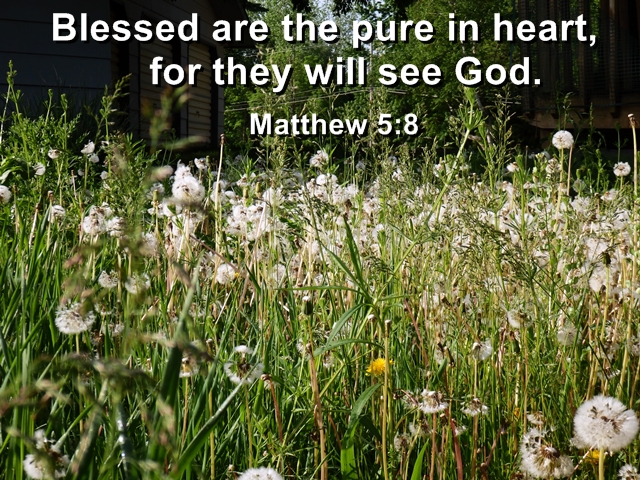
To See God

The expression “pure in heart” refers to a person whose inner most thoughts, motivation and purpose are pure, clean, wholesome and good; this is the one who will see God. To see God is to believe in God, and even more basic, they believe God; such a person is blessed indeed.

The person who is not pure in heart will not see God, possibly because he would rather not see Him. The person who is not pure in heart is one whose inner motivations are not wholesome or good, but are more likely centered on self, gain and getting what they want at whatever cost; they are not blessed because there is little room in their lives for a relationship with Him.

Posted in Bible | Tagged , , , , , , , , | Leave a comment

Merciful

Mercy is the most fundamental aspect of our relationship with God. We only have relationship with God because of His tremendous mercy, for without it, we are permanently estranged from Him. Thus, Jesus teaches mercy on our parts as a foundational requirement for being a disciple.

We have received His mercy; we are to show mercy to others when the occasion arises. We have received His love; we are to show love to others. How can we show mercy without love, and love without mercy? Yes, this is fundamental.

The person who has received God’s mercy and who shares God’s mercy with others, both through the Gospel and through our own attitudes and actions, will in the end, receive mercy when those who have refused it receive God’s judgment; this is also a fundamental truth.

Now we come to the reversal of this: What kind of person does not show mercy to others?

The ruthless, the cruel, the inhumane, the purely evil…

Will they receive mercy? No, they will be judged. Will they be blessed in this life by relationship with God? No, for they live in open rebellion against Him. Will they receive mercy in the end? No, they will receive justice instead.

Posted in current events | Tagged , , , , , , , , | 1 Comment

For They Will Be Filled

I

doubt that I need to discuss what it means to “hunger and thirst for righteousness” so let’s jump directly to what will become of the one who has no such desire. I think we can safely assume that the one who has no such desire will not be blessed, and one who hungers and thirsts for wickedness will not only find what they are looking for, but they will also find God’s curse in His judgment. Such a person will always need to be looking over his shoulder, will be running from the law, and will seldom have a restful night’s sleep; if they are lucky, they’ll live long enough to die from stress related illness, if not by the sword. Anybody want to sign up for that?

As with the other beatitudes, there is an apocalyptic element to this (see Isaiah 61). God’s ultimate gift to Mankind is the gift of righteousness, for when Jesus returns and culminates His Church, all evil will be eliminated and the righteous will abide eternally in His Kingdom without pain, suffering, oppression or death: Blessed indeed!

Posted in Christian living | Tagged , , , , , , , , | Leave a comment

For They Will Inherit the Earth

A person who is “meek” is often thought of as being resigned to their circumstances, even weak, but that really isn’t what is being described here. Those who are “meek” are those who understand that they are dependent upon God, and not upon their own strength or even upon the power of armies, for our own strength is a temporary affair, as is the might of an army; all will perish. Yet God’s strength is eternal, and His might never flags or fails. With this in mind, consider who is not meek; the proud, the loud, and the haughty. These are the ones who must always dominate others, who must always have the last word, and who will trample others to get ahead, for they fear losing control: They are not blessed for their own behavior is their curse.

The meek will inherit the earth, just like the descendants of Abraham would inherit the Land. Once again, Matthew has linked an idea relating to Jesus with Israelite history, and this time, He has done so in a way that leads us to an apocalyptic conclusion, for those who place their full faith and trust in God for their provision will not only enjoy relationship with Him now, but will reign with Him upon His return, thus receiving a double blessing of His grace.

Posted in Christian living | Tagged , , , , , , , , | 1 Comment

Those Who Mourn

Most of the time, we don’t associate blessing with mourning; maybe we should rethink this… Matthew didn’t actually say what those blessed ones are mourning; it could be the loss of a loved one, it could be the loss of their home or possessions, or it could be the sinful and rebellious state of this world. Maybe it doesn’t matter…

I think it is safe to say that for a person to truly mourn they first had to love; certainly, this would be true in the loss of a loved one. It would also be true if a person is mourning the loss of possessions, for if they didn’t love the possession(s) lost, would they actually mourn?

It wouldn’t seem so.

If the person was mourning for the wickedness of this world, wouldn’t that show they loved God a whole lot?

Even so, we might be looking at this whole thing from the wrong perspective; maybe Jesus intended something else. Consider for a moment those who do not mourn− what a terrible and sad life they must lead! Never having enough of a relationship with anyone for love to develop; never being able to mourn? Never having a loving relationship with God so as to mourn for those who rebel against Him?

Never loving− never mourning?

Those who mourn will receive comfort from God, both in the here and now and in the ultimate future when all pain and sorrow will cease. I don’t know about you, but for me, just knowing this is a comfort that brings joy into my life.

So, if God provides comfort for those who mourn, who brings comfort for those who don’t?

Posted in Christian Life | Tagged , , , , , , , , | Leave a comment

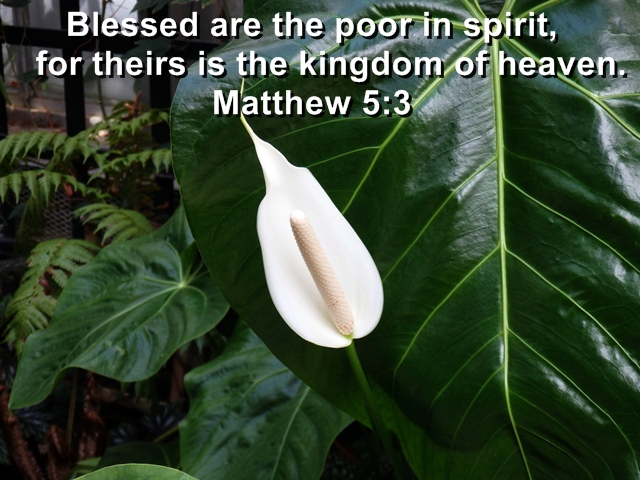
Poor in Spirit

The first Beatitude speaks of those who are “poor in spirit”. Much has been made about the difference between Matthew’s language and that of Luke in Luke 6:20, for Luke merely says “the poor”. Does Matthew have more in mind than mere economic circumstances?

I’m happy to let others argue, but it seems to me that Matthew, a Jew, might be aware of the Old Testament idea of poverty not only in literal terms, but as a state of mind, for the Hebrew word for “poor” has this additional connotation to it. In those days, a poor person not only had to deal with bad economic circumstances, they also had to contend with the fact that they had fewer rights in society, for then as now, they lacked the resources to enforce their rights; and consequently they were at the mercy of others.

Living in such a state made it clear to anyone who could fathom the notion, that the poor must depend entirely upon God. Most of us today, even those of us who don’t enjoy material abundance, live in circumstances far better than those of a poor person in ancient times, and maybe we too have a hard time seeing what Matthew means; let’s look at it this way: In our world, a person of very limited means is never far from being destitute, while a rich person has a much larger buffer to get through tough times. The poor person knows they live close to the edge; the rich person can convince himself that everything is wonderful, that he is the master of his own life, and in doing so, he only deceives himself, for God is the master of everything. We see time and again in Scripture that a rich person has a great obstacle to overcome in following God, for he thinks he is the one in control, while a poor man has no such delusion to overcome, and no great wealth to hold him back. The poor person is free to follow the Lord, while the rich person carries his wealth as a millstone around his neck; woe is he.

The kingdom of heaven is both a present reality and a future hope, for it is with us today in Christ, and will be fully realized in its ultimate fulfillment when He returns. For the person who recognizes his or her current dependence upon God for everything in life, it is a present reality indeed, and a source of great joy, “for theirs truly is the kingdom of heaven.”

Posted in Christian living | Tagged , , , , , , , , | Leave a comment

God is My Help

Surely God is my help;
    the Lord is the one who sustains me.

Let evil recoil on those who slander me;
    in your faithfulness destroy them.

Psalm 54:4-5

It doesn’t sound like David was having a good day when he wrote this; he was under attack from his enemies as it happens. Most of us aren’t on the run from assassins or cut-throats, but there are times in this life when it seems like we are under assault and feel overwhelmed by our circumstances.

One thing we can take from these verses is that David knew where his help would come from, it would come from God. The only problem, was that David didn’t know when God would act or why God didn’t set things right immediately.

But he did know that God would have his back.

Like David, we don’t know God’s timing, nor do we know God’s reasoning for His timing. In fact, other than a bunch of theological abstractions, I can’t even tell you why God allows so much trouble in our lives…

Yet we do know that God has our backs.

In difficult times, God is our Rock, our strength, and in such circumstances our relationships with Him take on a whole new significance as a source of strength and hope, transcending the problems of this life.

Oh, what an awesome God we have!

Oh yes, and He’s pretty awesome when things are going smoothly too.

Posted in Christian living | Tagged , , , , , , | Leave a comment

Wednesday Class Notes: July 10, 2024

Who is going to harm you if you are eager to do good? But even if you should suffer for what is right, you are blessed. “Do not fear their threats; do not be frightened.” But in your hearts revere Christ as Lord. Always be prepared to give an answer to everyone who asks you to give the reason for the hope that you have. But do this with gentleness and respect, keeping a clear conscience, so that those who speak maliciously against your good behavior in Christ may be ashamed of their slander. For it is better, if it is God’s will, to suffer for doing good than for doing evil. 

1 Peter 3:13-17

In 3:8-12, Peter told us what it looks like to love one another in the form of a lesson or instruction, and he continues the theme here asking who would want to harm you if you are doing good?  He continues with transition, into an implied question of “What if they harm me anyway?”  Peter’s answer to that unwritten question is that you will be blessed in spite of everything. The result of course, is that even if we suffer for doing the right thing, as sometimes happens in this life, we will be blessed.

In telling us not to fear their threats (or the things that others fear) Peter is quoting from Isaiah 8:12, and if you think about it, this is a very apt quote, for we who will live even though we die, and to whom blessings are assured, need not fear what the world can do to us for doing right. It may seem odd what Peter says next: always be ready to tell people, who ask, why you have this hope in Christ, and do it with gentleness and respect…

It may be that Peter is thinking that the way we react to problems will serve as a catalyst for such questions; after all, shouldn’t we be afraid?  Everyone else would be− that makes “evangelism” look quite different from handing out leaflets and knocking on doors. Those who slander you may become ashamed and… who knows? They might come to see things quite differently than before.

In any event, if God wills it, it is better to suffer for good than to suffer for wrong… so always do what is right in the eyes of the Lord.

Now, when you view this in its fuller context of 3:8-17, the whole thing becomes clear:  Love one another, live your life in the love of Christ so that the world may see His love through you.  If the world should react badly, you have nothing to fear because of what you have in Christ… and it might even give you a better chance to share.  In any event, living our lives as Christ would live is better than doing wrong.

Posted in Bible | Tagged , , , , | Leave a comment

There is a Point to the Beatitudes

“You are the salt of the earth. But if the salt loses its saltiness, how can it be made salty again? It is no longer good for anything, except to be thrown out and trampled underfoot.

“You are the light of the world. A town built on a hill cannot be hidden. Neither do people light a lamp and put it under a bowl. Instead they put it on its stand, and it gives light to everyone in the house. In the same way, let your light shine before others, that they may see your good deeds and glorify your Father in heaven.

Matthew 5:13-16

Jesus has just given us a series of character traits or attributes in the Beatitudes (Matt. 5:3-11), but so far, we have attributes without a purpose; in these verses, Jesus gets to His larger point.

To illustrate, He uses two metaphors, salt and light. Salt had many uses in the ancient world thus, it is very difficult to nail down the exact use Jesus might have been referring to; He just didn’t say. Over the years, people have chosen a possible use and claimed it as the thing Jesus had in mind, but to be perfectly honest, such a position is only a matter of speculation, so let’s try to avoid falling into that trap; we’ll just look at salt as a basic and useful substance. As an example, I’ll mention what were probably the two most common uses of salt, as a food preservative, and as the basic ingredient for seasoning food. For either of these uses, if the salt loses its saltiness, i.e. its usefulness, then it is worthless. If we, as “the salt of the earth” lose our usefulness, then we might fit into that same category.

This image becomes crystal clear in His next metaphor, light. We, as we exhibit the traits of character that Jesus spoke of in the beatitudes, become the “light of the world.” Imagine if you can, a world filled with the meek, the poor in spirit, peacemakers, and all of the rest of those attributes, next to what we are used to… this is what Jesus meant here by “the light of the world.” Light does no good if it is hidden from view; it’s just like salt that has lost its saltiness, so He tells us to let our light shine forth in this dark world as a contrast to the norm, to the glory of God.

That is what “Kingdom” is all about.

I mention this because the Sermon on the Mount is set in the context of Jesus proclaiming the Kingdom, and these verses wrap up the introduction of the Sermon. If you are looking at it from a structural point of view, the first 16 verses of this chapter set forth the thesis of the rest of Sermon, and as we continue, we will see an expansion upon this theme of bringing about the Kingdom of Heaven on this earth in the here and now.

Posted in Christian living | Tagged , , , , , , , | Leave a comment

Love, Justice and Our Response

I will sing of your love and justice;
    to you, Lord, I will sing praise.
I will be careful to lead a blameless life—
    when will you come to me?

Psalm 101:1-2a

At first this may seem to be quite simple, but look closely and you’ll see a hidden complexity that often confounds people. In the first line, we read of singing of God’s love and justice; an interesting combination. Consider for a moment His great and amazing love, so boundless, so unconditional. His love is so great that He was willing to do amazing things that we might be redeemed from our sins against Him. Yes indeed, contemplating God’s love is something we like to do. Yet in this line, we are singing of His love and justice.

Sometimes we think of justice as fairness, and that is true enough, yet we must admit that it is a little incomplete, for justice is more than just fairness because when most people apply fairness to themselves, it ends up meaning whatever they want at the moment, forgetting all about what is fair to the other person. If we consider the totality of our sin against God, what is just or fair about redemption?

Nothing, nothing at all, and that is why it is called grace.

Now we can see why singing of God’s love and justice together results in praise. Of course, when we see that God’s love resulted in His paying the price for our sin to satisfy His justice, resulting in grace, we sing praises, but the next line shows how we respond to His grace; we endeavor to lead blameless lives. It makes perfect sense, doesn’t it? We’ve received grace, so great was God’s love for us, so why wouldn’t we resolve to do the best we can to live lives that are pleasing to Him? This isn’t because of any rule or regulation, but it is the natural expression of our love and gratitude.

In the last line, David asked a question that we have the answer to, for He has come and He has left us with His Spirit by whom we can come into His presence any time we like; how is it that we should delay another moment entering into His presence with confidence and joy in our hearts to give Him the thanks and praise He has coming?

Posted in Christian living | Tagged , , , , , , | 2 Comments