A Warning

Do not be yoked together with unbelievers. For what do righteousness and wickedness have in common? Or what fellowship can light have with darkness? What harmony is there between Christ and Belial? Or what does a believer have in common with an unbeliever? What agreement is there between the temple of God and idols? For we are the temple of the living God.

2 Corinthians 6:14-16a

I have heard sermons in the past that used this text to teach that Christians should not marry unbelievers, but wouldn’t that be a funny thing for Paul to get into in a defense of his apostolic ministry? More to the point, wouldn’t there be a potential conflict with his instruction in 1 Corinthians 7:10-14 in which he told the people not to abandon their unbelieving spouses?

Hmm… What is old Paul up to here?

Paul’s wording is interesting: “yoked together”. There are similar references in two other places, Leviticus 19:19 and Deuteronomy 22:10. In Leviticus, different kinds of animals aren’t to be mated together; in Deuteronomy, two different kinds of animals are not to be yoked together to plow a field. To me, particularly since Paul has not given any of his usual hints that he’s changing the subject, the Deuteronomy reference makes a lot more sense than understanding this as a new unit about marriage. Remember, this section began in chapter 3 with outsiders coming into the church to convince people of a host of accusations against Paul…

Oh yes, he is referring to two kinds of animals plowing a field…

So, Paul is going back to the situation that led to the whole problem that broke out in Corinth and nearly destroyed the whole church there, when non-Christians used lies and slanders to attack him, and by extension, Christianity, while in their midst. With this understanding, the rest of this chapter is easy to follow. In our verses above, he uses a series of contrasts to illustrate his point. I should mention that Belial is a name that appears nowhere else in Scripture but was used numerous times in Jewish non-Scriptural literature of the times as a direct reference to Satan.

To support his position, Paul cites three Old Testament passages, and then concludes:

Therefore, since we have these promises, dear friends, let us purify ourselves from everything that contaminates body and spirit, perfecting holiness out of reverence for God.

2 Corinthians 7:1

To be holy means to be “set apart”. For the church be holy, it must be set apart for God; that is what it means to live in holiness. Being set apart is not to be better than everyone or to be self-righteous and speaking harshly about other people. Rather, we are supposed to love our neighbor as ourselves. However, it does mean that the church should not allow itself to be led astray or heavily influenced by non-believers. I have no doubt that the Corinthians who received this letter would happily testify to the disaster that this error caused in their midst.

As we continue, Paul will express his great joy that the Corinthians have repented of the mistake, the mistake he has just been talking about.

Posted in Bible | Tagged , , , , , , , | 2 Comments

Attaining the Goal

Not that I have already obtained all this, or have already arrived at my goal, but I press on to take hold of that for which Christ Jesus took hold of me. Brothers and sisters, I do not consider myself yet to have taken hold of it. But one thing I do: Forgetting what is behind and straining toward what is ahead, I press on toward the goal to win the prize for which God has called me heavenward in Christ Jesus.

Philippians 3:12-14

In the verses we covered in the last section, Paul was telling us about giving up his past to follow Christ to salvation and eternal life, and you will recall that he called all of his past accomplishments “garbage” in comparison to what he would gain as a follower of Jesus. Now, in some of the most memorable verses in the whole New Testament, Paul tells us that he still has a way to go before he will reach his goal. Before we get into these verses, I would like to remind you that he is still speaking in the context of being “worthy of the gospel” which is a theme he began back in the first chapter.

Verse 12 is quite telling: Not that I have already obtained all this, or have already arrived at my goal, but I press on to take hold of that for which Christ Jesus took hold of me. If we aren’t careful, we might misunderstand this verse. At first glance, it would seem to mean that Paul hasn’t yet arrived at Christ-like perfection, and that would be true. However, is that what Christ took hold of Paul for? Is that what He took hold of you for? Is that why Christ died on the cross? No, it clearly is not why Christ “took hold” of Paul or any of us, for in order for Christ to take hold, He first had to die, so we need to take the cross into account. As I see it, the key to understanding this lies back in verses 10-11: 

I want to know Christ—yes, to know the power of his resurrection and participation in his sufferings, becoming like him in his death, and so, somehow, attaining to the resurrection from the dead.

Why did Christ die on the cross? It was for forgiveness of sins, that we might receive the gift of eternal life (John 3:16). What was Paul’s goal in all of this, and what is he urging us to embrace? The same thing (Phil. 3:11). Paul has not yet attained the goal of eternal life; he is still alive in the body, so there is still work to do on this earth.

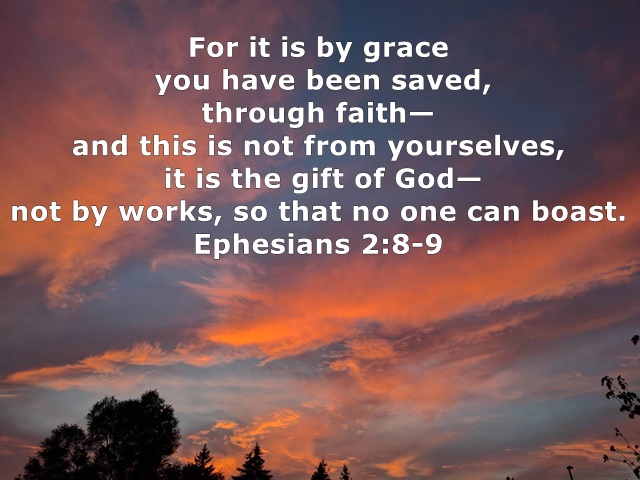
Let’s be careful that we don’t stray too far from the path here; it isn’t that Paul is seeking to earn his salvation, for that is assured through grace by faith.  Paul is still in this life concerned with his response to salvation, and that’s where being Christlike comes in.  Paul’s goal is eternity, his journey to eternity is by imitating Christ and spreading the gospel, and by the way, that’s our journey as well.  

Posted in Bible, Christian living | Tagged , , , , , , , | Leave a comment

An Appeal for Open Hearts

2 Corinthians 6:3-13

As Paul continues his defense of his apostolic ministry, he moves from the discussion of the ministry of reconciliation, to which we have all been called, into a discussion of faithfulness through hardships. He begins with a double negative, depending on your point of view, it could even be taken as a triple negative:

We put no stumbling block in anyone’s path, so that our ministry will not be discredited.

Strictly speaking, a double negative isn’t the clearest way to communicate one’s thoughts; they lead to confusion. It would have been clearer if Paul had simply said, “We have done nothing to discredit our ministry”. In any case, that is precisely the point he is making in this passage. At first glance we might get the impression that Paul is complaining a bit; there’s a note of unfairness on display here. Yet I don’t think that was his intention; I certainly hope not, for that would surely undo his point. Instead, I see a little shaming here− take a close look at this:

He begins with … Rather, as servants of God we commend ourselves in every way: in great endurance; in troubles, hardships and distresses then in verse 5 he cites 6 hardships: in beatings, imprisonments and riots; in hard work, sleepless nights and hunger. He follows these 6 hardships with his responses to them in 6-7: in purity, understanding, patience and kindness; in the Holy Spirit and in sincere love; in truthful speech and in the power of God; with weapons of righteousness in the right hand and in the left;” notice the contrast between his hardship and his attitude through the experiences.

Then he continues by citing his experiences in contrast with his condition:

through glory and dishonor, bad report and good report; genuine, yet regarded as impostors; known, yet regarded as unknown; dying, and yet we live on; beaten, and yet not killed; sorrowful, yet always rejoicing; poor, yet making many rich; having nothing, and yet possessing everything. (6:8-10)

Finally, in 6:11-13 he brings the discussion home to the Corinthians:

We have spoken freely to you, Corinthians, and opened wide our hearts to you. We are not withholding our affection from you, but you are withholding yours from us. As a fair exchange—I speak as to my children—open wide your hearts also.

Looking at this passage in its entirety, it’s fair to conclude that Paul is lodging a complaint. He has served the Corinthians faithfully and lovingly, yet they haven’t always been fair with him in return. They have listened to those who would lie about him, they have been eager to find fault with him and though he has been faithful in his service to them, they have not been faithful in return. Yet there isn’t an accusatory tone in what Paul has presented here, for you see, Paul has given us an example of resolving personal disputes in love.

Yes, he has mentioned the facts of the situation, but in doing so, his tone has been one of conciliation, not condemnation. I think we can learn from this, don’t you?

Posted in Bible | Tagged , , , , , , , | 1 Comment

Pride, Humility and Relationship with God

Jesus taught in parables to enable His listeners to more easily understand important concepts that may cut close to home.  In Luke 18:9-14, Jesus teaches us about pride and humility in a way that all of us can understand.

It seems that a Pharisee and a tax-collector were in the temple to pray.  The Pharisee stood up and prayed in a way that was giving thanks to God for making him better than everyone else.  He lists the extra things he did, above and beyond the requirements of the Law in a way that would shame other people.  The tax-collector, off at a distance, with head bowed simply asked God to have mercy on him.  Jesus ended the story by pointing out that the lowly tax-collector was the one who was justified before God; that only those who humble themselves will be exalted before God and those who exalt themselves will be humbled. (v. 14)

I could be mistaken, but it seems to me that the Pharisee in the story, had no idea that he needed God’s mercy, because all he could think of was how great he was; and maybe he was, in a sense.  If his conduct was really so righteous as he claimed, he was behaving better than most everyone else, but there was one problem.  Benjamin Franklin in his Autobiography wrote about a self-improvement project that he entered into as a young man.  He made a list of virtues, and every day he made a mark next to the virtue that he felt he had fallen short of that day.  The idea was that he would work very hard the next day to correct his behavior.  The problem that he found himself running into was that on the days that he didn’t fall short in any other virtue, he was so proud of himself that he fell way short in “Humility.”  Franklin reports that he soon abandoned the project.

It isn’t surprising that a Pharisee who came face to face with Jesus would reject Him as Messiah when He taught about mercy.  Apparently, they had no understanding that they needed mercy, so wonderful was their behavior…

May we be quick to humble ourselves that we never become modern-day Pharisees!

Posted in Bible, Christian living | Tagged , , , , , , , , | Leave a comment

Ministers of Reconciliation

2 Corinthians 5:11-6:2

Paul moves into this topic by referring to his critics who apparently have claimed that he was out of his mind for believing that Christ died for our sins and then rose again from the dead. Come to think of it, nothing much has changed; people today say that we are “deluded” in our beliefs along these lines. Yet for Paul, and hopefully for us as well, it was a great deal more than just a belief in Christ, for that belief brings with it far reaching implications:

For Christ’s love compels us, because we are convinced that one died for all, and therefore all died. And he died for all, that those who live should no longer live for themselves but for him who died for them and was raised again. (5:14-15)

We don’t simply believe the historical fact that Jesus died for our sins on the cross, was buried, and then rose again from the dead; now, what’s for lunch? Instead, when we accept this set of facts, we are compelled by His great demonstration of love for us, to make changes in our lives, not because He forces us to, but because we want to. When this transformation takes hold, people say we’re crazy. Paul sums up the changes this way:

So from now on we regard no one from a worldly point of view. Though we once regarded Christ in this way, we do so no longer. Therefore, if anyone is in Christ, the new creation has come: The old has gone, the new is here! (5:16-17)

In verses 18-19 Paul restates his message of Christ’s ministry on the cross and its result, and then says…

We are therefore Christ’s ambassadors, as though God were making his appeal through us. We implore you on Christ’s behalf: Be reconciled to God. God made him who had no sin to be sin for us, so that in him we might become the righteousness of God. (5:20-21)

As followers of Jesus Christ, we are His ambassadors in this world, which is no longer our home; everything has changed. God is making His great appeal to all humanity to be reconciled to Him through Christ, and His great appeal is being made through us. Just think for a moment, God’s eternal plan to redeem humanity, the plan that was hidden for ages is now underway. We have been reconciled to Him, and now we have a part to play in achieving God’s ultimate purpose, which is that we would not keep His grace only for ourselves, but that we would share it with everyone we come into contact with, and by putting His grace into practice, we would become His righteousness in a world where true righteousness is in short supply. Notice that this righteousness is not about keeping rules, but instead, is all about sharing God’s love.

With a message like this, we are faced with a question: What will I do today to bring His message of reconciliation to someone who needs it?

Posted in Bible | Tagged , , , , , , , | 4 Comments

A Radical Example

But whatever were gains to me I now consider loss for the sake of Christ. What is more, I consider everything a loss because of the surpassing worth of knowing Christ Jesus my Lord, for whose sake I have lost all things. I consider them garbage, that I may gain Christ and be found in him, not having a righteousness of my own that comes from the law, but that which is through faith in Christ—the righteousness that comes from God on the basis of faith. I want to know Christ—yes, to know the power of his resurrection and participation in his sufferings, becoming like him in his death, and so, somehow, attaining to the resurrection from the dead.

Philippians 3:7-11

We need to be mindful of our context as we begin this text.  Paul, in the preceding verses has been discussing his Jewish resume, his accomplishments, and his former position. Yes, he was an accomplished man, well-educated, influential and a member of the ruling elite of his day, and he has given all of that up to follow Christ.

Here, almost talking like an accountant, he is writing off losses and seeking gains.  What is it that he considers to be losses?  His former life, its accomplishments and position.  We need to recognize that he isn’t lamenting his loss of position and all the rest, he is considering these things, his training, his accomplishments, and position as losses in and of themselves.  Those things he declares in verse 8 to be “garbage”.  His training is garbage, his accomplishments are garbage, his former position is garbage, not the fact that he has given them up.

Why did he give them up? Simple, he gave up everything he had for Christ. In all of those former things, Paul was trying to attain righteousness by his own power and effort; now he has obtained God’s righteousness through his faith in Jesus Christ.  It would seem that in Paul’s estimation, he has attained a very strong bottom line as a result. Check out verse 10:  I want to know Christ—yes, to know the power of his resurrection and participation in his sufferings, becoming like him in his death…Interesting isn’t it, how he has tied together knowing Christ with “the power of his resurrection, and participation in his sufferings” and death. Then, notice in verse 11 how he links this with the attainment of His resurrection and eternal life.  It would seem that Paul’s whole point is that those attainments of this life, when compared to resurrection and eternal life, are just garbage; utterly worthless.

In light of all this, how should we look at our earthly life, its achievements, its positions, its ‘glories’?  If we dare to follow Paul’s example, then they must all be nothing more than garbage!  

OK, so maybe we aren’t willing to follow Paul’s radical example.  Yet maybe we should rethink this, for Paul was following Jesus’ example, just like we are supposed to be doing.

Posted in Bible, Christian living | Tagged , , , , , , , | Leave a comment

Wanna Hear a Secret?

HPIM2690-crop

Well, do you?

Have you ever had someone ask you this?

If so, you probably also know that the person usually says, “promise not to tell?” So, let’s start over…

Wanna know a secret?

Will you promise to tell everybody?

(Woops, this secret must be a special one, because you need to tell it to everybody!)

OK, are you ready?  Here comes the secret:

Jesus died for you, so that by His death you might live… forever.  He died so that you can be at peace with God and live a joy-filled life through good times and bad.  He will walk with you, He will comfort you and He will guide you by His Word…

BUT: There’s a catch!

You have to respond to this in faith… and tell everybody.

So, here’s a new question…

Who will you tell next?

Have a great week!

Posted in Christian living | Tagged , , , , , , | 1 Comment

The Next move

tumblr_m9jqciaEYQ1reo5jzo1_500_large

Here we are at the chess board, looking intently at the pieces on the table and trying to plot our next move… but this is no game―  it’s life.

Each of us has life moves to make; each of us needs a strategy and a plan…

Some people go see their financial advisor to make their plan.  Others speak with their public relations team or their marketing guru.

Paul had a different idea:

 I press on toward the goal to win the prize for which God has called me heavenward in Christ Jesus.

All of us who are mature should take such a view of things. And if on some point you think differently, that too God will make clear to you. Only let us live up to what we have already attained.

Philippians 3:14-16

In context (3:1 ff.) he was talking about the ultimate attainment of eternal life in Christ, saying that he hadn’t yet attained it since he’s still living in the physical body.  Then he slipped in that last little line:  “Only let us live up to what we have already attained.”

What have we already attained?

We have attained relationship with God through Jesus Christ.  We have attained an inheritance of eternal life and we are His servants on this earth.  As such, it seems that Paul is saying that we need to live accordingly, not trusting in the physical aspect of life but in recognition of the spiritual significance of our relationship with Christ.  Thus, things like financial or business advice might have their place, but it isn’t in planning “life.”  Life is not about our image that we attempt to project to others, it is about the reality of the way we live and behave.

What’s our next move?

To follow Jesus Christ!

Posted in Bible, Christian living | Tagged , , , , , , | Leave a comment

Moving on to a Better Future

2 Corinthians 5:1-10

These verses serve a twofold purpose. First, they amplify the point Paul has been making in this chapter, and second, they transition into his next subsection in his larger discussion defending his apostolic ministry. The new subsection will deal with preaching the ministry of reconciliation, as we will shortly see.

To accomplish this expansion and transition, Paul will use two metaphors, the first of which is seen in 5:1…

For we know that if the earthly tent we live in is destroyed, we have a building from God, an eternal house in heaven, not built by human hands.

The “earthly tent we live in” represents our mortal bodies, this earthly existence. Paul uses a building “not made by human hands” to represent our eternal future in Christ. Thus, if and when our tent is destroyed, after all, a tent is a temporary shelter, we will have a really cool house to live in. Of course, who would want to live in a tent when there’s a cool house waiting for them?

After this, he mixes metaphors:

Meanwhile we groan, longing to be clothed instead with our heavenly dwelling, because when we are clothed, we will not be found naked. For while we are in this tent, we groan and are burdened, because we do not wish to be unclothed but to be clothed instead with our heavenly dwelling, so that what is mortal may be swallowed up by life. (5:2-4)

I suppose we could read these verses and identify the exact number of writing and communication rules Paul has broken here in the way he introduces and mixes his metaphors, but in the final analysis, I think he made it work. The tent and house of verse 1 have become articles of clothing, and now our contrast is between being clothed and being naked. While that would normally be confusing and would make his meaning unclear, it seems to be clear enough that when we die, when that tent is destroyed, we will not be left with nothing, i.e. naked. Instead, we will be “clothed” with that new house not built by human hands, by the fact that we have inherited eternal life in Christ.

I should also point out that in these verses, Paul has shifted the meaning of “we”, for in the last two chapters, “we” meant Paul, as opposed to “you” Corinthians. Now, “we” means Paul and his readers. This reminds me of the time I was at a luncheon and sitting next to an English Professor. I asked her where she thought the line was between questionable grammar and style. Her response was, “Honey, you’ve written for three presidents; when you do it it’s style, when my freshmen do it it’s bad grammar.” Having completely understood her meaning, I’m happy to point out Paul’s unique writing style.

Now the one who has fashioned us for this very purpose is God, who has given us the Spirit as a deposit, guaranteeing what is to come. (5:5)

Whatever we might say about Paul’s writing style, this is a wonderful verse. God has created us to have an intimate relationship with Him for all eternity. Honestly, this all by itself, is wonderful, incredible, and heartening. Yet the next part is simply amazing, for by giving us His Spirit in this life, God has given us a foretaste of what is still to come and a guarantee that He is serious about our eternal future. Sit back and think about that… We have God present within us 24 hours a day, seven days a week. Yes of course, sometimes we feel overwhelmed by the day-to-day, our problems or challenges; maybe we have health issues or pain or… whatever it may be. We may groan a bit, we may long for our eternal destiny, but even then, God is with us and we can turn right into His loving presence if only we would remember to do so.

Therefore we are always confident and know that as long as we are at home in the body we are away from the Lord. For we live by faith, not by sight. We are confident, I say, and would prefer to be away from the body and at home with the Lord. So we make it our goal to please him, whether we are at home in the body or away from it. For we must all appear before the judgment seat of Christ, so that each of us may receive what is due us for the things done while in the body, whether good or bad. (5:6-10)

Paul is concluding this part of his defense of his ministry in these verses. The first thing we notice here is that in this, his final conclusion, he has dropped all of the metaphors, moving his descriptions to a clearer dichotomy: Either at home in the body or at home with the Lord.

While we live on this earth at home in our bodies, we live by faith, for we are not seeing our Lord directly and instead we have His Spirit within us as a deposit, a guarantee, of what is coming. As we go through this life, we will desire to live in a manner that is pleasing in His sight, and thus we will want to ask His Spirit within us to guide us in all that we do; this is the natural and normal response of any reasonable follower of Christ.

We know that when our Lord returns, He will return to judge all humanity for what we have done, whether good or bad, so of course, we want to do only good. Clearly, Paul is winding up his subsection by implying that the very thing he has been attacked for doing in the church in Corinth, is what is good in God’s sight; preaching faithfully the gospel of Jesus Christ.

Yet if we really think about it, these verses might beg a question: If we fall short, is Paul saying we are doomed?

To be quite honest with you, the answer to such a question depends entirely on how you approach the text. If you only read verse 10, you might get the idea that one little slip-up means you’re toast. The only problem is that verse 10 does not stand all alone, it is found in a larger context, and in that context, it is quite clear that Paul is telling us no such thing. We, along with Paul, would always want to do our best to be pleasing to God in the way we live, but remember that Jesus changed the paradigm on the cross. In fact, sharing that fantastic news is something that is always pleasing in God’s sight, and Paul’s whole point here is that in preaching Christ, while some people may not appreciate it very much, it is the one thing God always appreciates.

With that, Paul moves into the next subsection which is all about preaching the gospel of Christ.

Posted in Bible | Tagged , , , , , , , | Leave a comment

A Vote of No Confidence

Further, my brothers and sisters, rejoice in the Lord! It is no trouble for me to write the same things to you again, and it is a safeguard for you. Watch out for those dogs, those evildoers, those mutilators of the flesh. For it is we who are the circumcision, we who serve God by his Spirit, who boast in Christ Jesus, and who put no confidence in the flesh— though I myself have reasons for such confidence.

Philippians 3:1-4a

Chapter 3 starts out with Paul urging the people to rejoice in the Lord, and that seems simple enough, but then the subject seems to turn.  What follows is a denunciation of those who would teach the Philippians that they must first become Jews before they can be saved.

The word that jumps out at me in the second verse is the word “dogs”. So, catch this spectacle: Paul the Jew is calling those Jews who insist that a Gentile be circumcised a Jew before they can become a Christian, “dogs”. That is amazing when you consider that “dogs” are what the Jews call Gentiles! Dogs, evil doers and mutilators of the flesh; hey Paul, tell us how you really feel!  As we saw in Paul’s letter to the Galatians, he has no patience with this teaching, and there is little wonder why; the old ways are entirely over and done.

In verse 3, he points out who are the “circumcision”, the ones who serve in the Spirit and boast in Christ; and it isn’t the Jews.  Again, the old ways are done, gone, and irrelevant.  We as Christians have “no confidence” in the flesh, not even Paul, who might have a reason to claim some confidence in the flesh. This is an interesting little situation, for Paul has been writing from the end of the first chapter, and all through the second about being “worthy of the gospel” and through all that he described how we should be imitators of Christ, which is the sign of the New Covenant. Circumcision was the sign of a different covenant, and was required of Abraham and his descendants.  All of those old ways were merely illustrations of the reality to come in Christ, and now that the reality has come, those old physical things are over.  Thus, Paul dismisses confidence in the flesh (circumcision).

If someone else thinks they have reasons to put confidence in the flesh, I have more: circumcised on the eighth day, of the people of Israel, of the tribe of Benjamin, a Hebrew of Hebrews; in regard to the law, a Pharisee; as for zeal, persecuting the church; as for righteousness based on the law, faultless.

Philippians 3:4b-6

Here, Paul seems to be issuing a challenge of sorts, as if to say that if anyone could claim salvation by being a Jew, it is Paul, but Paul claims salvation in Christ alone.  He gives a brief summary of his resume as a Jew; it is an impressive one.  Thus, of all people, Paul the Jew among Jews, has no confidence in the old ways, for he knows that only Jesus Christ can take away sin and give the gift of eternal life.

If we were to extend his reasoning a little bit, we might ask a question like, “What of this world can possibly save you from destruction? Your fortune, your possessions, your education and accomplishments?”

No, none of these things can take away sin, and without that, there is only destruction.  It is no wonder, then, that Paul began this passage by encouraging the people to rejoice in the Lord always.

Posted in Bible | Tagged , , , , , , , | Leave a comment