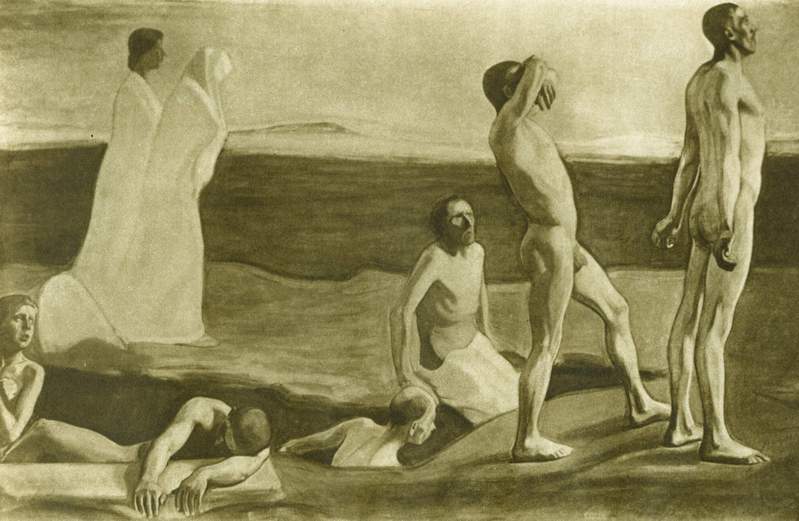
Sunday Sermon Notes: April 1, 2018

Title: The Kingdom Rose with Him

Text: Mark 16:2-8

The King on Trial

Pilate then went back inside the palace, summoned Jesus and asked him, “Are you the king of the Jews?”

“Is that your own idea,” Jesus asked, “or did others talk to you about me?”

“Am I a Jew?” Pilate replied. “Your own people and chief priests handed you over to me. What is it you have done?”

Jesus said, “My kingdom is not of this world. If it were, my servants would fight to prevent my arrest by the Jewish leaders. But now my kingdom is from another place.”

“You are a king, then!” said Pilate.

Jesus answered, “You say that I am a king. In fact, the reason I was born and came into the world is to testify to the truth. Everyone on the side of truth listens to me.”

“What is truth?” retorted Pilate. With this he went out again to the Jews gathered there and said, “I find no basis for a charge against him.

John 18:33-38

The last hurdle for the Jewish leaders, the one standing between them and victory over Jesus was the very man whose job it was to keep order and peace in the region, the man who represented the Roman Emperor. His name was Pilate, and in order for the Jewish authorities to silence Jesus, they needed his permission.

Look, let’s be honest; if Jesus wasn’t such a high-profile figure, they would just have killed Him, but Jesus was too well known by this time. No, they had to be legal and proper.

You would expect Pilate to be eager to do away with Jesus after the way He came into town, and don’t think for a moment that Pilate didn’t know all about that, certainly the Jewish leaders would have expected him to be a pushover, yet we can easily see from these verses that Pilate didn’t want any part of this.

The most amazing thing about this entire story, at least for me, is that Pilate examined the accused, after hearing the charge and found Him innocent of being a threat to Rome. Remember, it would be Pilate’s neck if Jesus was turned loose and then raised a rebellion against Rome, and Pilate found Him innocent.

Maybe he thought Jesus was just a nut. Surely, he knew that a nut who can stir a crowd is the most dangerous threat of all to the peace. Maybe he just thought that this was another religious squabble in the Jewish camp; they were famous for their squabbles, but the people had welcomed Him as their King only a few days before.

Whatever Pilate’s private thoughts might have been, he clearly didn’t see Jesus as a threat. If He were some kind of king, He had persuaded Pilate that His Kingdom wasn’t a worldly one that could possibly threaten Roman government. Isn’t that interesting in contrast to the views of the Jewish leadership, who saw Jesus as a threat in this world on so many levels? Again, please bear in mind that these were the very people who either knew, or with reasonable diligence, they should have known exactly who and what Jesus was.

For Pilate, the situation was becoming dire, for he feared that these crazy Jews would riot if he let Jesus go, so in the end Jesus was sent to the cross. We could say here that the fate of Jesus was sealed, but in reality, the power behind all of these political games was the one whose fate had been sealed.

Kingdom on a Cross

Jesus was the very embodiment of the Kingdom of God; we know that for certain. Everywhere He went He preached the Kingdom, healed the sick, made the lame walk, restored sight to the blind and chased out demons: The Kingdom is all about making us whole again. Yet because of the perfidy of Men and the cunning and conniving of the Evil One, Pilate sent Him off to be crucified; the Kingdom was nailed to a cross.

He bore our sins on that cross; our sins put Him on that cross. He was still Jesus, though. Jesus was the embodiment of the Kingdom of God. The Kingdom was nailed to the cross along with Jesus… It’s almost too much to comprehend.

As the hour approached, the skies had begun to darken. The taunts of the Jewish leaders that had begun when Jesus was nailed to cross, had died down; many people had gone home thinking the spectacle was pretty much over; there was a sense of unease among those who had remained. Jesus quoted the 22md Psalm near the end, and again there was a buzz in the crowd that remained; was He calling for Elijah to save Him?

But Jesus did not need saving, He was the Savior!

It was 3 o’clock in the afternoon when Jesus gave up His spirit. At that exact moment, a priest at the very pinnacle of the Temple blew his horn, a blast that could be heard throughout the city, signaling that the time had come for the day’s sacrifice. Little did he realize that the last and final sacrifice prescribed by the Law of Moses was taking place that very moment at Golgotha.

At the moment of His death, God springs back into action; there is an earthquake, and although the people at Golgotha didn’t know it yet, the veil in the Temple that barred entry into the Most Holy Place, the barrier that had separated all of humanity from God’s presence, had been torn open, for no longer was Mankind to be kept away from God.

In stark contrast to the ridicule of the Jewish leaders who should have known better, pagan Roman soldiers shame them by calling out that Jesus was indeed the Son of God!


Jesus died on that cross; the embodiment of the Kingdom was dead. They put Him into a tomb: Rest in peace.

He did not rest, nor did the Kingdom of which He was the embodiment.

I would imagine that His disciples and those other faithful ones who had followed to the end were also in a state of confusion: How could this be happening? But Jesus had told them all about it before it happened, didn’t He? Didn’t He tell them that He was going to die, several times in fact? Didn’t He tell them He would rise again on the third day? Why yes, He had told them about this.

Very early on the first day of the week, just after sunrise, they were on their way to the tomb and they asked each other, “Who will roll the stone away from the entrance of the tomb?”

But when they looked up, they saw that the stone, which was very large, had been rolled away. As they entered the tomb, they saw a young man dressed in a white robe sitting on the right side, and they were alarmed.

“Don’t be alarmed,” he said. “You are looking for Jesus the Nazarene, who was crucified. He has risen! He is not here. See the place where they laid him. But go, tell his disciples and Peter, ‘He is going ahead of you into Galilee. There you will see him, just as he told you.’”

Trembling and bewildered, the women went out and fled from the tomb. They said nothing to anyone, because they were afraid.

Mark 16:2-8

And the Kingdom rose with Him.

And because of what happened on that cross, the Kingdom would soon inhabit His followers and spread across the globe; it still is doing that, and it is even within us today.

Many want to argue about this still, many Christians want to argue and say the Kingdom will come some other time.

“How could the Kingdom of God be here now,” they say, “this world is so full of evil.”

This world is full of evil, I suppose, and it always has been, but didn’t Jesus say that His Kingdom was not of this world? Yes, He did say that, and when He rode into Jerusalem on that great day long ago, His Kingdom wasn’t of this world. When He preached the Kingdom and healed and restored and chased away demons, His Kingdom wasn’t of this world. The people of His day wanted a Messiah who would deal with their enemies and improve their lives “under the sun,” but that isn’t the kind of Messiah that Jesus is… and so they turned against Him.

Will we?

Posted in Sunday Class Notes | Tagged , , , , , , , , , | 5 Comments

Random Ramblings: March 31, 2018

It has been some time since I have written something for this Saturday column; real life seems to have a way of getting in a blogger’s way!

Today, I thought I’d do something here that I haven’t even considered doing before, and that is posting the next portion of our 1 Corinthians adventure in this column. To say that it is timely, would be a bit of an understatement…

If there is a natural body, there is also a spiritual body. So it is written: “The first man Adam became a living being”; the last Adam, a life-giving spirit. The spiritual did not come first, but the natural, and after that the spiritual. The first man was of the dust of the earth; the second man is of heaven. As was the earthly man, so are those who are of the earth; and as is the heavenly man, so also are those who are of heaven. And just as we have borne the image of the earthly man, so shall we bear the image of the heavenly man.

1 Corinthians 15:44b-49

With this paragraph, Paul expands on his message to the Corinthians about our resurrection spiritual bodies. In doing so, he has moved beyond seeds and plants, and people and other creatures, for now he is explaining how we will be able to move entirely beyond the earthly into the heavenly, thanks to what Jesus has done on the cross. Oh yes dear reader, you’ve heard me correctly.

You will recall Paul’s discussion of the gospel earlier in this chapter, and how it centered around the death, burial and resurrection of Jesus Christ. We as Christians often speak of grace and the forgiveness of sins, and often in doing so we can go on and on for quite some time. Yet in these few verses, Paul has taken us far beyond the building block of forgiveness and God’s grace, and into our ultimate futures which is glorious beyond measure, and reading this passage, we have a little introduction to something that glory has in store for us that isn’t often talked about.

There really isn’t much more for me to add to this, except to suggest that as we celebrate Jesus’ resurrection from the grave, we might want to consider all that this greatest of all historical events means for everyone who follows Him.

Posted in Random thoughts | Tagged , , , , , , , , , | 6 Comments

The Resurrected Body

1 Corinthians 15:35-44a

But someone will ask, “How are the dead raised? With what kind of body will they come?” How foolish! What you sow does not come to life unless it dies. When you sow, you do not plant the body that will be, but just a seed, perhaps of wheat or of something else. But God gives it a body as he has determined, and to each kind of seed he gives its own body. (15:35-38)

Having covered the issue of whether or not there is a resurrection, Paul now moves on to a related resurrection issue; will we be resurrected just as we are, or will we be different? In these verses, Paul is making the point that there are many different kinds of bodies, which although obvious, isn’t really something we usually think about. He begins his discussion with a metaphor, this time of a seed. You plant a seed and God causes the seed to grow into whichever kind of plant the seed came from; each type is different. Yet, you don’t plant the plant, you plant its seed.

When we die, our mortal remains are like the seed of a plant; what comes forth from the grave is like the plant itself. It came from what was “planted” but is much grander than the seed it came from.

In 15:39-41 he mentions that there are different kinds of bodies. There are human bodies, animal bodies, fish and birds; they are all different. There are also earthly bodies and heavenly bodies, each of which has its own kind of “splendor”, just as the sun and the moon each has its own kind of splendor.

Paul is ready to zero in on his point…

So will it be with the resurrection of the dead. The body that is sown is perishable, it is raised imperishable; it is sown in dishonor, it is raised in glory; it is sown in weakness, it is raised in power; it is sown a natural body, it is raised a spiritual body. (12:42-44a)

When we are raised from the dead, we will be different, and just as a plant is more grand than its seed, so our resurrection bodies will be grander than our earthly bodies− that much is easy enough to understand, but what exactly is a “spiritual body”?

Hold on… isn’t “spiritual body” an oxymoron?

That’s a fair question. To find an answer to the question, we do have an example to examine, and as usual, our example is found in Christ Himself. Jesus has already been raised up from the dead; He is the firstfruit of the Resurrection.

Did He rise from the grave imperishable? Yes.

Did He rise from the grave in glory? Yes.

Did He rise from the grave in power? Yes.

Did He rise from the grave in a spiritual body? We could put this a different way, couldn’t we? We could say “Therefore, He rose from the grave in a spiritual body” instead, but I haven’t put it that way because there is additional evidence to consider.

We know that Jesus had a physical body after the resurrection because good old “doubting Thomas” wanted to touch it before he was convinced that Jesus actually rose from the grave, and that is exactly what he did. We also know that Jesus had a physical body because up there in Galilee He not only cooked fish, but he ate them; you need a physical body for both of those activities, don’t you? So, let’s think about the resurrection story some more…

When the women first went to the tomb early in the morning, they saw the stone rolled away, but they didn’t see Jesus… and then He was there. The followers of Jesus were together in a locked room… and then Jesus was there. Two disciples were walking along the road alone, and then Jesus was there. The disciples were talking with Jesus, and suddenly He began to rise up into heaven.

Physical bodies as we understand them cannot do any of these things, can they? Jesus arose from the dead in bodily form, but He had a different kind of a body, just as Paul has been saying in this passage. Yes, it was a spiritual body, and I don’t know about you, but I am really looking forward to that particular upgrade!

Posted in Bible | Tagged , , , , , , , , , | 14 Comments

Seriously now…

Now if there is no resurrection, what will those do who are baptized for the dead? If the dead are not raised at all, why are people baptized for them? And as for us, why do we endanger ourselves every hour? I face death every day—yes, just as surely as I boast about you in Christ Jesus our Lord. If I fought wild beasts in Ephesus with no more than human hopes, what have I gained? If the dead are not raised,

“Let us eat and drink,
for tomorrow we die.”

Do not be misled: “Bad company corrupts good character.”  Come back to your senses as you ought, and stop sinning; for there are some who are ignorant of God—I say this to your shame.

1 Corinthians 15:29-34

Reading this passage, one might have the impression that Paul is going for the kill in dealing with the issues relating to the resurrection that he has been discussing in this section. We might even detect the presence of a bit of ad hominem here. An argument is said to be ad hominem when a person attacks another person in stead of that person’s position on an issue. In our time, we should be quite familiar with ad hominem attacks, for the entire political world is engaged in such tactics. Just turn on any cable news station this afternoon, and you will see examples of this. If someone attacks you for your faith, saying you are “deluded, deranged and dangerous”, you have just received an ad hominem attack.

An ad hominem argument is a logical fallacy, and if this paragraph was all that Paul wrote on the issue in 1 Corinthians, it would’ve been a fallacious argument. However, in this case, after having addressed the actual issue very thoroughly, Paul is really using it as a sort of wake-up call for any remaining holdouts to really consider how poor their arguments against the resurrection are.

He begins with a practice of being baptized for the dead. Read his words carefully and ask yourself if he was endorsing the practice.

Hardly!

We might even infer that whoever was doing this was also promoting the no resurrection point of view: It sounds an awful lot like ridicule to me.

Look at vv. 30-32 in which Paul puts forth a comparison and contrast between his constant danger of being arrested and/or killed for preaching the gospel, and the whole notion of “eat, drink and be merry”. If there were no hope of a resurrection, why would he and those with him expose themselves to such danger? If there is no resurrection, there could be no judgement or eternity, and if that were true, why not eat, drink and be merry?

He winds up this part of the discussion by calling on everyone to set aside such nonsense and to be sensible on the subject. Instead of spreading such ridiculous thinking, they should be spreading the gospel of Jesus Christ, and just to be clear about everything, yes, he was trying to shame them.

I can’t help but wonder how our reactions to such teaching would compare to Paul’s.

Posted in Bible | Tagged , , , , , , , , | 7 Comments

“But Christ has indeed been raised from the dead…”

1 Corinthians 15:20-28

But Christ has indeed been raised from the dead, the firstfruits of those who have fallen asleep. (15:20)

If Jesus did not rise from the dead, then the gospel would be a lie; but He did rise from the dead!

In these verses, Paul gives a gospel “refresher course” to the Corinthians, reminding them that Jesus has risen, and that in due course, so will we. He was the first, having risen to reign over the kingdom of God. He reigns today as well, in anticipation of that Great Day when He will return at the consummation of the kingdom, to put an end to all evil on the earth and to raise all who have “fallen asleep” over the centuries (15:20-25).

The last enemy to be destroyed is death. For he “has put everything under his feet.” Now when it says that “everything” has been put under him, it is clear that this does not include God himself, who put everything under Christ. When he has done this, then the Son himself will be made subject to him who put everything under him, so that God may be all in all. (15:26-28)

God has put every enemy under Christ’s feet; He will be the one to judge evil and death, and when this has been accomplished, God will reign over the consummated kingdom forever.

This short summary of the end of this world wasn’t placed in this chapter so that we might indulge in speculation about the details of The End. Rather, it is the conclusion of Paul’s point in the prior passage (15:12-19) in which he made the point that if there is no resurrection, our hope is all in vain. Remember, he is correcting misunderstandings about the issue of the resurrection of the dead, as well as any contentions about the resurrection of Christ.

Before we continue, I wonder how we react when people speculate in our midst about such things. To be clear, I am not referring to unbelievers, I mean people who say they follow Christ. Quite a few Christians question whether or not Jesus actually rose from the grave in bodily form, suggesting that His resurrection was more a spiritual thing, something mystical perhaps, but not physical. Even worse, some even suggest that the whole resurrection is sort of a myth, an oral tradition… or maybe something figurative.

How would we respond to that?

Paul’s reaction is found here in chapter 15− and he isn’t quite finished yet.

Posted in Bible | Tagged , , , , , , , , | 9 Comments

Resurrection: A Binary Choice

1 Corinthians 15:12-19

As Paul continues to make his case for the resurrection, he makes a point that should be self-evident: If Christ rose from the dead, then a Christian cannot say there is no resurrection of the dead, because if they do, they negate their own faith in Christ. It would appear from 15:12 that certain elements in the congregation were saying just that:

But if it is preached that Christ has been raised from the dead, how can some of you say that there is no resurrection of the dead? If there is no resurrection of the dead, then not even Christ has been raised. And if Christ has not been raised, our preaching is useless and so is your faith. More than that, we are then found to be false witnesses about God, for we have testified about God that he raised Christ from the dead. But he did not raise him if in fact the dead are not raised. (15:12-16)

Yes, it should be self-evident that there either is resurrection or there is not; there is no cherry picking in the matter of resurrection. He continues…

And if Christ has not been raised, your faith is futile; you are still in your sins. Then those also who have fallen asleep in Christ are lost. If only for this life we have hope in Christ, we are of all people most to be pitied. (15:17-19)

To put it in its simplest form, you can’t really be a Christian and deny the resurrection, for denying resurrection of the dead entirely negates being a Christian.

I think I’ll just leave it at that for now, because this is a great point to consider carefully:

Did Paul really mean to say that? I’d really like to hear what you think!

Posted in Bible | Tagged , , , , , , , , | 6 Comments

Misunderstandings about Resurrection

Now, brothers and sisters, I want to remind you of the gospel I preached to you, which you received and on which you have taken your stand. By this gospel you are saved, if you hold firmly to the word I preached to you. Otherwise, you have believed in vain.

1 Corinthians 15:1-2

Paul begins a new section about resurrection with these verses. It would appear that this was not a question they asked in their letter to Paul but reflects an issue that Paul has heard about that was troubling the congregation. It would seem that then, as now, certain elements within the church were challenging theresurrection.

These two verses give us the introduction for what will follow in this chapter. Once again, Paul is using a persuasive outline; this is his thesis statement in which he points out that our entire faith is based upon the proposition that Jesus was raised bodily from the grave.

For what I received I passed on to you as of first importance: that Christ died for our sins according to the Scriptures, that he was buried, that he was raised on the third day according to the Scriptures, and that he appeared to Cephas, and then to the Twelve. After that, he appeared to more than five hundred of the brothers and sisters at the same time, most of whom are still living, though some have fallen asleep. Then he appeared to James, then to all the apostles, and last of all he appeared to me also, as to one abnormally born.

1 Corinthians 15:3-8

His first point is that Jesus has been seen by hundreds of people post resurrection− there are many eye witnesses who can still tell you that they saw Him. In the old Law, truth was established on the testimony of 2 or 3 witnesses− Paul has hundreds of witnesses… and oh yes, he was also a witness. You might also note that he twice said “according to the Scriptures” in this paragraph. It should not have surprised anyone that Jesus died, was buried, and rose again on the third day since this had all be foretold in the Scriptures.

This is actually a very compelling argument because it might be possible to get a few people to conspire together to perpetrate a fraud, but the more people who participate in a lie, the higher the likelihood that someone will recant their story under pressure, and many of these had been under pressure. In fact, many had been pressured by Paul himself…

For I am the least of the apostles and do not even deserve to be called an apostle, because I persecuted the church of God. But by the grace of God I am what I am, and his grace to me was not without effect. No, I worked harder than all of them—yet not I, but the grace of God that was with me. Whether, then, it is I or they, this is what we preach, and this is what you believed.

1 Corinthians 15:9-11

Paul himself had persecuted the Church, had put serious physical pressure on people to renounce their faith, even to deny that they had seen the risen Christ, I would suspect. Yet they did not do so. Then he had been approached on that Damascus road by none other than the risen Christ Himself, and somehow, by God’s amazing grace, Paul had been not only saved from his egregious sins, but he became the Apostle to the Gentiles: He has given reliable testimony to the Corinthians about the resurrection of Christ, and it is because of the resurrection of Christ that they have a foundation of faith.

From here, Paul takes an unusual approach as he continues his case for the resurrection…

Posted in Bible | Tagged , , , , , , , , | 9 Comments

Photo of the Week: March 28, 2018

View from Lafayette Park, Washington DC

Posted in Photo of the Week | Tagged , , , , , , | Leave a comment

What then shall we say, brothers and sisters?

1 Corinthians 14:26-40

Some of the new translations place a subheading between this section and the last, and while that may be a convenient way to break up the chapter, it gives the impression that the subject has changed, but actually it would appear that Paul is winding up the whole discussion from 12:1-14:25…  What then shall we say, brothers and sisters? (14:26a)

In 14:26b-28 Paul indicates that whatever kind of message, whether a hymn, instruction, a revelation or something in a tongue, they must be presented in an orderly and clearly understandable fashion for the edification and building up of the entire Body of Christ. If someone is going to speak to the assembly in a tongue, there must be an interpreter, or else the person must hold their tongue. Again, this is for the sake of edification of the entire assembly.

In the next paragraph, Paul gives essentially the same word for any prophets or prophetic messages.  In 14:34-35, he indicates that the women should remain quiet in the assembly and address any questions or comments to their husbands at home, and then…

Or did the word of God originate with you? Or are you the only people it has reached? If anyone thinks they are a prophet or otherwise gifted by the Spirit, let them acknowledge that what I am writing to you is the Lord’s command. But if anyone ignores this, they will themselves be ignored. (14:36-38)

If you just read through this passage, Paul was moving right along giving instructions… no big deal, just take notes and make necessary corrections to improve the flow of your worship time. Then suddenly, he changes the tone entirely, which seems to me to indicate that there were three groups in the Corinthian assembly who tended to insist of causing confusion or disruption in their worship services: People speaking in tongues, people bringing prophecy, and… women.

The modern eye skips right to the last one and jumps to the conclusion that Paul has just uttered a shocking, terrible and sexist bit of instruction. I wouldn’t be too quick to jump to conclusions if I were you…

Paul is writing this in response to an inquiry made in a letter from Corinth about a situation they were experiencing there c. 55 AD. We can only infer from the answer Paul has given what the exact issue was, since sadly, their letter is not available to us. In any case, the culture and circumstances of mid first century Corinth were quite different from anything we are likely to experience today. Secondly, and this is my guess, it may have been that the people speaking in tongues and prophesying were predominantly female. If that guess is correct, then Paul’s quiet comment would have been directed more in the direction of the women who insisted on speaking in tongues and giving prophecy in a disorganized fashion, then on women generally, and then there are Paul’s final words on the subject:

Therefore, my brothers and sisters, be eager to prophesy, and do not forbid speaking in tongues. But everything should be done in a fitting and orderly way. (14:39-40)

Paul’s conclusion of the section (chs. 12-14) is an inclusive one. All should be eager to prophesy, none should forbid tongues, and all should conduct themselves in an orderly manner in the assembly. This is why I see Paul’s comments in 14:34-35 as actually intended for those who are causing disruption rather than at women as a class of humans. Sadly, many over the years have not seen it this way.

Posted in Bible | Tagged , , , , , , , , | 3 Comments

The Role of Spiritual Gifts

1 Corinthians 14:1-25

All too often we study this section without taking its context into account. As a result, many of us use this passage as a source of proof texts to back up one position or another regarding speaking in tongues. This is troubling on several levels, not the least of which is the fact that we tend to use the same passage to prove conflicting positions.

As you might suspect, when this happens, context is being ignored in favor of winning an argument. In this particular case, we are engaged in an argument that we shouldn’t even be participating in, no matter which side of it you are on.

As I mentioned at the beginning of this section, this is a study of 1 Corinthians, it is not a study of spiritual gifts as such. If you are interested in a study of spiritual gifts please see Your Spiritual Gifts Revealed which is available for free download on my website.

Let’s remember that chapter 14 is the third chapter in a section of the letter to Corinth that is discussing misunderstandings about spiritual gifts. It follows along from the previous chapter’s discussion of love as a contrast to the gifts themselves, as something that is eternal, while spiritual gifts are not. Paul has moved into a discussion here of the gifts in the context of the church assembly, and his overall point is that speaking in tongues really isn’t something that belongs in the worship assembly. He doesn’t say that because there is anything wrong with speaking in tongues; he says he himself speaks in tongues. Rather, his point is that it simply doesn’t edify the Body of Christ.

I realize that many would jump in here and assert that there is no longer any such thing as speaking in tongues… or prophecy, for that matter. I know this because that’s the way I learned it myself. If that happens to be your view, I would only say that Paul’s discussion here is in answer to an inquiry from the church in Corinth c. 55 AD: Context again!

I would also point out the lack of evidence from the New Testament for such an assertion.

Paul’s use of the contrast between speaking in tongues and prophecy is an interesting one, and it may be a bit confusing for some of us. That confusion would arise from a misunderstanding of what prophecy actually is. So often in our time prophecy is spoken of as though it was foretelling the future and nothing more. Yet this understanding is a mistake, for a prophet is one who brings a message from God to His people. Quite often in Scripture this message is one of correction in which God is telling His people that action is needed to correct an error of one kind or another. Certainly, that is case for most of the Major and Minor prophets of the Old Testament.

With this in mind, the contrast between speaking in tongues that we cannot understand is in sharp contrast with someone who brings a clear message from God to His people, and thus, Paul’s point is clearly made in these verses.

Notice that Paul wraps up his point by pointing out that should an unsaved person visit the worship assembly and be confronted by people who speak in an unintelligible manner, they would conclude that Christians were crazy, but if they heard a clear message from God they might well be brought to repentance and relationship with Christ.

That is the case Paul is making in this passage. It applies just as much today as it did then, and we will miss that critical point if we indulge ourselves by mining the text for ammunition to use in an unnecessary argument.

Posted in Bible | Tagged , , , , , , , , | 8 Comments