

Monticello, home of Thomas Jefferson, “Author of the Declaration of Independence”
Monticello, home of Thomas Jefferson, “Author of the Declaration of Independence”

This morning I was sitting here sipping my first cup of coffee as the first rays of the sun began to gleam in the sky to the east. I could hear the crickets chirping their song, joined by a chorus of frogs down by the creek, and some birds overhead in their trees. I probably wasn’t entirely awake; my mind was wandering around to nowhere in particular, sort of carried away by the warm and humid breeze as I was taken to a place far away and long ago.
I found myself sitting in the front passenger seat of my Dad’s 1964 Ford Galaxy as we drove slowly through a neighborhood in Los Angeles, California. I had a clipboard in my hands as we drove and I was on the lookout for houses that were flying the flag; it was another Fourth of July, July 4, 1968− exactly 50 years ago.
I began waking up in earnest at the thought of that: Fifty Years Ago!
It was my first ever experience at working in a political campaign: 50 years ago today. Can I possibly be that old?
1968 was a tumultuous year in America, and outward shows of patriotism were not at all in vogue. Vietnam, Civil Rights, demonstrations, riots, violence, assassinations, long hair, beards, flower power… Even I knew that things were a mess; it wasn’t quite a month since Senator Kennedy had been assassinated right there in LA: In LA! Things like that simply did not happen in my hometown…
Congressman Corman had a very smart idea. He would ask volunteers to go through ever precinct in his district and take down the addresses of every house that flew the flag on the Fourth of July, and then he would send each one a personal thank you, and that was what I was doing with a little help from my Dad that day, my first time as a campaign volunteer… 50 years ago today.
I took another sip of coffee, and that’s when it came to me: July 4th, 50 years, Adams and Jefferson.
Back in 1776 John Adams and Thomas Jefferson were both members of the Continental Congress, they both served on the Committee that drafted the Declaration of Independence along with Benjamin Franklin. Adams and Jefferson became very good friends in the years that followed, both served in the Administration of George Washington, Adams as Vice President, Jefferson as Secretary of State. Yet they fell out over political differences in the second term, and after Washington shocked the world by stepping down they ran against each other for president.
It got a bit nasty if I’m honest. Adams won the election, but Jefferson defeated him four years later, and they did not speak for many years. Yet as the years went by, both regretted their estrangement, and finally Adams sent a letter to Jefferson, and they renewed their friendship as pen pals. By 1826 both men were in poor health, but as the morning of July 4th dawned, each man had the other on his mind; it was 50 years to the day since the Declaration of Independence.
About mid-morning Jefferson slipped into eternity. A few hours later, Adams joined him. Not knowing what had taken place earlier that day, his last words were, “Jefferson survives.” Thus, the last two living men who signed the Declaration of Independence both died on the fourth of July, 50 years after its signing.
What were the chances of that happening?
Hosea 2: 9-13
“Therefore I will take away my grain when it ripens,
and my new wine when it is ready.
I will take back my wool and my linen,
intended to cover her naked body.
So now I will expose her lewdness
before the eyes of her lovers;
no one will take her out of my hands. (2:9-10)
Picking up where we left off last time, we see that the narrative continues with everything that God will withhold from idolatrous Israel as a result of their turn to worshipping false gods. Remember, this began with a plea to turn things around, and as I mentioned previously, Hosea was not the first prophet sent to the Northern Kingdom. In fact, unlike Amos, Hosea was a resident of the Northern Kingdom. If you look carefully at these verses, you will see an interesting thing: God isn’t taking “things” away from Israel in these lines so much as He is keeping the (negative) promises of the Law of Moses. The Law promised the Israelites that if they followed the Law they would receive temporal blessings such as long life, good crops, material abundance, many children and so forth. It also promised that if they failed to keep the Law, God would take those blessings away, and they would have famines and floods and every sort of disaster in this life. The text continues:
I will stop all her celebrations:
her yearly festivals, her New Moons,
her Sabbath days—all her appointed festivals.
I will ruin her vines and her fig trees,
which she said were her pay from her lovers;
I will make them a thicket,
and wild animals will devour them. (2:11-12)
There’s some interesting insights here; Israel seemed to think that God’s blessings had been provided by false gods (her lovers). Can you imagine? God’s promised covenant blessings credited to false gods! No wonder God is taking steps…
I will punish her for the days
she burned incense to the Baals;
she decked herself with rings and jewelry,
and went after her lovers,
but me she forgot,”
declares the Lord. (2:13)
Finally, verse 13 clears up any questions we might have had about what is going on here, and about who the speaker really is. Israel had fallen into Baal worship and had thus renounced her covenant relationship with the God of her forefathers. For many of us today, more accustomed to thinking of God as merciful, meek and mild, seeing His judgment pronounced against Israel here might come as something of a shock. Yet this is a rather naive viewpoint, if I may speak directly. Israel had willingly entered into a very explicit covenant with God. It spelled out exactly what they would receive from God if they held up their end of the bargain, and God certainly held up His end of it. As Israel began to slip away from their responsibilities, God was more than patient; He sent multiple warnings that action was required to come back into compliance. Yet the people scoffed at the warnings and dealt harshly with the messengers.
It finally got to the point where God had to act, to keep His promises about what a fatal breech of the covenant would bring about. No sir, the people were entirely without excuse.
However, the story is far from over…
Have you ever had a dream in which you are at some kind of a social event where everyone you know is present and then you realize to your horror that you are naked? I know that a lot of people either have had, or regularly have a dream like this, and I’m sure that psychologists have an explanation of its significance; maybe it’s feelings of inadequacy or insecurity or… who knows? I do know, however, that for a great many people, that is one of the scariest scenarios imaginable, right up there with public speaking. The truth is that the way we dress affords a certain sense of security for most people; it’s a statement of who we are, how we think of ourselves, or even who we want others to think we are. If that costume or uniform is suddenly taken away and we are seen by others as we truly are, the whole façade is gone…
Mark Twain once quipped that if all government officials were required to be naked when at their jobs, all oppression would cease. I’m not really sure, but I do suspect that if we walked into a government office and found ourselves dealing with naked people, their attitudes would probably be a lot more humble than they usually are.
The whole idea of being naked before God is found in these things, for to be naked before God is to achieve a state of mind and spirit in which we are in humble submission before Him. We would have no secrets, we would be unable to convince ourselves that there could ever be anything we could either hide or keep from Him. It would be a state in which we would become entirely real in His presence; no airs, nothing withheld, nothing covered up, and for sure, nothing avoided. In a very real sense, it would be as though we lived back at the very beginning of time, when Mankind lived in perfect harmony and fellowship with God, when:
Adam and his wife were both naked, and they felt no shame.
Genesis 2:25
Of course, I’m speaking metaphorically, even though in the case of Adam and Eve it was literal. You see, you don’t actually have to be undressed to be naked before God. In reality, that’s how He sees all of us all of the time anyway, for no one can hide anything from God, not our thoughts, not even our innermost motivations.
I’ve been doing this longer than I sometimes like to remember, and right here in the conversation there’s usually someone who jumps in to tell us about their amazing spiritual life, how many hours each day they pray, how much incredible time they spend in the Word, how they put Christ first and ‘self’ last in all things, and generally how much farther along they are than everyone else. As I say, I’ve been at this a very long time, certainly long enough to recognize that the ones who really are far along in the Journey never talk like that. Like the Apostle Paul, they are quick to admit how much farther they still need to go.
For most of us, the idea of baring all before God is a daunting one at first; for sure it’s humbling, but don’t worry, humbling is the whole point.
OK, yes, this discussion has probably gone on long enough for today, so I’ll leave you with a little exercise. Please do not share your answers, it’s just for you. Suppose you were in a room with your 10 closest friends from church, or your 10 closest Christian friends if that works better for you. Suppose you were invited to share your testimony about Christ in front of that group, completely naked as a sign of your honesty, humility and truthfulness. The deal is that nobody will call the police, nobody will laugh, and nobody will judge you or tell anyone else about it.
Why wouldn’t you do it?
See if you can limit your reasons to 5, the 5 biggest reasons. Remember, this is just between you and you: no one else will hear your answers, because you aren’t going to tell: Be honest with yourself.
Why should you do this little exercise?
Because you will end up with a list of the 5 biggest impediments that stand between you and your relationship with God. That is the power of this metaphor, by the way.
“Yet the Israelites will be like the sand on the seashore, which cannot be measured or counted. In the place where it was said to them, ‘You are not my people,’ they will be called ‘children of the living God.’ The people of Judah and the people of Israel will come together; they will appoint one leader and will come up out of the land, for great will be the day of Jezreel. “Say of your brothers, ‘My people,’ and of your sisters, ‘My loved one.’
Hosea 1:10-11; 2:1
In the original Hebrew, this is how our text should look. I mention this because realizing it allows us to carry the context forward, making what follows much easier to understand. You will recall that chapter 1 ended with a long view to the time when the Son of God would restore the unity of God’s people, both Northern and Southern Kingdoms, both Jew and Gentile; that thought actually moves all the way into chapter 2, as you can see. Yet before we see this image again, we find a new series of warnings.
Unlike chapter 1, with it’s image of Hosea’s marriage to Gomer, here we see Israel (the mother) and her children (brother and sister)…
“Rebuke your mother, rebuke her,
for she is not my wife,
and I am not her husband.
Let her remove the adulterous look from her face
and the unfaithfulness from between her breasts.
Otherwise I will strip her naked
and make her as bare as on the day she was born;
I will make her like a desert,
turn her into a parched land,
and slay her with thirst. (2:2-3)
Israel had turned away from God and entered into the worship of the pagan idol Baal. Thus, Israel had committed adultery, spiritual adultery. Hosea’s imagery is that of a father pleading with his children to bring their mother home, for if she did not repent, there would be serious repercussions from her act of infidelity. If we step back from the imagery and look at the national situation, God is pleading with anyone in Israel who has remained faithful to Him to plead with their countrymen to repent, for if the people did not turn away from this outrage against God, National disaster would be the result: That is Hosea’s actual message here.
I will not show my love to her children,
because they are the children of adultery.
Their mother has been unfaithful
and has conceived them in disgrace.
She said, ‘I will go after my lovers,
who give me my food and my water,
my wool and my linen, my olive oil and my drink.’ (2:4-5)
A Nation is made up of its people, and in the case of Israel, it was the people, the vast majority of the people, who had gone after the false gods. It would seem that they have done so because they felt their needs were better met by these false gods, and thus, they indulged. Consequently, the warning Hosea is delivering here is that not only will this be a National disaster, but it will get very personal for those who have entered into adultery against God by taking on idolatrous worship.
Therefore I will block her path with thornbushes;
I will wall her in so that she cannot find her way.
She will chase after her lovers but not catch them;
she will look for them but not find them.
Then she will say,
‘I will go back to my husband as at first,
for then I was better off than now.’
She has not acknowledged that I was the one
who gave her the grain, the new wine and oil,
who lavished on her the silver and gold—
which they used for Baal. (2:6-8)
Israel seemed to think the grass would be greener worshipping Baal, God wasn’t terribly amused, and will withhold from the people what they thought they could get from their “lover”. Soon they would realize that they had been better off before they fell into idolatry. They would try to return home, but would they be ready to acknowledge that it had been God who provided everything they needed all along?
It’s too soon to know, after all, this is only chapter 2!
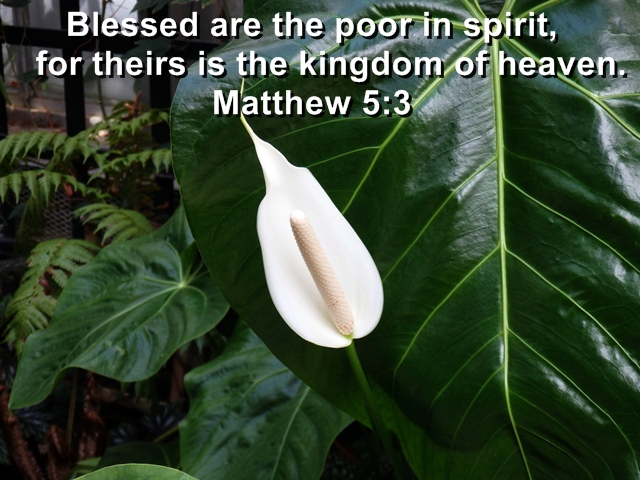
The first Beatitude speaks of those who are “poor in spirit”. Much has been made about the difference between Matthew’s language and that of Luke in Luke 6:20, for Luke merely says “the poor”. Does Matthew have more in mind than mere economic circumstances?
I’m happy to let others argue, but it seems to me that Matthew, a Jew, might be aware of the Old Testament idea of poverty not only in literal terms, but as a state of mind, for the Hebrew word for “poor” has this additional connotation to it. In those days, a poor person not only had to deal with bad economic circumstances, they also had to contend with the fact that they had fewer rights in society, for then as now, they lacked the resources to enforce their rights; consequently, they were at the mercy of others.
Living in such a state made it clear to anyone who could fathom the notion, that the poor must depend entirely upon God. Most of us today, even those of us who don’t enjoy material abundance, live in circumstances far better than those of a poor person in ancient times, and maybe we too have a hard time seeing what Matthew means; let’s look at it this way: In our world, a person of very limited means is never far from being destitute, while a rich person has a much larger buffer to get through tough times. The poor person knows they live close to the edge; the rich person can convince himself that everything is wonderful, that he is the master of his own life, and in doing so, he only deceives himself, for God is the master of everything. We see time and again in Scripture that a rich person has a great obstacle to overcome in following God, for he thinks he is the one in control, while a poor man has no such delusion to overcome, and no great wealth to hold him back. The poor person is free to follow the Lord, while the rich person carries his wealth as a millstone around his neck; woe is he.
The kingdom of heaven is both a present reality and a future hope, for it is with us today in Christ, and will be fully realized in its ultimate fulfillment when He returns. For the person who recognizes his or her current dependence upon God for everything in life, it is a present reality indeed, and a source of great joy, “for theirs truly is the kingdom of heaven.”

Good Monday from the Heartland.
The path of life is not a wide one that is full of traffic and congestion, it is quieter than that. It isn’t a great highway, it’s more like a quiet country lane…
Maybe if your life’s path is full of noise and traffic you should take the next exit and get on that other road.
As you walk along, you come across many things, some are beautiful, some not. There are turns, twists, hills and dips. Sometimes you come across a cool and refreshing stream, other times you go a long way in the hot sun, with dust and bugs all around. As you move along you come across places where you can’t see much because of the high brush on either side… and then there’s a fork and you must decide which way to go.
On such a lane you might want to notice the footprints of those who’ve gone before. If they have gone one way at the fork in the path, you get the idea that this is the way to follow…
There have been many who have gone down the path of life before us, and the legacy they left for us was to follow the footprints of the One who made the path in the first place; following those footsteps will get us to the end of life’s path, right where there is a little narrow gate: Go through that gate and enter in to eternal life, for Jesus has told us all about it:
“Enter through the narrow gate. For wide is the gate and broad is the road that leads to destruction, and many enter through it. But small is the gate and narrow the road that leads to life, and only a few find it.
Matt. 7:13-14
Yes, when you get to the gate go right on in, those who have gone before, and the One who made the path will be glad to see you’ve made it home.
Title: Jesus, Sinners and Critics
Text: Mark 2:1-17
Jesus Meets His Critics
Parallel Texts: Matthew 9:2-8; Luke 5:17-26
In this passage, Jesus has returned to Capernaum from His Kingdom Tour, and the people are excited to have Him back in town. During this period, Capernaum is His ‘home base’. As the crowd grew with the usual curious listeners, sick and damaged people, it became impossible for everyone to gain entry into the house where Jesus was staying as He preached, and a very enterprising group of men climbed up to the roof, bringing a paralyzed man on a stretcher with them. They opened the roof door which was a common feature in those flat-roofed houses, and lowered the paralyzed man into the room where Jesus was teaching.
When Jesus saw this, He went over to the man on the stretcher and told him that his sins were forgiven.
There was a group of teachers of the law in the room, who may have come from Jerusalem to investigate the report that had reached the city about the Kingdom Tour, and these guys were pretty amazed at what they saw. It occurred to them that Jesus had just made a mistake in telling the unfortunate man his sins were forgiven, because only God can forgive sins: Blasphemy… Gotcha!
Immediately Jesus knew in his spirit that this was what they were thinking in their hearts, and he said to them, “Why are you thinking these things? Which is easier: to say to this paralyzed man, ‘Your sins are forgiven,’ or to say, ‘Get up, take your mat and walk’? But I want you to know that the Son of Man has authority on earth to forgive sins.” So he said to the man, “I tell you, get up, take your mat and go home.” He got up, took his mat and walked out in full view of them all. This amazed everyone and they praised God, saying, “We have never seen anything like this!”
Mark 2:8-12
I love this part! Jesus, knowing their thoughts goes over to these guys and asks a question: So boys, what’s easier, to tell this guy his sins are forgiven, or to tell him to get up, pick up his mat and walk?
Who says Jesus had no sense of humor?
Then, He went back to the paralyzed man and told him to get up, take his mat and walk… and that’s just what the guy did!
I can just imagine what those old boys from Jerusalem thought then… hilarious! Boy, did they have a report for the bigwigs back home.
Of course everyone was amazed at what they had witnessed, but I wonder if they fully comprehended the scene. Right in front of the teachers of the law, Jesus had forgiven a man’s sins, the teachers were correct in what they were thinking, for only God can forgive sins. Jesus read their thoughts; a little miracle nobody seemed to notice, and went right for the jugular, so to speak. He told a paralyzed man to get up and walk, and the man was made whole again, and did just that. Thus, Jesus had taken upon Himself God’s role to forgive, and then backed it up by making the man whole physically.
Wholeness, spiritually and physically: Jesus removed the consequences of sin, at least symbolically , right in front of their eyes. To state what happened in another way, Jesus had just shown the whole crowd that He was the Son of God… and the teachers of the law, by definition if nothing else, would have had to know that.
So, what do you think was in their report to HQ?
Jesus and Sinners
Parallel Texts: Matthew 9:9; Luke 5:27-28
Still in Galilee, Jesus calls another disciple, and this time He has a questionable choice: Levi (Matthew) the tax collector. Tax collectors are none too popular in our day, but back then they were outright crooks in most cases. They would be informed of the amount they had to collect, and whatever they collected over and above that amount would be theirs to keep. Oh yes, this was all nice and legal under Roman law. So say you are a tax collector and you are supposed to collect $100.00 from 10 people. Let’s see, if you can get $10.00 from each one, you could turn the money over to the authorities and be done, but your family would go hungry. If you collected $ 12.50 each, you’d make $25.00 and maybe that would be fair, but if you could force them to pay $150.00 each, even better!
So, let’s see; where was I? Oh yes, they were unpopular indeed!
Jesus called Levi to discipleship, and then they go to a party with tax collectors and other unsavory characters: The stage is set for another round with His critics.

Does the truth really count for anything anymore? Does anybody really care, or is the truth just whatever it seems like to me?
Does government tell us the truth about anything, say the economy for instance? Do athletes tell the truth about steroids? How about the news media, are they telling the truth about the stories they report?
Well, I can’t say, for there is clearly enough falsehood flying around out there that when people do tell the truth you really have to wonder…
So, what is truth?
We aren’t the first people to ask this question; in fact, it’s as old as the Scriptures. It’s a question that Pilate asked Jesus two thousand years ago. (John 18:38) Jesus told Pilate that He “came into the world to testify to the truth.” He also taught us that He is “The way, the truth and the life” (John 14:6)
As Christians there is one thing that we can be certain of: Jesus is Truth; His words are true. We need to keep this in mind as we see and hear the world around us proclaim “alternate” truths. If these “truths” are in conflict with the teachings and person of Christ, they are falsehoods. As we listen to newscasts talk about things that are in conflict with what Jesus taught… we know what to conclude.
The truth is that very little in this world is what it appears to be! This is the lesson of Scripture and it is the lesson of history, and it is the first rule of understanding our world.
We can place our faith and our trust in Jesus− all else is questionable.
NOTE: I am writing this piece on Thursday morning because pursuant to the commends of She Who Must Be Obeyed, by the time this posts I will be in a nearby state visiting her sister. Consequently, I will not have seen many of your comments and I hope you don’t think I’m ignoring any points that have been made.
Last time I ended with 2 questions for the group, and unlike our previous sessions, I’d like to answer them too. They were:
As for the first one, our Sunday worship is called a “service” because when we are in community with other Christians, service is our worship. That is both service to God and service to each other, and it takes a great many forms from giving God the praise He is due, to serving the needs of those who are hurting. Service is worship, service is love in action, and love in action is worship− this is what it means to live as Jesus lived. We don’t do this because we are compelled to do so; it isn’t The Law. Rather, it is our natural response to His love and to His amazing grace by which we have received everything in Christ.
Since this service is the result of our love for both God and those around us, it is selfless and humble in its nature, it does not keep a scorecard, and we desire nothing in return. Thus, we offer ourselves as living sacrifices to God.
Now for my answer to the second question: Can we worship together as One in spite of our diversity? Of course we can! You see, if we can take care of question 1, question 2 will take care of itself.
The only problem is that most Christians never get through the first question. Sadly, most of our leaders haven’t either, so we aren’t led to do so. It seems so daunting, so we say this can’t happen until Jesus returns, but in doing so we must ignore the fact that New Testament teaching on this whole subject is usually found to be in the present tense imperative, thus it is something we should be working at in the here and now.
Over two years ago, I wrote some posts about nakedness as a metaphor in Scripture. The real idea was that we need to be naked before God. No, this isn’t really about a wild new dress code, it’s about baring our souls before God. When we talk about baring our souls before God it tends to sound sort of academic or abstract, but when we compare it to baring our bodies well, it gets real for most people in a hurry; thus, the metaphor. Starting next week, I’m going to revisit that study making improvements and corrections where needed, not to mention some additions that have come to mind since then.
The reason for this, is that it explains how we get from a typical point of beginning to the place where we can truly offer ourselves as living sacrifices, pleasing to God as our perfect and true worship (service) to God. You will recognize that it has many of the elements we covered in our recent study of spiritual practices, only in a metaphorical setting that gets us to where the rubber meets the road.
I hope to see you then!

Click the image to visit my other blog, Photo Vistas, my journey in pictures


 Life Project Blog