

On the beach in Jamaica
On the beach in Jamaica

To the angel of the church in Laodicea write:
Laodicea was a proud and wealthy city situated near a famous hot spring; it was known as a place of cures. It would appear that even the people in the church were proud and wealthy, quite a contrast to the others we have seen. The truth, however, was different, for Laodicea had serious problems. As we go through the letter, you will notice that Jesus has no commendation for Laodicea, as He found nothing deserving a compliment. Many readers might suggest that Laodicea best represents the church of modern times and those who prefer a dispensational approach will say that ours is definitely the period of Laodicea. Before we are too quick to sign on to this view, I must point out that dispensationalists have been misidentifying their historical period as “Laodicea” for over a thousand years now as the time frames are re-adjusted every hundred years or so. It is much more likely that the seven letters and the seven churches are representative of the church as a whole over all of the ages, and that you can find similarities and differences in local congregations with all of the letters, in all times.
Preamble (3:14b)
These are the words of the Amen, the faithful and true witness, the ruler of God’s creation
The “Amen” is an unusual title for Jesus, but it makes sense when we consider the meaning of the word: It means “truly” or “so be it”. Consider 2 Cor. 1:20 where Paul adds the “yes” or the “amen” to the promise of God, which makes it true.
Historical Prologue (3:15, 17)
I know your deeds, that you are neither cold nor hot. I wish you were either one or the other!… You say, ‘I am rich; I have acquired wealth and do not need a thing.’ But you do not realize that you are wretched, pitiful, poor, blind and naked.
If you lived in a city in which the economy was built around a curative hot spring, this “lukewarm” reference might well gain your attention. If the water wasn’t hot, it will lose its curative feature. If it isn’t cold, it isn’t even refreshing to drink; it’s just water… blah… and you lose everything. Because of their wealth, they thought all was well; they had life under control: How often we fall into this trap! Their spiritual condition, however, was pathetic.
Curse (3:16)
So, because you are lukewarm—neither hot nor cold—I am about to spit you out of my mouth
It looks to me that Jesus had had just about enough of their arrogance.
Stipulation (3:18-20a)
I counsel you to buy from me gold refined in the fire, so you can become rich; and white clothes to wear, so you can cover your shameful nakedness; and salve to put on your eyes, so you can see.
Those whom I love I rebuke and discipline. So be earnest and repent. Here I am! I stand at the door and knock.
Laodicea, in addition to its famous hot spring, was well known for the dark wool garments produced there and the eye salve produced in its medical school. Here, Jesus uses the images along with gold refined by fire, which is a symbol of the regal authority of God, in the stipulation. They were to exchange their earthly wealth for the far greater wealth that God could provide. They were to find white clothes, symbolizing purity and in essence, to clothe themselves with Christ, instead of relying upon earthly position, wealth and finery. They were to open their eyes and see their true peril. Jesus stands at the door and bids them to let Him into their lives; into their congregation, where it would seem He hadn’t been particularly welcome in quite some time.
To put this in a simple way, they must repent of their old ways, and let Jesus in. Also, notice that Jesus has given them this stipulation as an act of love. He has no wish that any harm should befall this errant church; rather He wants them to repent while there is still time for them.
Blessing (3:20b-21)
If anyone hears my voice and opens the door, I will come in and eat with that person, and they with me.
To the one who is victorious, I will give the right to sit with me on my throne, just as I was victorious and sat down with my Father on his throne.
Christ offers this church an open invitation for relationship, a covenant relationship. This is what is symbolized here in the eating together. It is hard not to think of the Messianic Banquet in this context also, for ultimately the ones who repent and overcome will enter into that great feast.
Witnesses (3:22)
Whoever has ears, let them hear what the Spirit says to the churches

We love because he first loved us. Whoever claims to love God yet hates a brother or sister is a liar. For whoever does not love their brother and sister, whom they have seen, cannot love God, whom they have not seen. And he has given us this command: Anyone who loves God must also love their brother and sister.
1 John 4:19-21
This just about sums it all up, don’t you think? God so loves us that He went to extreme measures in showing it, sending His Son to die for us… because so great was God’s love (John 3:16).
If God loves us, and we in turn love God, then we must also love our brother or sister. As you can see from these verses, there is no negotiating to be done. In fact, John says that it is a command from God that we love our brother− End of discussion.
Well… almost. It may strike some as odd that God has commanded love. It is really a fair question to ask if someone asked it… How can I be commanded to love? I see my brother or sister, and I don’t feel anything for them. As I’ve written before words are funny things; they mean stuff. In English, we only have one word: “Love.” John wrote in Greek. Greek has five words for our “love” and they mean different things. The word that John used here is agapaō which is the word used in the New Testament for God’s love. It is not the word for romantic love. When we are commanded to love one another, this command has nothing whatsoever to do with emotions. Instead, it has everything do with attitude.
To love your brother or sister in Christ means to put their interests ahead of your own. If your brother or sister is in need, we are to take care of their need before we take care of our need. We are to be willing to set aside our cares and hurts to see to the needs of others… just like Jesus did. If we see our brother or sister hurting, we do something about it. Jesus saw us hurting from sin and death, so He did something about it, setting aside His own personal needs… that is unless you’d claim that He really needed to be tortured and murdered, or that it was His idea of fun…
This is the attitude that makes the Body of Christ possible. If we were to approach the Body (church) as our little plaything or as our chance to be important, or in the way humans often approach things, then the Body will fight and divide. Hmmmmm, we might think about that one! If we approach it as people who love one another and put others ahead of ourselves, the Body is the most amazing and awesome thing this side of Heaven, as they say.
So, can we do it? Sure we can! We can do all things through Christ who strengthens us. It begins with a commitment to follow Jesus, and it carries on when we are more satisfied in His presence than when we are any place else. Need help or guidance in this? No problem, seek Him, and follow where He leads. You’ll know what to do.
To the angel of the church in Philadelphia write:
Preamble (3:7b)
These are the words of him who is holy and true, who holds the key of David. What he opens no one can shut, and what he shuts no one can open.
The “key” is the symbol of authority, the ability to open and shut, to go where others cannot go, and to do what others cannot do. In 1:18 Jesus had the keys to death and Hades; He can open the grave, to open the door of death and release people from its grip. John calls the key the “key of David”, a phrase taken from Isaiah 22:22, because it is held by the Messiah, the “son of David”. Jesus of course is the ultimate King of Israel and carries with Him the ultimate kingly authority.
Historical Prologue (3:8-9)
I know your deeds. See, I have placed before you an open door that no one can shut. I know that you have little strength, yet you have kept my word and have not denied my name. I will make those who are of the synagogue of Satan, who claim to be Jews though they are not, but are liars—I will make them come and fall down at your feet and acknowledge that I have loved you.
The church in Philadelphia may not have been big, rich and powerful in the earthly sense, but even when tested they have remained faithful to the Lord; in this they are an example for us to follow. They have been opposed by the Jews in their city, those who refuse to follow God’s Son, their Messiah, and God will deal with the situation in due course.
Blessing (3:9-10)
I will make those who are of the synagogue of Satan, who claim to be Jews though they are not, but are liars—I will make them come and fall down at your feet and acknowledge that I have loved you. Since you have kept my command to endure patiently, I will also keep you from the hour of trial that is going to come on the whole world to test the inhabitants of the earth.
For the sake of clarity, I have included verse 9 again here as it is both historical context and blessing. Verse 10 is taken in various ways by various commentators based upon their view of the entire book of Revelation, and as always, you are free to choose which view you prefer. I will offer my thoughts after verse 12.
Stipulation (3:11)
I am coming soon. Hold on to what you have, so that no one will take your crown.
Jesus’ stipulation for Philadelphia is just as relevant for us today as it was in the late first century: Hold on to what you have in Christ so that no one can take your (victor’s) crown.
Blessing (3:12)
The one who is victorious I will make a pillar in the temple of my God. Never again will they leave it. I will write on them the name of my God and the name of the city of my God, the new Jerusalem, which is coming down out of heaven from my God; and I will also write on them my new name.
This letter is unique; it has no criticism of the church, it has no curse, and it has two blessings. Many commentators over the years have attributed this to the notion that Philadelphia is “the city of brotherly love”. Maybe so, but the text doesn’t say it. In fact, the whole brotherly love connection has to do with the relationship of the pagan king who established the city and his brother almost 200 years before this. As I see it, the reason for the success of this church is simply that they were faithful to Christ. Looking at the blessings, I would offer these thoughts:
First, the church at Philadelphia will triumph over its accusers, the Jews of the city who oppose them. This may take place as their oppressors come to accept Christ in the future, and it may come when the great Day arrives and they see the enormity of their error. In either case, the church in Philadelphia will hold to the truth, come what may. Second, it will be kept safe through the hour of trial. Third, they will become pillars in God’s temple. In this, they will be forever in
God’s presence, since the temple represents God’s dwelling place. Remember, David desired to build God’s earthly temple in Jerusalem, but he was prevented from doing so by his sin. The overcomers in Philadelphia will be a part of God’s heavenly temple. Finally, Christ will write upon the conquerors the name of God and the name of the new city of God, the New Jerusalem; they will receive the gift of eternal life in the household of God.
Witnesses (3:13)
Whoever has ears, let them hear what the Spirit says to the churches.
God is love. Whoever lives in love lives in God, and God in them. This is how love is made complete among us so that we will have confidence on the day of judgment: In this world we are like Jesus. There is no fear in love. But perfect love drives out fear, because fear has to do with punishment. The one who fears is not made perfect in love.
1 John 4:16b-18
This short text is tricky; we need to be sharp to get the full benefit of it. “God is love.” OK, so far, so good, this part is easy. Them John says, Whoever lives in love lives in God, and God in them. For us to live in love is to also live in God, and when we do that, God lives in us because God and love are parallel. They are inseparable. Here comes the curve: John is building again. Because of the inseparable nature of God and love, living our lives in love will make love complete, and ensure that we will be confident on the day of judgment: This is how love is made complete among us so that we will have confidence on the day of judgment: OK, this one is really interesting… John finishes this way:
In this world we are like Jesus. There is no fear in love. But perfect love drives out fear, because fear has to do with punishment. The one who fears is not made perfect in love.
Did you catch that? If we live in love, we live in God, and God lives in us. This is because love and God cannot be separated. If we live this way, we live like Jesus lived. Jesus did not fear death, why should He− He knew exactly where He was going! When we live in love, we need have no fear of judgment, for that love drives fear of judgment out of our lives.
When a person dies, the next step is judgment. You might believe that we die and immediately go to judgment, or you might believe that we die and sleep until judgment day, but to be honest, it doesn’t matter. Judgment is the next step either way. Just as Jesus knew exactly where He was going, so do we, we are going to be at His side.
So what really happens?
When we go to judgment, there are two sets of books. There is the Book of Life and there are the Books of Deeds. If your name is in the Book of Life, that’s it, you’re in! If not, the other books are consulted, and you are judged by your deeds: You don’t want to be involved in those deeds books. The judgment is not a horrifying ordeal if you are in the Book of Life. Your name is read and that’s it, “welcome home.” What John is telling us here is that living in love means that our names are in the Book of Life.
Let’s put it another way: We read about this day in Revelation 21:11 ff. If you are in Christ, living in love (they are the same thing) your name is in the Book of Life. That being the case, you are not being put on trial or accused of anything at all, for your sins have been taken away entirely; they are as far from you as the east is from the west. There is no sin to even discuss: Period. That is why John can say here, that perfect love drives out all fear. The love God has always had for you terminated all discussion and your appearance at judgment is like a welcoming ceremony.

Title: Unconditional Surrender
Text: Mark 5:1-20
Parallel Texts: Matthew 8:28-33; Luke 8:26-39
Right after Jesus completed His teaching in parables, He and His disciples began to make their way across the Sea of Galilee, where they encountered a fierce storm that threatened to swamp their boat; Jesus calmed that storm. Their journey comes to its destination on the far shore, and immediately Jesus encounters a storm of a different sort, much more fierce and dangerous, for He encounters a storm of the soul in the form of a man tortured by unclean spirits. More often than not, this text is taught by getting into the details, how many soldiers in a legion, the man was naked, chains couldn’t bind him, he cut himself, how many pigs were there, everyone was afraid, the guy lived in the tombs…
I’d like to focus on the big picture instead.
If you haven’t read the passage, I’d suggest that you do so now; take your time and get the whole picture in your mind…
To really get the full impact of what is going on, you need to remember that Jesus just calmed the storm, and to keep in mind that in prophetic passages, the sea is often used to represent this world; always churning, tossing and tempestuous. The winds came, the waves tossed and Jesus spoke the Word and brought peace. Not only can He intervene in Nature with authority, He will bring calm to this world in due course. Then, after calming the storm, He arrives at the shore in a region inhabited primarily by gentiles, and a crazed and demon possessed man comes running.
Mark goes into great detail showing us just how far gone this fellow was, and how he was uncontrollable. He is dirty, naked and crazy. He lives near the unclean pigs and in the unclean tombs, oh yes, he pushes all of the Jewish buttons for “unclean” and is inhabited by unclean spirits!
You could almost say that this man represents the reasons for the tempest-tossed and always churning seas… as though this was representative of the spiritual causes of the condition of this world. Into all of this comes Jesus and His Kingdom Tour; we might expect a clash, right? A war, Armageddon, thunder, lightning, fireworks, armies of angels… all that apocalyptic stuff. And what to our wondering eyes should appear?
Surrender of all forces hostile to the Kingdom in Jesus’ presence.
We should reflect on this!
It turns out that the man was inhabited by many demons. How many, whether dozens, hundreds or thousands, I don’t know, the text says “many” and all of the numbers in the commentaries are speculative, but they were all surrendering to Christ, and they were driven into a herd of pigs and drowned. Of all creatures, pigs! Of course, the people in town were afraid, that seems a rational thing to me, for who could grasp the full picture of what was going on at that point? Isn’t it interesting that Jesus told the man, now restored, to go home and give his testimony? Yes, that is another interesting piece to the puzzle.
When this story is viewed in its context, there is so much more than we usually hear about. The context is: 1) Kingdom Tour, Jesus announcing that the Kingdom of Heaven is at hand and demonstrating certain aspects of it as we have already seen. 2) Jesus has just calmed the storm, showing He has command over both Nature and this world. Now, He confronts the storm within the human soul and His enemies immediately surrender, and the human soul is restored to wholeness… and sent out to share his testimony with others. This, dear reader, is a picture of redemption and the age to come; that age is the one in which you and I are living.
Our adversary is cunning and dangerous, and we must not take him lightly. Yet, we must also not over-estimate his strength, for greater is He who is in us that he who is in this world. I always like to add one more thing here: We are also the ones who are on the offensive while our enemy is on the defensive, desperately trying to hold on to what he has, in a cause he knows will fail.
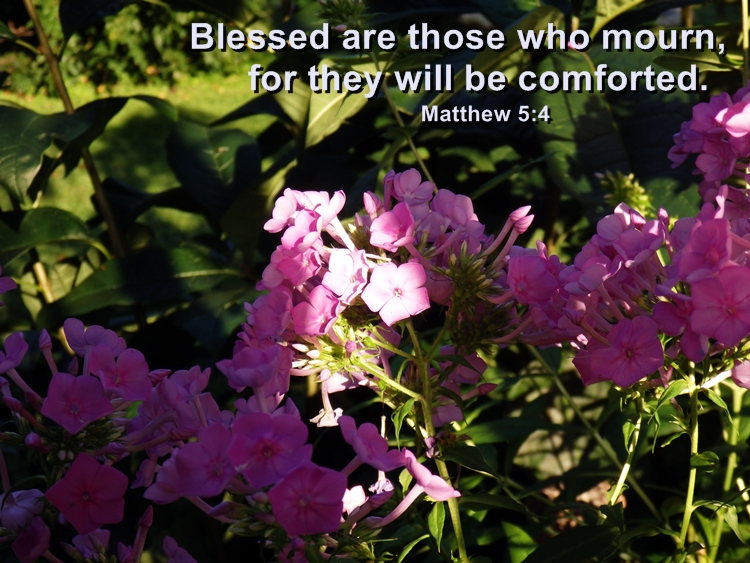
Most of the time, we don’t associate blessing with mourning; maybe we should rethink this… Matthew didn’t actually say what those blessed ones are mourning; it could be the loss of a loved one, it could be the loss of their home or possessions, or it could be the sinful and rebellious state of this world. Maybe it doesn’t matter…
I think it is safe to say that for a person to truly mourn they first had to love; certainly, this would be true in the loss of a loved one. It would also be true if a person is mourning the loss of possessions, for if they didn’t love the possession(s) lost, would they actually mourn?
It wouldn’t seem so.
If the person was mourning for the wickedness of this world, wouldn’t that show they loved God a whole lot?
Consider for a moment those who do not mourn− what a terrible and sad life they must lead! Never having enough of a relationship with anyone for love to develop; never being able to mourn? Never having a loving relationship with God so as to mourn for those who rebel against Him?
Never loving− never mourning?
Those who mourn will receive comfort from God, both in the here and now and in the ultimate future when all pain and sorrow will cease. I don’t know about you, but for me, just knowing this is a comfort that brings joy into my life.
The ancient city of Sardis was built at the top of a very steep hill. Its defensive position was thought to be impregnable, for there was only one small access point which was easily defended, and as a result, its inhabitants were proud and over confident. It was the capital of Lydia because of its invulnerability to attack; oh yes, the people there were over confident. We have quite a few ancient records of the persecution of the church in Asia Minor, but the funny thing is that Sardis is never mentioned, for it would seem that the church there never bothered anybody enough to be persecuted.
Here’s another funny thing about Sardis, the impregnable fortress of a city: It was conquered in 549 BC in a night time surprise attack… and again in 218 BC. Apparently all had been forgotten by the time John wrote these words down, because Jesus hints at another kind of surprise in store for them.
To the angel of the church in Sardis write:
Preamble (3:1b)
These are the words of him who holds the seven spirits of God and the seven stars.
The seven spirits (or sevenfold spirit) represents the wholeness or fullness of the Spirit: the Holy Spirit, The stars represent the messengers (angels) of God.
Historical Prologue (3:1c, 2b, 4a)
I know your deeds; you have a reputation of being alive, but you are dead… or I have found your deeds unfinished in the sight of my God… Yet you have a few people in Sardis who have not soiled their clothes.
You will have noticed that the covenant elements of this letter aren’t as neatly distinguished from one another as they are in most of the others, but they are present nonetheless. The Sardis church has a good reputation, they seem to be in good shape by all outward appearances, but they aren’t in reality, for they are dead. This shouldn’t be overly challenging for us to understand, because it well describes the modern church in an awful lot of places. They have wonderful services, they maintain grand old traditions and say all of the right things, but the love, the light and the life are simply not there. Yet even in the midst of such a congregation, there are a few who have not become stagnant, who have not become overconfident and who are spiritually alive.
Stipulation (6:2a, 3a)
Wake up! Strengthen what remains and is about to die… Remember, therefore, what you have received and heard; hold it fast, and repent.
Curse (3:3b)
But if you do not wake up, I will come like a thief, and you will not know at what time I will come to you.
This is a common theme in the New Testament; take a look at Matt. 24:43; Luke 12:39; 1 Thess. 5:2, 4; 2 Pet. 3:10 and Revelation 16:15. All of these liken Christ’s return to the surprise of a thief in the night, who pops in when you least expect it. He could come at any time without warning which puts to bed any thought that there will be a bunch of signs to announce the imminence of His return as so many modern commentators would suggest. The message therefore is “Wake up and get ready.”
Blessing (3:4b-5)
They will walk with me, dressed in white, for they are worthy. The one who is victorious will, like them, be dressed in white. I will never blot out the name of that person from the book of life, but will acknowledge that name before my Father and his angels.
White is the color of purity or holiness, so those clothed in white will be pure in God’s sight at the time of His coming, as opposed to those in dirty clothes that bear the stains of sin. These are the ones who were ready, who remained awake in their faith and in their spirit; they were not over confident, and they reap the reward of eternal life.
Witnesses (3:6)
Whoever has ears, let them hear what the Spirit says to the churches.
Dear friends, since God so loved us, we also ought to love one another. No one has ever seen God; but if we love one another, God lives in us and his love is made complete in us.
1 John 4:11-12
John is continuing his thoughts that we looked at in vv. 7-10, and as I mentioned last time, this is the central core of Christian theology, the part that everything else is built upon. Simply stated, this love core flows like this:
1. God loved us while we were still sinners.
2. God sent His Son to die for our sins.
3. We loved God and responded to the Gospel.
4. God loved our brothers and sisters in Christ.
Therefore, so do we.
We see this pattern at work once again in verse 11. God loved us, so we should love each other. Then John, as was his custom, takes one more step. Since no one has ever seen God, and since God loves all of us and we love Him, if we also love each other, God’s love will be complete in us and visibly expressed within His Body, the Church. This is as far as John has gone so far…
At this point, we can infer that there is another step. The other step is implied in John’s mentioning that “no one has seen God.” OK, why did he choose to write that? Think…
No one has seen God, but if we love one another as God loved us, then His love will live amongst us, and though us all will see it.
I have seen a number of debates about Evolution and Creation. These kinds of discussions usually have at their core, an assumption that if we cannot observe some “evidence” that God exists, then we can determine that He does not exist. I’m no scientist, but this seems to be a natural inclination on the part of people who are educated with regard to the Scientific Method. Remember that one from your school days? It was the one about observations, and testing theories with observable evidence.
Back to John. Have you ever thought that it would be nice if you could find the positive “proof” of God’s existence? Yes, something that can be observed and studied?
Are you sitting down?
John just gave it to you− The proof is God’s love at work in our lives and within the Body of Christ; at least it should be. Maybe if we started taking these verses to heart and putting them into our everyday manner of living, like we are commanded by God to do, more people would notice that the greatest “proof” of God, the observable evidence is right there in front of us all: Love for one another as Jesus has loved us, and gave His life for us.
Let’s wrap up for today with a question to think about: Do you ever wonder if it is a coincidence that the whole concept of Godly love has been corrupted and demeaned in our culture? After all, doesn’t society use the word “love” to mean just about anything other than Godly love?
To the one who is victorious, I will give some of the hidden manna. I will also give that person a white stone with a new name written on it, known only to the one who receives it.
In our post concerning the letter to Pergamum, I gave you the “short version” of the three images found in this blessing. Now, let’s examine these a little more carefully to see what is going on…
Hidden Manna
In the original post I said that this should be understood as servants of the Lord who will have a seat at His banquet table in the Kingdom, and that is certainly the bottom line. However, this image has very deep roots in Jewish tradition and I know that some of you will be interested in the side trip, so here, at no extra charge, is our side trip:
Manna first appears in Scripture in Exodus 16 when the people in the desert cry out for food and God sends them “bread from heaven”. This bread from heaven falls like dew, looks like frost and tastes like honey, and when the people first saw it they said “manna” which means “what is it?” The name stuck. Then, in Ex. 16:32-35 the people are told to collect some of the manna as a remembrance of God’s miraculous provision:
Moses said, “This is what the Lord has commanded: ‘Take an omer of manna and keep it for the generations to come, so they can see the bread I gave you to eat in the wilderness when I brought you out of Egypt.’”
So Moses said to Aaron, “Take a jar and put an omer of manna in it. Then place it before the Lord to be kept for the generations to come.”
As the Lord commanded Moses, Aaron put the manna with the tablets of the covenant law, so that it might be preserved. The Israelites ate manna forty years, until they came to a land that was settled; they ate manna until they reached the border of Canaan.
The jar of manna remained with the Ark of the Covenant for quite a long time. Being with the Ark, it was “before the Lord” because that was where His presence was said to be on the earth in the Most Holy Place. According to Jewish tradition, the prophet Jeremiah removed the jar of manna and the Ark so they would not be captured by the invading Babylonians, and hid them in a cave near Mount Nebo; the account comes from 2 Maccabees 2:4-8:
These same records also tell us that Jeremiah, acting under divine guidance, commanded the Tent of the Lord’s Presence and the Covenant Box to follow him to the mountain where Moses had looked down on the land which God had promised our people. When Jeremiah got to the mountain, he found a huge cave and there he hid the Tent of the Lord’s Presence, the Covenant Box, and the altar of incense. Then he sealed up the entrance.
Some of Jeremiah’s friends tried to follow him and mark the way, but they could not find the cave. When Jeremiah learned what they had done, he reprimanded them, saying,
No one must know about this place until God gathers his people together again and shows them mercy. At that time he will reveal where these things are hidden, and the dazzling light of his presence will be seen in the cloud, as it was in the time of Moses and on the occasion when Solomon prayed that the Temple might be dedicated in holy splendor.
This is how the manna came to be the “hidden manna”. Notice when the manna and the rest of the contents, will be found again; it will be “when God gathers his people together again” at a future date. The manna is also discussed in various apocalyptic Jewish texts in reference to the Messianic Banquet, which is said to take place at the consummation of the Kingdom of God. As a symbol, the Messianic Banquet communicates the joy, abundance and fellowship of the kingdom at a great feast presided over by the Messiah. In Scripture, the main text on this subject is Isaiah 25:6-8:
On this mountain the Lord Almighty will prepare
a feast of rich food for all peoples,
a banquet of aged wine—
the best of meats and the finest of wines.
On this mountain he will destroy
the shroud that enfolds all peoples,
the sheet that covers all nations;
he will swallow up death forever.
The Sovereign Lord will wipe away the tears
from all faces;
he will remove his people’s disgrace
from all the earth.
The Lord has spoken.
It is well worth noting that this symbolic feast takes place when the Kingdom of God comes into fullness, and when there is no more death, sadness and disgrace. Later, the author of 2 Baruch, who wrote at about the same time as John wrote Revelation, tells of the great feast where the menu will include such delicacies as wine in abundance, Leviathon, ( a huge sea beast) and land behemoths (symbolizing the enemies of God) and…. You guessed it: Manna. (See 2 Baruch 29:3-8)
In the New Testament, similar images can be found in Matt. 22:1-14; 25:1-13; and Revelation 19:6-9. In addition, the Lord’s Supper is a foreshadowing of such a Banquet when understood in light of Jesus’ comment in Luke 22:16:
For I tell you, I will not eat it again until it finds fulfillment in the kingdom of God
Thus, I have concluded that the “hidden manna” in Revelation 2:17 is a reference to the recipient’s having a seat at the table at the consummation of the Kingdom of God at the second coming of Christ.
The White Stone with the Secret Name
I gave you my reasons for my conclusion about the white stone in the original post; the white stone represents complete and total acquittal for any and all guilt deriving from sin. That is simple enough and requires no further explanation. As for the secret names, that is a little more involved.
The Greek word John used in 2:17 is kainos. If we search, we will find that John uses it several times in Revelation: There is a “new song” in 5:9 and 14:3, there are “new names” in 2:17 and 3:12, there is the “new Jerusalem” in 3:12 and 21:2, a “new heaven and new earth” in 21:1 and the consummation of the Kingdom of God in which Jesus makes “everything new” in 21:5. Therefore when Jesus says that “overcomers” will receive “new names”; they are being offered places in the coming redemption and transformation of all creation. Yet, we still have the issue of the new names being known only to “him who receives it”.
In the ancient world, giving a name is a sign of power and authority. This is true in Greek myth as well as in Scripture; for instance, recall the story in Genesis 2:19-20 when God gave Adam the right to name all of the animals as an act of dominion over them (cf. Gen. 1:26). Now consider the events described in Luke 8:26-39: Jesus comes upon a man who is possessed by a “Legion” of demons. They cry out to Jesus, “What do you want with me Jesus, son of the Most High God?” As you can see, they knew Jesus’ real name: “Son of God” and to the ancient mind, this might indicate that they had power over Him. Now, recall Jesus’ reply: “What is your name?” Jesus was not about to let them have the upper hand, and when they answered, He drove them out of the region.
The Christians in Pergamum were suffering under the power of their oppressors, but in promising them new names known to no one else, He is promising them freedom from those who have persecuted them. Thus, the white stone of acquittal combined with freedom from oppression is a very nice aspect of the wedding feast of the Lamb in a transformed world.
Well dear reader, there you have it; I hope this has been helpful to you so that you can see another example of how to figure these symbols out.
In our next post, let’s take a look at the letter to Sardis; see you then!

Click the image to visit my other blog, Photo Vistas, my journey in pictures


 Life Project Blog