Watch It!

 But among you there must not be even a hint of sexual immorality, or of any kind of impurity, or of greed, because these are improper for God’s holy people. Nor should there be obscenity, foolish talk or coarse joking, which are out of place, but rather thanksgiving. For of this you can be sure: No immoral, impure or greedy person—such a person is an idolater—has any inheritance in the kingdom of Christ and of God. Let no one deceive you with empty words, for because of such things God’s wrath comes on those who are disobedient. Therefore do not be partners with them.

Ephesians 5:3-7

Take a look at these verses again; see the things that Paul is telling us not to do? What is the common thread between all of them?

Exactly, good work!

They are all self-centered. The things Paul tells us we should do are all outwardly focused. Yes, dear reader, that is how these verses fit into the larger context here… and Paul’s theme continues on to the next batch of verses that we’ll look at next time.

That is the most important part about this short text, it is the main lesson here, and now that I have done my teaching duty, I have a couple of observations of a slightly more “advanced” nature that may not be for the faint of heart.

In verse 3, Paul refers to “sexual immorality” and “greed”. These are the most obviously self-centered things he mentions… and oddly in today’s world they are the most controversial. We live in a time when we can’t, as a culture, define sexual immorality, because the word “immorality” implies that there is a standard of conduct beyond the statutes adopted by the government. Nobody would have been concerned with that before the 20th century, and “morality” was even a highly prized virtue at one time, but sadly, that time has passed, and now we seem to think, as a society, that anything that is legal in a court of law is just fine, but that is a bald-faced lie! Human governments decide what they will permit, but they cannot over rule Almighty God. If you are tempted to argue with me on this point, just remember that the Nazi Holocaust was all perfectly legal, as were most of the outrages of history.

Yet Paul’s point here is not based upon a legal issue, for Paul’s focus is not legal or transactional; it is entirely relational. You see the real danger to the believer in things like immorality and greed comes from the fact that these impulses, unchecked, are very strong indeed, and can pull a man or woman completely away from their relationship with Christ. In fact, a person falling into this kind of trap can be pulled so far away from His loving arms that they may not be able to return, assuring their destruction…

In verse 4, Paul tells us that obscenity, foolish talk and coarse joking are “out of place” and I think many will also understand this in a transactional sense. It is important that we all recognize that sin and its consequence isn’t the point, for remember that Paul is writing to Christians whose sins are forgiven. However, the way we talk reveals a great deal about the way we think, for if we speak in a sloppy and undisciplined way, the chances are that our thinking is sloppy and undisciplined as well, and thus if we are in the habit of speaking in a way that is far from reflecting our relationship with Christ, then the chances are very good that we do not have a healthy relationship with Him. Now obviously I’m not saying that we can engage in pious talk and fool God into thinking we are pious; we probably won’t fool anyone around us either. Paul is trying to teach us that if our talk is “out of place” our thinking probably is as well, and we are on a slippery slope with our faith.

We need to be more focused on our relationship with Jesus Christ− all of us! Can we just change our thinking and living entirely on own power? Maybe, maybe not. If we are waiting for the Holy Spirit to jump into the fray and zap us with perfection however, we’ll be waiting for a very long time, because that isn’t how He works. You see, the Holy Spirit is waiting for us to make the first step. He has given us the instruction to make an effort; you’ve just read it.

We make the effort, we make a commitment and seek His strength and His presence and He sustains us through the process; that’s how it works.


Posted in Bible | Tagged , , , , , , , | 2 Comments

TLP Living: 12/3/18

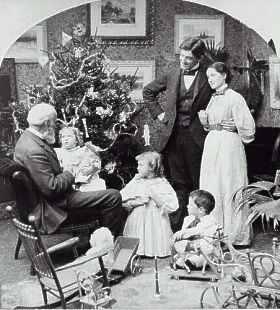
Visions of Christmas Past- Redux

The Christmas season is upon us, and even I can’t put it off any longer! I thought that it might be fun to take a look at it from two different points of view, looking back and looking forward.  Today, let’s look back…

For me, the notion of Christmas in the Victorian era is a great one; it somehow seems so innocent and wholesome.  I don’t know why this is, maybe I’m just a sucker for that period, but somehow things just seem more simple.  My honest guess is that this would amuse the people who lived then, but what the heck, let’s deck the halls!

Of course you would have to start out with your Christmas cards, this was the era that invented them, and since internet connections weren’t that great in those days, everyone would actually write them and send them in the mail!

OK, try to picture this: People would go about town singing Christmas Carols in public!  Apparently the ACLU was asleep on the job in those days: Horror!


People did crazy things like look out for their neighbors, give gifts to them and carol in their yards to bring festive cheer and love into their lives… I must say that we are much better off today because instead of having to go out and do things like that, we can download a movie about other people doing it and feel just as good in the warmth and security of our own homes…

Then it would be time to get the house ready for the big day.  If you were well-to-do, you might go out and buy fancy ornaments for your tree, but if you weren’t, homemade ones were perfectly fine too.  In fact, a great deal of their decorating involved people coming together to make things and spend time together.

When the time came, everyone in the family would come together to celebrate.  Gifts were exchanged; often the gifts were hand-made as well as the decorations.  For most people, gifts that their loved ones made themselves were as good as the store-bought ones, because they were made out of love for one another.

And of course, if there weren’t any gifts, that’s OK too… they would spend time in each other’s company.  I guess that’s why the Christmas season in the Victorian context seems more innocent to me… or maybe there wasn’t anything good on TV; who can say?

Of course, I’ve been having a little fun with this comparison, but please don’t get the idea that I don’t appreciate the season in our own times; it’s a wonderful time… and let’s be honest, it’s what you make of it.

If we’re all caught up in the material and commercial aspect of it, it won’t be as much fun as it could have been.  I’m all for Christmas Simplification!  Why not just be happy with the Day, what it means and with one another’s’ company?

Of course my kids just call me “Scrooge”!

One last thing, I came across this video from 1898 called “Santa Claus” and I had to include it here, even though it’s a bit off-topic.  It’s pretty short; you’ve got to check it out.  It is charming in its simplicity…

Posted in Christian living | Tagged , , , , , , , | 2 Comments

TLP Inspiration: 12/3/18

A Child is Born

Isaiah 9:1-7

For to us a child is born,
to us a son is given,
and the government will be on his shoulders.
And he will be called
Wonderful Counselor, Mighty God,
Everlasting Father, Prince of Peace.
Of the greatness of his government and peace
there will be no end.
He will reign on David’s throne
and over his kingdom,
establishing and upholding it
with justice and righteousness
from that time on and forever.
The zeal of the Lord Almighty
will accomplish this.

Isaiah 9:6-7

This passage falls within a section that runs from 8:1-9:7. The section begins with a discussion about the relationship between the lack of belief in Judah and the resulting invasion of the Assyrians (8:1-10). It affirms that God will not allow His people to be entirely wiped out, and moves on to tell those who remain faithful not to join in disbelief (8:11-22) presenting a very dark picture of anguish for those who are not faithful to God. 9:1-7 tells of hope; that just as God brought light out of darkness at the creation, so will He bring light to a world darkened by unbelief.

Our passage begins by telling the people that deliverance will come first in the North; “Galilee of the Gentiles”. This area was the first to be invaded by foes from the North, and would also be first to see deliverance. It is “of the Gentiles” because at the time of writing, the Israelites had been taken into captivity from this area, and the resultant inhabitants were Gentiles. The two tribes mentioned in the text, Zebulun and Naphtali were representative of those “lost” tribes. The reference, in verse 4, to the defeat of Midian is noteworthy, as it reminds the people of what God has done for them in the past. In addition, it was a deliverance that had particular effect on Zebulun and Naphtali. (Judges 7) Of course, after God’s deliverance the people again fell into disobedience and were re-conquered. This was a cycle that Isaiah’s readers should have been well aware of. Yet this time, the deliverer would be far greater than before.

Deliverance would come through a child of the House of David; but not a ruler like any they have seen before. Verse six contains a series of names for this coming ruler which reveal beyond dispute that the child will be no mere mortal: “Mighty God” for example is hardly a term that Jews would apply to a mortal man. “Everlasting Father” is most definitely another one that is beyond debate: the child would be God! Verse 7 indicates that his rule will last from that time on forever, and that all of this would be accomplished through the “zeal of Lord Almighty”.

In short, Isaiah is telling the people that they have grave trouble with God, and bad times ahead. This is all brought on by their own disbelief and rebellion against God, yet in the end, God will replace their disbelief with deliverance when He Himself will rule over His people.

It would be unthinkable for a Christian not to see Jesus Christ as the fulfillment for this prophecy in light of Matthew 4:13-17 in which Matthew specifically states that Jesus went back to Galilee to fulfill it. Note also that in verse 17 what is Jesus telling the people? “Repent, for the kingdom of heaven is near.” Jesus was bringing the kingdom of heaven to Galilee. He established this kingdom by bringing deliverance to those who would remain faithful to God through His work on the cross. This was deliverance not by the sword, but by forgiveness; and the Kingdom of Heaven came into being; a Kingdom that makes war obsolete, for it is not of this world. (Isaiah 9:5; John 18:36)

Posted in Christian living | Tagged , , , , , , , , , | 1 Comment

Sunday Sermon Notes: December 2, 2018

Title: In the Beginning

Text: John 1:1-5, 14

In the beginning was the Word, and the Word was with God, and the Word was God. He was with God in the beginning. Through him all things were made; without him nothing was made that has been made. In him was life, and that life was the light of all mankind.

John 1:1-4

John begins his account with the words, “in the beginning” with a very different beginning in mind than we find in Genesis 1:1, for while Genesis begins with the creation, John begins with God alone.  The “God” that John refers to here is first called the Word (logos) God, the uncreated Creator, before the creation of anything: The Word. That “Word” was there first of all… with God; in fact, the Word was and is God.

We throw those terms around in our day, don’t we? “The Word” referring to the Scriptures, and we seem to like to use it to prove our various points in arguments with each other as though the “Word” is our own very precious tool for debating. Yet John, the Apostle of Jesus Christ uses it as a name for Almighty God.

Notice how the Word becomes God, and then in the next verse God becomes “he.” He was with God in the beginning. The Word was with God in the beginning: “The Word”, “God” and “He” were all together in the beginning, before anything had been created.

They are One.

Jesus is God’s messenger to mankind, as well as being the embodiment of God’s message (Heb. 1:1-4). It was by His Word that the universe came into being, and it is by His blood that we may enter into relationship with Him, as told in His Word.  Thus, we may say that the Word is not only God’s person, essence and power, but that it is one and inseparable from the person of Jesus Christ, who is entirely one with God. Verse 2 is set up as transition in the sense that it begins the move from “what” to “whom”; from “the Word” to “he”: Jesus was there.

Now it becomes clear and unambiguous that this “he” is the one through who all things have been made.  This is stated positively “all things” and negatively “without him nothing…”  Within him was life which reminds us of God breathing life into Adam. (Gen. 2:7). “He” contained life, was its very source, and this essence will be the light of the world.  Life and light are two themes that carry throughout the entire gospel of John, and will become more and more clear as we go on.  For now, suffice it to say that His very essence is “Truth” and that will illuminate a dark world that carries on without either Truth or God’s presence, since fellowship with God had ceased after the entry of rebellion into the world.

Verse 5 begins the next little section of John’s text, a section that continues through verse 13. The theme is that of the manifestation of the Word in this dark world, and in this it is interesting to note the transition from the Word, to God and then of Word-God into “light’. We can easily see through this device that the three terms, Word, God and light are being used interchangeably to describe attributes of God, thus they are One in their reference to Christ, who is as yet unnamed in the text.

The light shines in the darkness, but the darkness has not understood it.

John 1:5

Once again, John has put into one simple statement a fact that theologians have struggled with for centuries; the world around us just doesn’t “get it”. OK, those poor souls who live in the darkness of this world don’t understand the light; why does this surprise us? At the same time as we are surprised that this world struggles with the message of Christ, some of us are surprised that we should be called to reach out to the world around us to deliver the message of light to them and help them to see it for what it is− grace and truth. Why should we be surprised to be called to help others understand it? Why should we resist this calling?

The Word became flesh and made his dwelling among us. We have seen his glory, the glory of the one and only Son, who came from the Father, full of grace and truth.

John 1:14

Up to this point, we know that the Word was with God and that the Word was God; the “Word-God.” We have also seen John refer to this Word-God as “he”. Now, for the first time, John identifies “him” as the Son of God, Jesus Christ. Yes, for it was none other than Jesus who became flesh and made His dwelling among us at the incarnation, it is of Jesus that the Hebrews author asserts, “and through whom also he made the universe” (Hebrews 1:2) which is parallel to John 1:3; there can be no doubt about whom it is that John is referring to here. It is Jesus who is the Son, having come to us from the Father.

Now that we are certain of just who John has been talking about, we can look at the attributes John mentions about Him, He was full of “grace and truth.” Notice the balance between those two; how many of us maintain that kind of balance between grace and truth when we are interacting with others? Some of us have a great deal of grace, so much so in fact, that we can overlook almost anything; we might even make the truth hard to find. Others are so strong on truth that we find ourselves pointing fingers at those around us, seldom displaying love or compassion or understanding.

The preacher who pounds his pulpit while heaping condemnation on the sinners around the room thinks he’s being just like Jesus, but where is the grace? The preacher who is willing to tolerate virtually any behavior also thinks he’s being just like Jesus, but where’s the truth? Oh yes, dear reader, it is so very hard for us to see ourselves the way that others do, and even harder to see ourselves as God sees us, but since being like Christ is our goal, we need to try.

It might just be that you, me and everyone else should seek His guidance in this through fervent and regular prayer that He, through His Spirit would guide our every action, that all around us would see His love at work in each of us.

Posted in Sunday Class Notes | Tagged , , , , , , , , | Leave a comment

TLP Inspiration:12/1/18

Priorities

For God was pleased to have all his fullness dwell in him,  and through him to reconcile to himself all things, whether things on earth or things in heaven, by making peace through his blood, shed on the cross.

Colossians 1:19-20

Leading up to these verses Paul gave a list of attributes that he attributed to Christ, and here, as a way of summing up he goes the next step and puts all of the fullness of Jesus Christ into perspective.  Notice that God was “pleased” to have His own fullness residing in Jesus, and to have Jesus reconcile all to Himself. If you think about it, if there was reconciliation, there must first be a conflict…

We know that there was indeed a conflict, a conflict that engulfed all Creation the moment that Adam entered into sin way back in Genesis 3. It’s a funny thing, but for most of us, we don’t really think of sin the way we should, for we tend to think of it as a violation of some sort of rule or ordinance. Yet sin is much more than a simple violation; it’s rebellion, rebellion against God. So here we are, God was pleased indeed to place all of His fullness in the Person of Jesus and to have Jesus establish reconciliation on the cross, for in doing so He paid the entire cost of the rebellion: There is now peace between Man and God.

Why should He do that?

Love.

His love was so great that He placed His fullness into His Son and sent His Son to make peace with humanity; that’s quite a thing to ponder wouldn’t you say? I realize that this statement doesn’t pay the bills, nor does it solve all of the problems we encounter in this life, but it does something much greater than simply taking away problems and circumstances. Instead it transcends the problems of the day-to-day and empowers us to see greater things, to set higher aspirations so that the complications of the here and now are put into their proper perspective.

When you come right down to it, what God has done for us through Jesus Christ puts the hassles of life where they belong… on the low priority list.

Wow!

Posted in Christian living | Tagged , , , , , , , | Leave a comment

YLP Inspiration: 11/30/18

donmerrittonline.com

Posted in Christian living | Tagged , , , , , , , , , | 1 Comment

Love’s Perspective

Follow God’s example, therefore, as dearly loved children and walk in the way of love, just as Christ loved us and gave himself up for us as a fragrant offering and sacrifice to God.

Ephesians 5:1-2

We’ve now seen Paul’s transition from general to more specific instruction, and when we left off at the end of chapter 4 it seemed that Paul was describing love among believers as the main priority in Christian living. Now, in the first two verses of chapter five, he confirms this impression with his brief comments on love, in what is really a bridge between instructional passages.

When you take these verses in with chapter 4 in mind, they are even more beautiful than when they are quoted alone, as they often are. Why? Because they show us that as we treat others as we should, which is to say that we place their interests and well being ahead of our own, we are actually following God’s example.

We love to think of ourselves as children of God, and Paul takes this thought and brings it into sharp focus, pointing out that we express this relationship in following God’s example in the way we live our lives. Yet we sometimes seem to feel like we are being asked to make sacrifices living for others instead of ourselves. I know I have heard this mentioned by some who are perhaps not having their best of days… yet Paul manages to put even this into perspective. When he mentions Jesus, he reminds us of how Jesus showed His love for us in giving Himself up as a sacrifice for our sin. As he moves further into this discussion, Paul will show us how we do this by no longer living according to old ways.

Posted in Bible | Tagged , , , , , , , | 3 Comments

“Big Boy” Thinking

Do not let any unwholesome talk come out of your mouths, but only what is helpful for building others up according to their needs, that it may benefit those who listen. And do not grieve the Holy Spirit of God, with whom you were sealed for the day of redemption. Get rid of all bitterness, rage and anger, brawling and slander, along with every form of malice. Be kind and compassionate to one another, forgiving each other, just as in Christ God forgave you.

Ephesians 4:29-32

As we review these verses, it becomes pretty clear that Paul is addressing the role of “self” in our lives. Right off the bat, notice what he says about “unwholesome talk”; he does not say “Don’t cuss or you’re going to hell.” No, he tells us that our speech should be for the benefit of others. Yet he goes even further than that when he says our speech should benefit others according to “their needs.”

Who does that? Don’t most people talk about their own needs, express their feelings to resolve their issues, let you know how they feel? Don’t the shrinks tell us we need to express our feelings…?

Unwholesome talk…?

I’ve often said in these posts that following Christ is counter-intuitive; this is one of those times.

He goes on, and raises a second question: What does he tell us is grieving to the Holy Spirit of God? Maybe we should come back to that one.

In the final piece of this text, Paul tells us to get rid of “bitterness, rage and anger, brawling and slander, along with every form of malice.”

What are we to replace these with? Kindness, compassion and forgiveness…

It’s beginning to sound like “love one another” isn’t it? Can we love one another if we are filled with bitterness and rage?

No.

Are slander and malice expressions of love?

No.

How about anger and brawling; are they expressions of love?

No.

Now let’s try kindness, compassion and forgiveness; are these expressions of love?

Yes.

Did you notice that all of the “no’s” were self-focused? Did you notice that the “yes” ones were outwardly focused for the benefit of others?

Yeah, I thought so. OK back to speech…

We all know that Jesus taught us to set our own interests aside and put the interests of others ahead of our own; what does this sound like when we speak? Is our speech grieving to the Holy Spirit within us?

I’ll let you answer those on your own.

A couple of sections back we spoke of spiritual maturity. To me, spiritual maturity is a fairly simple concept: deal with self. A mature Christian is one who puts others first… really. I don’t mean to help out when you have time or when you feel like it, or so you will be recognized. I mean really change our orientation and worldview.

Well, I said it was simple, I didn’t say it was easy.  One thing is for sure: we won’t get there by following the ways of this world, and with that, this passage just slipped back into Paul’s larger context.

Posted in Bible | Tagged , , , , , , , , | 5 Comments

Paul Becomes Practical

Therefore each of you must put off falsehood and speak truthfully to your neighbor, for we are all members of one body. “In your anger do not sin”: Do not let the sun go down while you are still angry, and do not give the devil a foothold. Anyone who has been stealing must steal no longer, but must work, doing something useful with their own hands, that they may have something to share with those in need.

Ephesians 4:25-28

In verses 17-24, Paul told the Ephesians that they must no longer live according to their old ways, instead urging them to live lives worthy of their calling, according to the ways of the truth they had been taught in Christ. Here, in this passage he becomes more specific in his instructions.

It would be well for all of us to consider carefully his words here, for they are both wise and practical. I hardly need to elaborate, for there is nothing in these few verses that will be news to anyone. We know that we should take care in what we say, that dealing with each other truthfully is the right thing to do, and of course we all know that we shouldn’t let our anger carry us away into rage. Oh yes, we all are angry sometimes, and often with good cause. But anger for a good reason is no excuse for losing control; everybody knows that… don’t they?

Well, maybe not. I know one young lady who, with good reason may become angry, but she seems to feel that since she has been wronged… yet again… by a certain individual, that she can let her mouth go completely out of control, after all, she has been wronged again, so it’s OK.

Well, it isn’t OK. It’s pretty easy for me to see how this gives a foothold to the devil, particularly when the same incident is still the object of her wrath days later.

Stealing: Nobody is likely to tell me that stealing is OK, right? Well, of course if it’s just a box of pens from work, that doesn’t count does it? Spending your time at work on Facebook: no of course that isn’t stealing; after all, you haven’t actually taken anything, right? Well, except for the money you were paid to do actual work− no that doesn’t count…

What does Paul say about that?

Gee, on second thought, maybe we can all take a little look into the mirror and ask how we can represent Jesus better in everyday life.

Notice how Paul redirects all of this: No, we shouldn’t steal; everyone should do something useful so they can have something to share with those in need! I would take away from this the notion that Paul wants us to consider the affect all of our actions have on others, and in the process perhaps we will worry less about ourselves. Now if I were irritated by the comment above about doing Facebook at work, shifting my focus onto how things I do can affect others might just stop the rationalizing about how wasting time at work is my right, for I would come back to the realization that others are supposed to be put first in all our lives.

Posted in Bible | Tagged , , , , , , , , | Leave a comment

TLP Inspiration: 11/27/18

donmerrittonline.com

Posted in Christian living | Tagged , , , , , , , , , | Leave a comment