
Sunday Sermon Notes: June 6, 2021

Let everyone be subject to the governing authorities, for there is no authority except that which God has established. The authorities that exist have been established by God. Consequently, whoever rebels against the authority is rebelling against what God has instituted, and those who do so will bring judgment on themselves. For rulers hold no terror for those who do right, but for those who do wrong. Do you want to be free from fear of the one in authority? Then do what is right and you will be commended. For the one in authority is God’s servant for your good. But if you do wrong, be afraid, for rulers do not bear the sword for no reason. They are God’s servants, agents of wrath to bring punishment on the wrongdoer. Therefore, it is necessary to submit to the authorities, not only because of possible punishment but also as a matter of conscience.

Romans 13:1-5

Paul’s message, simply stated, is that human government is ordained by God, and that’s all I should have to say about it. Yet even though human government is ordained by God, human government exists in a corrupted world environment, and we should not pretend to be shocked when it turns out to be corrupt: It happens. What is really instructive in this teaching is that the government Paul was referring to had a nasty habit of persecuting Paul and his readers; yes, maybe we should reflect on that for a while.

If I had been Paul, I might want to write something quite different on this topic, but if I had, or if he had, then a great disservice would have been done to the Gospel. God did not call us to serve His kingdom so that we could engage in political action, for His Kingdom is not of this world. Instead, He has called us to share the Gospel, to share His love with those who have not yet heard it, to nurture and mentor other, younger Christians to maturity in the faith, not to protest stupid court decisions or corruption in Congress or the White House… or wherever it may exist in your location. I will add that if we did a better job of serving His purpose in a free society, it is quite likely that a very different group of people would be elected to represent us, without our ever needing to bring up politics.

By the way, when I teach such self-explanatory texts as this one, this is often where I toss out a question, a rhetorical one of course: When you are driving your car around town, do you observe the speed limit, or do you prefer to behave as the pagans do?

That one gets a groan from the group every time… not to mention laughter.

This is also why you pay taxes, for the authorities are God’s servants, who give their full time to governing. Give to everyone what you owe them: If you owe taxes, pay taxes; if revenue, then revenue; if respect, then respect; if honor, then honor.

Romans 13:6-7

Taxes: Nobody likes taxes, except the ones somebody else must pay. Here in America, we have a horrible tax system, and I will boldly declare that if the entire Tax Code went up for a vote as is, and if it didn’t already exist, no one would vote for it; no one has even read the whole thing, and the people who enforce it don’t even understand it, and if you don’t believe me, ask a tax lawyer!

Now ask yourself, how was the tax system Paul lived under? Well… it was horrible as well. Money is not supposed to be our primary concern in this life; our priority is supposed to be on things that are above, so why should the inequities of the tax system be our priority? Paul’s message is pay them what they want and get on with serving our Lord in peace and love, for that is what we are here for.

Yes, I know… I’m gritting my teeth too, but that only goes to show that we have a long way to go to attain maturity in the faith.

Let no debt remain outstanding, except the continuing debt to love one another, for whoever loves others has fulfilled the law. The commandments, “You shall not commit adultery,” “You shall not murder,” “You shall not steal,” “You shall not covet,” and whatever other command there may be, are summed up in this one command: “Love your neighbor as yourself.” Love does no harm to a neighbor. Therefore love is the fulfillment of the law.

Romans 13:8-10

In this short passage, Paul is nothing short of profound; deep in fact. Yet it is so simple that we might just fly past it and not notice how profound it is; a second grade child can easily understand it, and it requires a mature adult to miss it− that is how simple it is.

Love does no harm to a neighbor. Therefore love is the fulfillment of the law.

If we think of love as a mere emotion or feeling, maybe we can miss this, but godly love is not an emotion, it is a commitment to put the interests of other people ahead of our own, and love in action puts the interests of everyone ahead of our own. If we actually do this, then we will not do anything to offend or hurt them, and if we love God we will not do anything to hurt or offend God. We will not do this because somebody told us that we must, we will do this because we want to.

In short, this is the transformation that Paul spoke of in 12:1-2; this is love in action from 12:9-16.

There are times when I grow weary of people telling me that the Bible never tells us how we should accomplish the Christian life; yes, dear reader, I grow weary of such remarks:

I happened across these verses just the other day as I was finishing up in Philippians for some recent posts; this is similar to several other passages written by Paul and others, and tells us how to be transformed…

Finally, brothers and sisters, whatever is true, whatever is noble, whatever is right, whatever is pure, whatever is lovely, whatever is admirable—if anything is excellent or praiseworthy—think about such things. Whatever you have learned or received or heard from me, or seen in me—put it into practice. And the God of peace will be with you.

Philippians 4:8-9

There is a principle in these two verses that I think people tend to miss, one that is critical to healthy and happy living.  These two verses are quoted often, I’ve even heard them quoted to “prove” that we shouldn’t use bad language, but to me, that sort of thing really misses the point. Let’s see if we can find a little more than meets the eye here.

Notice that verse 8 begins with the word “finally.” This should clue us in to the fact that Paul is summing up everything he’s been teaching, and this should tell us there is a larger context here.  Paul tells us that we should take note of whatever we find along our life’s path that is true, noble, right, pure, lovely, admirable, excellent or praiseworthy and think about them.  Notice that excellent and praiseworthy are set apart so as to sum up the others. Notice also the way he says we should think about them: “Think about such things.”  This tells us more that we should be focusing on these kinds of things, which rather expands the focus from the specific instance, to the category at large.  To put it another way, we are to focus our minds and attention to things that are excellent and worthy of praise, rather than on things that are not.

Don’t rush through this, for it is very significant advice.  Ask yourself what is not included in this, and I think you’ll end up with a list of things that we usually think about; our problems, our feelings about things, our little resentments, our little hurts and things that aren’t uplifting. Surely the kinds of things Paul wants us to be thinking about wouldn’t include our circumstances, illnesses and pains, but would instead include the kinds of things that would inspire us to greatness, and to service of humanity and to God. Now you can see how Paul has been able to have such a positive attitude in his imprisonment.

He wraps up with this statement:

Whatever you have learned or received or heard from me, or seen in me—put it into practice. And the God of peace will be with you.

This is one of those “if – then” statements. Put into practice the things Paul has taught and God will be with you.  By implication, if you don’t put them into practice, you’ll likely find yourself far from God. Now if I was to make such a remark, your eyebrows would surely rise, for who am I?   But by the time he was writing this, Paul had proven himself as the Apostle of Christ, the things that he has taught the people have been from God and for the sake of His purpose; they are the things that will put each of us firmly within God’s purpose and will. Paul has taught us how to be in fellowship with our Lord Jesus Christ, and when we dwell in this place, His presence and peace are surely with us.
Posted in Sunday Class Notes | Tagged , , , , , , , | 1 Comment

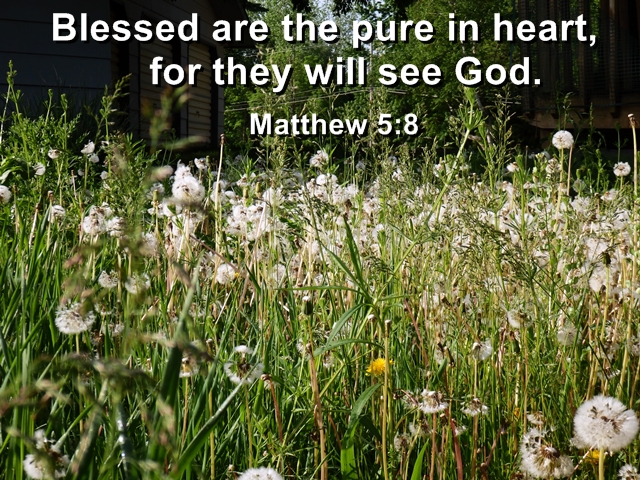
To See God

The expression “pure in heart” refers to a person whose inner most thoughts, motivation and purpose are pure, clean, wholesome and good; this is the one who will see God. To see God is to believe in God, and even more basic, they believe God; such a person is blessed indeed.

The person who is not pure in heart will not see God, possibly because he would rather not see Him. The person who is not pure in heart is one whose inner motivations are not wholesome or good, but are more likely centered on self, gain and getting what they want at whatever cost; they are not blessed because there is little room in their lives for a relationship with Him.

Rather sad, isn’t it?

Posted in Christian living | Tagged , , , , , , , | 6 Comments

Concluding Remarks

Philippians 4:10-23

Paul closes out his letter in this final part of chapter four. This is largely a personal message to the Philippians, but there are some things about it that we can learn, especially if we keep the theme of the letter in mind; being worthy of the gospel.  As Paul has shared what it means for a believer to live the Christian life and to walk with Jesus, as opposed to just believing, in these last verses we see this teaching in practice.

In verses 10-13, Paul expresses his happiness that the Philippians have shown their regard for him in sending one of their men to Paul with aid, as you might recall.  He is happy not so much because he needed anything, but because they expressed their concern.  Then, he goes on to mention that he has learned to be content with whatever he has, be it plenty or little, whether he is hungry or well-fed, for he can do all things through Christ who strengthens him. (v. 13) Once again, we see that Paul’s orientation to focus on Christ is all that is really needed to get through any situation.

In vv. 14-19, we see another aspect of the sharing on the part of the Philippians; it seems to be a habit with them.  On more than one occasion they have sacrificed to share their material resources with Paul, and in so doing they have made their faith manifest.  They didn’t simply say, “Gee, that’s a shame I’ll pray for you.” They sacrificed to meet a need; they behaved as Christ would behave.

Isn’t that what this whole letter has been about?

You might recall that in the very beginning of the letter, Paul mentioned that because he has been locked in prison, guarded by Caesar’s palace guard, Caesar’s very household had come to hear the gospel.  In those early verses, Paul didn’t actually say whether or not any of them had come to faith, only that they had heard.  All things considered, that was a really amazing thing, but in verse 22, Paul reveals the most amazing thing of all:

All God’s people here send you greetings, especially those who belong to Caesar’s household.

There were believing brothers in Christ within the very household of Caesar, because Paul had been imprisoned in Rome to await his trial before Caesar, a trial that was to cost him his life. Even in that dire circumstance, the gospel moved forward to the glory of God.

How much we can accomplish for the gospel if we will only take to heart the lessons that we have found in this letter!

Posted in Bible | Tagged , , , , , , | 1 Comment

Amazing Insight

Finally, brothers and sisters, whatever is true, whatever is noble, whatever is right, whatever is pure, whatever is lovely, whatever is admirable—if anything is excellent or praiseworthy—think about such things. Whatever you have learned or received or heard from me, or seen in me—put it into practice. And the God of peace will be with you.

Philippians 4:8-9

There is a principle in these two verses that I think people tend to miss, one that is critical to healthy and happy living.  These two verses are quoted often, I’ve even heard them quoted to “prove” that we shouldn’t use bad language, but to me, that sort of thing really misses the point. Let’s see if we can find a little more than meets the eye here.

Notice that verse 8 begins with the word “finally.” This should clue us in to the fact that Paul is summing up everything he’s been teaching in the letter, and this should tell us there is a larger context here.  Paul tells us that we should take note of whatever we find along our life’s path that is true, noble, right, pure, lovely, admirable, excellent or praiseworthy and think about them.  Notice that excellent and praiseworthy are set apart so as to sum up the others. Notice also the way he says we should think about them: “Think about such things.”  This tells us more that we should be focusing on these kinds of things, which rather expands the focus from the specific instance, to the category at large.  To put it another way, we are to focus our minds and attention to things that are excellent and worthy of praise, rather than on things that are not.

Don’t rush through this, for it is very significant advice.  Ask yourself what is not included in this, and I think you’ll end up with a list of things that we usually think about; our problems, our feelings about things, our little resentments, our little hurts and things that aren’t uplifting. Surely the kinds of things Paul wants us to be thinking about wouldn’t include our circumstances, illnesses and pains, but would instead include the kinds of things that would inspire us to greatness, and to service of humanity. Now you can see how Paul has been able to have such a positive attitude in his imprisonment.

He wraps up with this statement:

Whatever you have learned or received or heard from me, or seen in me—put it into practice. And the God of peace will be with you.

This is one of those “if – then” statements. Put into practice the things Paul has taught and God will be with you.  By implication, if you don’t put them into practice, you’ll likely find yourself far from God. Now if I was to make such a remark, your eyebrows would surely rise, for who am I?   But by the time he was writing this, Paul had proven himself as the Apostle of Christ, the things that he has taught the people have been from God and for the sake of His purpose; they are the things that will put each of us firmly within God’s purpose and will. Paul has taught us how to be in fellowship with our Lord Jesus Christ, and when we dwell in this place, His presence and peace are surely with us.

I have one final thought that I’d like to share with you in light of this discussion. In another place, in a similar discussion, Paul said this:

Do not conform to the pattern of this world, but be transformed by the renewing of your mind. Then you will be able to test and approve what God’s will is—his good, pleasing and perfect will.

Romans 12:2

I’ve heard people say that Paul’s injunction from Romans 12 is a goal that we really can’t attain in this life. Certainly, on our own power it would be a very tall order, but the fact remains that it is stated as an imperative, a command. Could it be that Paul has just told the Philippians how to accomplish this transformation, and that with help from the Holy Spirit that transformation of the mind isn’t so impossible after all?

In any case, it might be well worth our serious consideration.

Posted in Bible | Tagged , , , , , , | 1 Comment

Photo of the Week: June 3, 2021

Posted in Photo of the Week | Tagged , , | Leave a comment

Paul Point of Viewing

Rejoice in the Lord always. I will say it again: Rejoice! Let your gentleness be evident to all. The Lord is near. Do not be anxious about anything, but in every situation, by prayer and petition, with thanksgiving, present your requests to God. And the peace of God, which transcends all understanding, will guard your hearts and your minds in Christ Jesus.

Philippians 4:4-7

The final chapter of Philippians is largely personal in nature, and I like to think of it as taking place at a certain stop on a longer journey; Paul is giving some last instructions before heading off, and we are getting set to head off on a different road.  In a way, that’s what was really happening at the time. Paul was going into the final stretch before heading home to glory, but the Philippians still had a long trail ahead before they would attain their reward.

These verses comprise another very memorable bit of advice from Paul, and they are as full of significance today as they were almost 2,000 years ago. As we head off in our journey, Paul reminds us to rejoice in the Lord always.

For emphasis, he repeats his admonition; I can only imagine how that struck the Philippians, aware as they were of Paul’s situation. If Paul can rejoice in his situation, how can we not rejoice in ours?  Then this man who was awaiting the judgment of Caesar that would send him to the executioner’s block tells the Philippians to be sure that their gentleness is evident to all− amazing.

He reminds us that the Lord is near, so we shouldn’t be anxious about anything, and sends us right into His presence as he encourages us to be in prayer. We are to present our prayers and petitions to God with thanksgiving, and the peace of God that “transcends all understanding” will guard our hearts and minds.  I just can’t help but think that this would have made a big impression to the Philippians, as it has to so many ever since.

I would like to suggest that we all spend a little time reflecting on these words while remembering the circumstances that Paul found himself in when he penned them, and to ask our Lord to show us where He wants us to go next on our journey through this life.

Posted in Bible | Tagged , , , , , , | 1 Comment

Arriving at the Point

All of us, then, who are mature should take such a view of things. And if on some point you think differently, that too God will make clear to you. Only let us live up to what we have already attained.

Philippians 3:15-16

Following his great rallying cry of verses 12-14, Paul will make a plea to the Philippians and by extension to us, to continue forward in Christ. He begins with these two verses.  This is a transition into his exhortation for us to follow his example. You can see that by the way he links the two sections with the first sentence, yes; we who are mature should take the view that he has expressed, and if we find ourselves disagreeing on some point, don’t worry for God will sort things out.

Notice that he goes on to urge us to live up to what we have already attained, which moves us to his larger exhortation. Before we get to that exhortation, maybe we should ask ourselves what it is that we have attained. By our faith we have entered relationship with our Lord Jesus Christ and received forgiveness of our sins and eternal life. In chapter one he urged us to be “worthy of the gospel” and now he urges us to “live up to what we already attained”.

Join together in following my example, brothers and sisters, and just as you have us as a model, keep your eyes on those who live as we do. For, as I have often told you before and now tell you again even with tears, many live as enemies of the cross of Christ. Their destiny is destruction, their god is their stomach, and their glory is in their shame. Their mind is set on earthly things. But our citizenship is in heaven. And we eagerly await a Savior from there, the Lord Jesus Christ, who, by the power that enables him to bring everything under his control, will transform our lowly bodies so that they will be like his glorious body.

Philippians 3:17-21

Here is the exhortation− Paul is urging the people to follow his example, and the example of others who live as he does.  Because of this, it is quite clear that he is talking about the way we all live; follow the example of the way he and certain others live. This is an important distinction, for many say all of the right things and live quite differently.

Pay careful attention to verses 18 and 19: Many live a different kind of life than Paul does− a life that leads to destruction.  My first question about this would be, “Just exactly who are we talking about?” My first impulse is to assume that he must be talking about unbelievers, to make a distinction between Christians and non-Christians; some might even want to toss in the concept of phony Christians or fake Christians, or Christians who aren’t “really” saved.  I’d prefer to leave that kind of speculation to others; they are probably much smarter than I am if they can make such judgments. I’ll ‘play it safe’ and stick with the context.  Since Paul is sending this message to Christian believers, I must infer that he thinks it is possible for Christians to follow the wrong path, thus the warning; otherwise, the warning is pointless and sent to the wrong people. Are there Christians that we might know of (or be) who live for the things of this world and neglect the heavenly priorities of Christ? If so, we should not follow their example.

Our citizenship is in heaven! Our priorities must be on heavenly things. As citizens of heaven, we must concern ourselves with the mission that Jesus has given us, to love others, to put their interests ahead of our own in true humility, and to share the awesome gospel of Jesus Christ, for this is the way that will lead us to our reward. As it happens, it is also the reason that Paul wrote this letter to the Philippians.

Posted in Bible | Tagged , , , , , , | Leave a comment

Weekly Bible Study Notes: June 2, 2021

John 15:1-17

Today we continue our study of Jesus’ remarks to the disciples in the Upper Room.  Our passage is one of the best known in all of Scripture in which Jesus uses the illustration of a vine to describe key relationships within the Christian Life.  The text moves to its climax in verse 16 with the word “then” giving us a conditional statement that if our relationships are working together properly, “then” our requests will be granted.

This is the seventh and final “I Am” statement in the Gospel of John, and it is intended as an illustration of the relationship between the Father, the Son and the Church.  Jesus is the vine, the Father is the gardener and the disciples are the branches.  Notice that Jesus points out the fact that in a vine a branch has the function of bearing fruit, and no fruit can be borne by a branch that has been removed from the vine.  His point here is that the disciples must remain in Him in order to accomplish their purpose.  The Father as gardener will remove any branches that do not bear fruit, and prune the ones that do so that they may bear even more fruit… but what is “fruit”?  It is easy to say that He is referring to the making of new disciples, and certainly this is part of the answer.  Considering that the Father will be pruning individual branches as well as the entire vine, however there would seem to be something more involved.  In this case, it would be the removal of sin from our lives so that we will not only build new disciples, but that we would live such a life of love and purity that we would produce even more disciples than before.  One could say that this pruning involves God’s fine-tuning of our spiritual lives so as to bring about maximum growth not only in ourselves, but as a result, in the entire Christian community.

Here Jesus restates the “I Am” in verses 5-6 and adds that we must remain in Him or we cannot produce anything.  Consider what happens when we attempt to produce spiritual fruit apart from Christ, entirely on our own… what is the result?  Usually, the result is either nothing at all or the entry point for sin and wickedness into the community of believers.  One might even suggest that this is the formula for the development of cults, in the extreme case. Much has been made of verse 6 in certain circles, but notice the word “like”.  If we do not remain in Him, we are “like” branches that will be cast in the fire.  It did not say that we will be cast in the fire; repentance is an option, and most of us have had our times of straying and then come back to living “in Him”.

Verses 7-8 establish clear linkage between “remaining” and being disciples.  If we remain in Him… we will be seen as His disciples.  Remember that a disciple is one who knows what the Master knows (and my words remain in you) and who does what the Master does (bear fruit).  Thus, if we are His disciples in reality then He will answer our requests for His purpose.  It would go without saying that we wouldn’t be making selfish requests.

Jesus now introduces a second analogy to illustrate this relationship, and that is the relationship between the Father and the Son.  The illustration is Father/Son is the same relationship that is between Son/disciple.  The Father has loved the Son, and the Son has responded with love and obedience.  Therefore, since the Son has loved us, we must respond with love and obedience. To remain in His love is to have our joy made complete.

Going one step further now in 12-13, Jesus tells us exactly what obedience looks like: “Love one another as I have loved you.”  This is the command He is talking about, and as we saw a few sections back, this means putting others ahead of ourselves: always.  The Christian life has no room for self!  Verse 13 goes still further when Jesus mentions that the greatest love is to lay down your life for your friends.  In His case this meant the cross.  In our case, who knows the future?  One thing is clear however, to lay down our life of selfishness is paramount.

There is an interesting contrast between “servant” and “friend” in the last 3  verses, one that is even stronger than the NIV gives us, for the Greek word rendered “servant” (doulos) is the word for “slave”.  The contrast is clear: A slave is an inferior relationship while a friend is an equal relationship.  Don’t get crazy just yet, for this equality is entirely conditional.  Go and bear fruit.  Love one another.  These are the conditions, and realize that the first will not happen until we accomplish the second.  Then the Father will grant whatever we ask.  This is the conditional nature of the Christian life, and the challenge before us today.  As our culture continues to crumble and the church falters, what will we do?

We will remain in Him, love one another and bear fruit!

John 15:18-16:4

While the first 17 verses of chapter 15 discuss relationships within the Christian community, verses 18 and following discuss the relationship between the Christian community and the outside world.  In the first instance, the relationship is characterized by love, but in the second it is characterized by hate.  This is a new reality that the disciples must deal with, one that exists to this day. To begin to understand this phenomenon, we must remind ourselves that the world Jesus speaks of is continuing to live in rebellion against God.  Jesus brought this contrast between God and Rebellion into the harsh light of day and the people didn’t like it.  His disciples will do the same thing with the same result.  We too will make this contrast easy to see if we live according to His teachings.  We will also cause some to believe and be saved, but the majority will not appreciate our work.  For this reason, Christians in “tolerant” America are ridiculed in the press, movies and television, and are often singled out in the public square for derision.

Christians are not “of this world” but instead “our citizenship is in heaven.” (Phil. 3:18-20) The world we live in today is “post-modern” meaning that the overriding standard of morality is what is right for me.  Post-modernism doesn’t allow anyone to say that something is “right” or “wrong” absolutely, calling instead on individuals to seek that which is right for them and demanding “tolerance” from everyone else.  Obviously, post-modernism is not the philosophical basis of the Bible, and as we all know many people have a hard time listening to anyone tell them differently.  This entire philosophy demonstrates that most people do not wish to be reconciled to God, or as Jesus put it, to “know the One who sent me.”

As a result of Jesus’ ministry, the world was left “without excuse.”  He has spoken the truth of sin, death, right and wrong, and He topped it all off by confirming His teachings with miraculous signs so that there would be no way for anyone to claim that His teachings were simply another random philosophy: They were the very words of God.  As a result, rebellious humanity in large part hated both Jesus and His Father, as the prophets had foretold.

Jesus reminds the disciples about the coming of the Holy Spirit. Note that this is not a teaching about the Holy Spirit as much as it is teaching about what their responsibility would be.  The presence of the Holy Spirit is beneficial in a great many ways, but it doesn’t mean that we have no work to do; our part is to teach people about the Gospel and make disciples.

Jesus has told His disciples unpleasant facts about their futures, and now in 16:1-4 He tells them why He has done so.  The unpleasant future would soon begin with the arrest and senseless murder of Jesus Himself by Jewish leaders who believed that they were keeping God’s Law by doing so.  The book of Acts documents a reign of terror against the early church in which many were arrested and tortured or murdered by people who thought they were doing God’s work in silencing God’s truth.  This is not only an irony but sheer madness.  Jesus has told them of these things so that they would not drift away from their faith when the trials came; so that they would hold steadfast in the knowledge that God’s plan was playing out.  In truth, the more the church has been persecuted, the more it has grown because of the courageous stand taken by the followers of Christ.  Sadly, there have also been times when the church itself has persecuted the truth by torturing and murdering “heretics” who were teaching the truth within the church.

Posted in Bible | Tagged , , , , , , | 4 Comments

Worthy of the Gospel

Not that I have already obtained all this, or have already arrived at my goal, but I press on to take hold of that for which Christ Jesus took hold of me. Brothers and sisters, I do not consider myself yet to have taken hold of it. But one thing I do: Forgetting what is behind and straining toward what is ahead, I press on toward the goal to win the prize for which God has called me heavenward in Christ Jesus.

Philippians 3:12-14

In the verses we covered in the last section, Paul was telling us about giving up his past to follow Christ to salvation and eternal life, and you will recall that he called all of his past accomplishments “garbage” in comparison to what he would gain as a follower of Jesus. Now, in some of the most memorable verses in the whole New Testament, Paul tells us that he still has a way to go before he will reach his goal. Before we get into these verses, I would like to remind you that he is still speaking in the context of being “worthy of the gospel” which is a theme he began back in the first chapter.

Verse 12 is quite telling: Not that I have already obtained all this, or have already arrived at my goal, but I press on to take hold of that for which Christ Jesus took hold of me. If we aren’t careful, we might misunderstand this verse. At first glance, it would seem to mean that Paul hasn’t yet arrived at Christ-like perfection, and that would be true. However, is that what Christ took hold of Paul for? Is that what He took hold of you for? Is that why Christ died on the cross? No, it clearly is not why Christ “took hold” of Paul or any of us, for in order for Christ to take hold, He first had to die, so we need to take the cross into account. As I see it, the key to understanding this lies back in verses 10-11: I want to know Christ—yes, to know the power of his resurrection and participation in his sufferings, becoming like him in his death, and so, somehow, attaining to the resurrection from the dead.  Why did Christ die on the cross? It was for forgiveness of sins, that we might receive the gift of eternal life (John 3:16). What was Paul’s goal in all of this, and what is he urging us to embrace? The same thing (Phil. 3:11). Paul has not yet attained the goal of eternal life; he is still alive in the body, so there is still work to do on this earth.

Let’s be careful that we don’t stray too far from the path here; it isn’t that Paul is seeking to earn his salvation, for that is assured through grace by faith.  Paul is still in this life concerned with his response to salvation, and that’s where being Christlike comes in.  Paul’s goal is eternity, his journey to eternity is by imitating Christ and spreading the gospel, and by the way, that’s our journey as well.

Brothers and sisters, I do not consider myself yet to have taken hold of it. But one thing I do: Forgetting what is behind and straining toward what is ahead, I press on toward the goal to win the prize for which God has called me heavenward in Christ Jesus.

Philippians 3:13-14

Thus, Paul ties this together for us with a rallying cry that has spanned two millennia, thrilling the followers of Jesus, encouraging all of us to strive to take the gospel to the nations, and moving us to minister to one another in His love.  This is where Paul takes his stand, and this is where we stand with him for the cause of Christ.

Posted in Bible | Tagged , , , , , , | 3 Comments

Examples to Follow

But whatever were gains to me I now consider loss for the sake of Christ. What is more, I consider everything a loss because of the surpassing worth of knowing Christ Jesus my Lord, for whose sake I have lost all things. I consider them garbage, that I may gain Christ and be found in him, not having a righteousness of my own that comes from the law, but that which is through faith in Christ—the righteousness that comes from God on the basis of faith. I want to know Christ—yes, to know the power of his resurrection and participation in his sufferings, becoming like him in his death, and so, somehow, attaining to the resurrection from the dead.

Philippians 3:7-11

We need to be mindful of our context as we begin this text.  Paul, in the preceding verses has been discussing his Jewish resume, his accomplishments, and his former position. Yes, he was an accomplished man, well-educated, influential and a member of the ruling elite of his day, and he has given all of that up to follow Christ.

Here, almost talking like an accountant, he is writing off losses and seeking gains.  What is it that he considers to be losses?  His former life, its accomplishments and position.  We need to recognize that he isn’t lamenting his loss of position and all the rest, he is considering these things, his training, his accomplishments and position as losses in and of themselves.  Those things he declares in verse 8 to be “garbage”.  His training is garbage, his accomplishments are garbage, his former position is garbage, not the fact that he has given them up.

Why did he give them up? Simple, he gave up everything he had for Christ. In all of those former things, Paul was trying to attain righteousness by his own power and effort; now he has obtained God’s righteousness through his faith in Jesus Christ.  It would seem that in Paul’s estimation, he has attained a very strong bottom line as a result. Check out verse 10:  I want to know Christ—yes, to know the power of his resurrection and participation in his sufferings, becoming like him in his death... Interesting isn’t it, how he has tied together knowing Christ with “the power of his resurrection, and participation in his sufferings” and death. Then, notice in verse 11 how he links this with the attainment of His resurrection and eternal life.  It would seem that Paul’s whole point is that those attainments of this life, when compared to resurrection and eternal life, are just garbage; utterly worthless.

In light of all this, how should we look at our earthly life, its achievements, its positions, its ‘glories’?  If we dare to follow Paul’s example, then they must all be nothing more than garbage!

OK, so maybe we aren’t willing to follow Paul’s radical example.  Yet maybe we should rethink this, for Paul was following Jesus’ example, just like we are supposed to be doing.

Posted in Bible | Tagged , , , , , | 1 Comment